

Functional Fitness: Everyday Strength for Modern Life
on Jan 11, 2026Most British adults are surprised to learn that nearly 60 percent of urban dwellers struggle with muscle imbalances due to routine gym workouts. If your goal is true physical wellness, simply lifting weights or running does not prepare your body for real-world challenges. Discover how functional fitness, with its focus on practical movement and holistic strength, can transform ordinary routines into powerful tools for everyday health and optimal performance.
Key Takeaways
| Point | Details |
|---|---|
| Functional Fitness Focuses on Real-Life Movements | This exercise approach prepares the body for daily activities through compound movements that engage multiple muscle groups. |
| Common Myths About Fitness | Many misconceptions, such as the belief that muscle soreness equals an effective workout, can mislead individuals about the true benefits of strength training. |
| Core Stability is Essential | A strong core is crucial for protecting against injuries and enhancing movement quality in various activities. |
| Proper Technique and Progression Are Key | Mastering basic movements and following a structured progression can prevent injuries and ensure sustainable fitness development. |
Defining Functional Fitness and Common Myths
Functional fitness represents an approach to exercise that prepares your body for real-life movements and challenges, going far beyond traditional gym routines. Unlike isolated muscle training, functional fitness focuses on compound movements that mirror everyday activities like lifting, bending, pushing, and pulling. Rehabilitation professionals originally developed these training techniques to help patients regain independence through targeted, practical exercises.
The core philosophy of functional fitness centres on training multiple muscle groups simultaneously, which more accurately reflects how our bodies actually work. Traditional workout approaches often emphasise isolated muscle exercises, but functional fitness recognises that our muscles rarely work in isolation during daily tasks. By incorporating multi-joint movements that engage several muscle groups, practitioners develop practical strength, improved balance, and enhanced overall physical coordination.
Several persistent myths surround functional fitness that can mislead individuals. Many people believe that cardiovascular exercise alone is sufficient for fitness, or that weight training automatically leads to bulky muscle development. However, comprehensive fitness research consistently debunks these misconceptions. Strength training actually helps build lean muscle, increases metabolic rate, and provides functional strength applicable to everyday activities. Another common misconception is that muscle soreness indicates an effective workout, which is not necessarily true.
Pro tip: Start incorporating functional fitness movements like squats, lunges, and push-ups that mimic real-world actions to develop practical, full-body strength more effectively than traditional isolated exercises.
Core Components and Key Movement Patterns
Functional fitness is fundamentally built upon a series of complex, integrated movement patterns that challenge the body’s entire muscular and neurological systems. Multi-planar movements are the cornerstone of this approach, engaging multiple muscle groups simultaneously and mimicking the dynamic, three-dimensional nature of real-world physical activities. Unlike traditional isolated exercises that target singular muscle groups, these movements require coordination, balance, and core engagement.

The key movement patterns in functional fitness typically include fundamental human motions such as squatting, lunging, pushing, pulling, rotating, and bending. Each of these patterns recruits multiple joints and muscle groups, creating a holistic approach to strength and mobility. Sport-specific training techniques emphasise developing skill-related fitness components, including speed, power, endurance, agility, and dynamic balance through carefully designed exercise progressions.
Core stability forms the critical foundation of these movement patterns. A strong, responsive core allows for efficient power transfer between the lower and upper body, reduces injury risk, and improves overall movement quality. Practitioners focus on exercises that challenge the body’s stabilisation mechanisms, requiring precise neuromuscular control and integrated muscle recruitment across different planes of motion.
Pro tip: Begin your functional fitness journey by mastering basic movement patterns with bodyweight exercises, focusing on proper form and controlled movements before adding external resistance or complexity.
Functional Fitness Exercises for Daily Life
Practical home-based functional fitness exercises are designed to prepare your body for everyday movements, enhancing strength, flexibility, and overall physical performance. These exercises deliberately mimic real-world actions like lifting, bending, pushing, and carrying, transforming routine workouts into comprehensive body conditioning. By integrating movements that directly translate to daily activities, functional fitness helps individuals build practical strength that extends beyond traditional gym training.
The core functional fitness repertoire includes fundamental exercises targeting multiple muscle groups simultaneously. Key movements include squats, which replicate the action of sitting and standing; lunges, simulating walking and climbing stairs; push-ups for upper body and core strength; and planks to develop overall stability. Compound movements like deadlifts and overhead presses can be adapted to individual fitness levels, using body weight, resistance bands, or light weights to progressively challenge the body.
What distinguishes functional fitness is its emphasis on integrated, multi-directional movements that improve balance, coordination, and mobility. Unlike isolated muscle training, these exercises train the body to work as a cohesive system, reducing injury risk and enhancing performance in everyday tasks. This approach is particularly beneficial for people of all ages, allowing them to maintain independence and physical capability throughout their lifetime.
Here is a summary of essential daily-life functional fitness exercises and their practical benefits:
| Exercise | Real-World Application | Main Benefit |
|---|---|---|
| Squat | Standing from a chair | Leg strength, joint stability |
| Lunge | Climbing stairs, walking | Mobility, balance |
| Push-up | Pushing objects, rising | Upper body, core strength |
| Plank | Carrying loads, postural support | Core stability, endurance |
Pro tip: Start with bodyweight versions of functional exercises, focusing on perfect form and controlled movements before progressively adding resistance or complexity.
Benefits Compared to Traditional Training
Functional training fundamentally transforms how we approach physical conditioning, offering a more holistic and practical approach to fitness compared to traditional strength training methods. While conventional gym routines typically isolate specific muscle groups, functional fitness emphasises integrated, multi-dimensional movements that mirror real-world physical demands. This approach ensures that the strength and skills developed during exercise directly translate to improved performance in daily activities and athletic endeavours.
Professional athletic research demonstrates significant performance advantages of functional training over traditional strength programmes. Key differences include enhanced neuromuscular control, improved agility, and more comprehensive muscle engagement. Traditional weight training often focuses on muscle hypertrophy and isolated strength, whereas functional fitness prioritises movement quality, core stability, and overall body coordination. This approach not only builds strength but also increases flexibility, balance, and injury resilience across various physical domains.
The biomechanical benefits of functional fitness extend beyond mere muscle development. By challenging the body through complex, integrated movements, practitioners develop a more intuitive understanding of their physical capabilities. This approach trains the nervous system to work more efficiently, creating smoother, more controlled movements that are less prone to injury. Unlike traditional training, which can create muscular imbalances, functional fitness promotes balanced, symmetrical strength development that supports long-term physical health and performance.
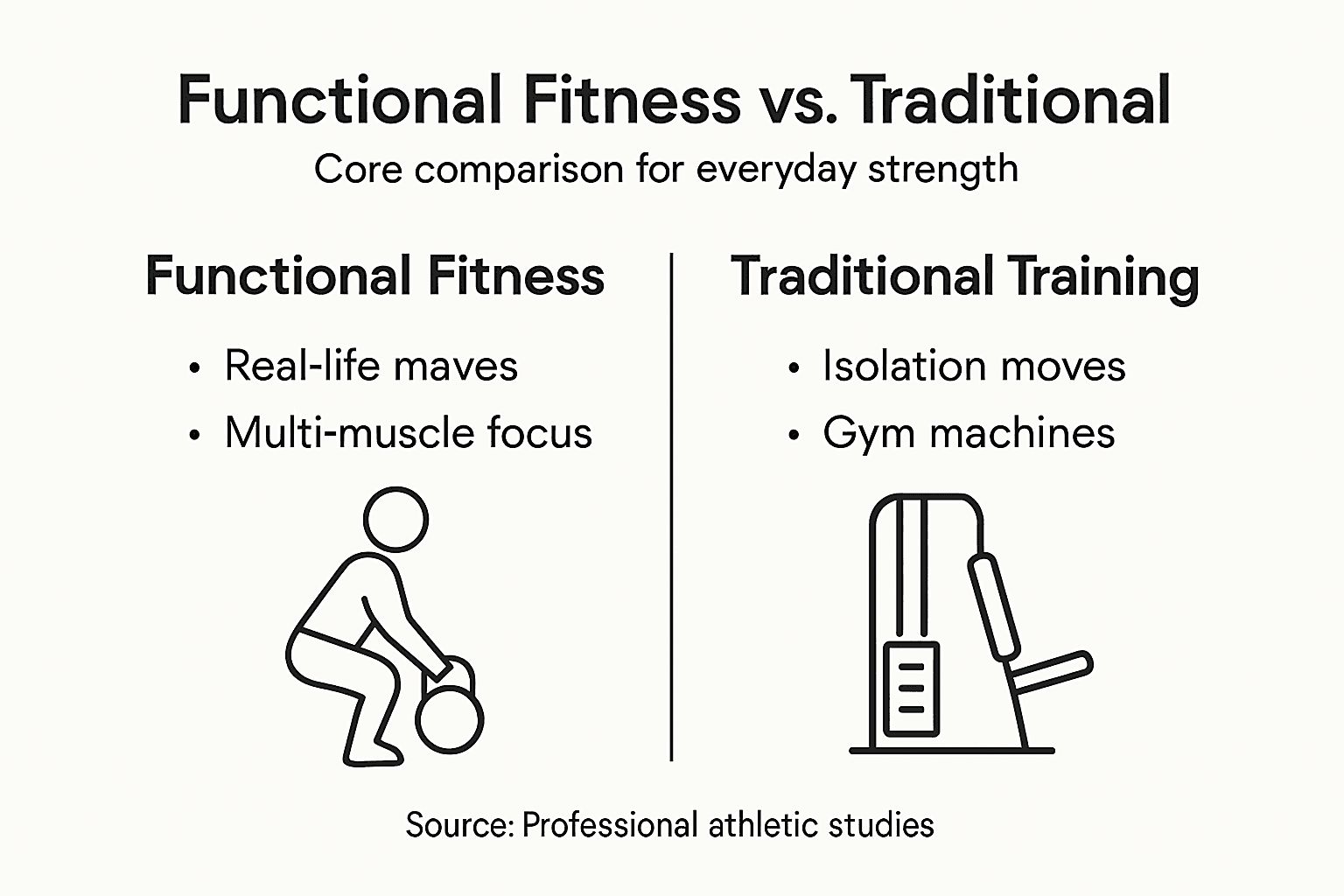
The following table compares functional fitness with traditional training, highlighting the effects on everyday physical performance:
| Aspect | Functional Fitness | Traditional Training |
|---|---|---|
| Movement Type | Multi-joint, everyday actions | Isolated muscle exercises |
| Core Engagement | Consistently required | Varies, often minimal |
| Injury Prevention | Focus on balance and control | Risk of muscular imbalances |
| Application to Daily Life | Enhances real-world functional strength | Often limited to specific movements |
Pro tip: Incorporate functional movement assessments into your fitness routine to identify and address movement limitations, ensuring more balanced and effective strength development.
Common Pitfalls and How to Avoid Them
Exercise technique represents the most critical factor in functional fitness, with poor form potentially transforming beneficial movements into potential injury risks. Many individuals rush into complex exercises without mastering foundational movement patterns, leading to compromised biomechanics and increased strain on joints and muscles. Understanding proper technique involves breaking down each movement into its constituent parts, focusing on alignment, controlled motion, and engaging the correct muscle groups.
Workout progression requires careful, strategic planning to prevent overtraining and potential injuries. Common mistakes include increasing intensity too rapidly, neglecting rest periods, and failing to listen to body signals. Sustainable functional fitness demands a nuanced approach that balances challenge with recovery, recognising that progress is not linear and individual adaptation varies significantly. This means incorporating adequate rest, monitoring fatigue levels, and being willing to modify workouts based on current physical condition.
Hydration, warm-up, and recovery are frequently overlooked aspects of functional fitness that can dramatically impact performance and injury prevention. Many practitioners underestimate the importance of comprehensive warm-up routines that prepare muscles and nervous systems for complex movements. Similarly, post-workout recovery, including stretching, proper nutrition, and sufficient sleep, plays a crucial role in muscle repair and long-term fitness development. Understanding these interconnected elements transforms functional fitness from a mere exercise routine into a holistic approach to physical wellness.
Pro tip: Start each workout with a dynamic mobility routine targeting the specific muscle groups you’ll be engaging, and always prioritise perfect form over lifting heavier weights or completing more repetitions.
Elevate Your Everyday Strength with Functional Fitness Essentials
The journey to real-world strength starts with mastering key movement patterns like squats, lunges, and push-ups that improve your balance and mobility. If you are looking to build practical fitness that supports your daily activities while avoiding common pitfalls such as poor technique and imbalanced training, having the right support gear and wellness products makes all the difference. At Stomart.co.uk, you can discover a wide selection of sports and outdoor gear alongside personal wellness gadgets designed to enhance your functional fitness routine safely and effectively.
Take the next step to transform your workouts and daily life by exploring high-quality equipment and health essentials that complement the holistic approach of functional training. Start today with products that prioritise core stability, neuromuscular control, and balanced strength development. Visit https://stomart.co.uk to browse new arrivals and seasonal offers that help you move stronger now. Your everyday strength and confidence await.
Frequently Asked Questions
What is functional fitness?
Functional fitness is an exercise approach that prepares your body for real-life movements and challenges, focusing on compound movements that mimic everyday activities rather than isolating muscle groups.
What are the key benefits of functional fitness compared to traditional training?
Functional fitness enhances real-world strength, improves coordination, balance, and overall functional performance, while traditional training often focuses on isolated muscle exercises that may not relate directly to everyday activities.
What are some basic functional fitness exercises I can do at home?
Basic functional fitness exercises include squats, lunges, push-ups, and planks. These movements replicate daily actions and can improve strength, flexibility, and overall physical performance.
How can I prevent injuries while doing functional fitness exercises?
To prevent injuries, always focus on proper technique, progress your workouts gradually, and ensure adequate rest and recovery. Additionally, begin with a dynamic warm-up to prepare your body for the movements you’ll be performing.