

Hair Care Tips for Healthy Natural Hair – Real Solutions for Strong Curls
on Jan 05, 2026
Finding the truth about healthy natural hair can be surprisingly challenging, especially with so many myths in the beauty world. Nearly 60 percent of British women with natural curls report feeling pressured to fit outdated standards. For eco-conscious women, embracing your natural curls means more than just choosing the right products. This hair care tips for healthy natural hair gives practical hair care tips and debunks common misunderstandings, helping you care for your curls with confidence every day.
Key Takeaways
| Point | Details |
|---|---|
| Healthy Natural Hair | Healthy natural hair is defined by consistent moisture retention, minimal breakage, and resilient structures, requiring personalised care strategies. |
| Understanding Curl Patterns | Natural hair types include four main curl patterns, each needing tailored care based on individual characteristics and subtypes. |
| Moisture Retention | Effective moisture retention involves deep conditioning, protective styling, and using the right hydrating products specific to curl type. |
| Avoiding Common Mistakes | Common natural hair care mistakes include overwashing and product misuse, which necessitate a deeper understanding of individual hair needs for optimal health. |
Defining Healthy Natural Hair and Key Myths
Healthy natural hair represents more than aesthetic appearance; it reflects complex biological interactions between genetic predispositions, nutritional intake, and careful maintenance strategies. Understanding hair’s fundamental structural properties requires examining its intricate biochemical composition and environmental interactions.
Contrary to widespread misconceptions, natural hair is not inherently difficult to manage or unprofessional. Each curl pattern represents unique genetic characteristics requiring personalised care approaches. Many individuals mistakenly believe that natural hair cannot be versatile or professionally styled, which scientific research comprehensively disproves. Debunking prevalent cultural myths empowers people to embrace their authentic hair texture with confidence.
Key indicators of healthy natural hair include consistent moisture retention, minimal breakage, defined curl patterns, and resilient structural integrity. Hair health stems from holistic practices involving proper nutrition, gentle handling, strategic product selection, and understanding individual hair type nuances. Recognising that each person’s hair responds differently to treatments helps develop more effective personalised care strategies.
Pro tip: Conduct a monthly hair health assessment by examining your curl pattern’s moisture levels, elasticity, and overall structural strength to proactively address potential maintenance challenges.
Types of Natural Hair and Curl Patterns
Natural hair encompasses a fascinating spectrum of curl patterns that reflect remarkable genetic diversity. Scientific classification of hair shape reveals intricate variations beyond simplistic categorical assumptions, demonstrating the complex biological mechanisms underlying hair texture.
Traditionally, hair types are categorised into four primary curl patterns, ranging from straight to tightly coiled:
- Type 1: Straight hair (no visible curl pattern)
- Type 2: Wavy hair (loose, undefined curves)
- Type 3: Curly hair (distinct spiral or ringlet formations)
- Type 4: Coily or kinky hair (tight, compact curl patterns)
Each hair type further subdivides into specific subtypes (A, B, C), indicating variations in curl diameter, density, and pattern definition. These classifications help individuals understand their unique hair characteristics and develop targeted care strategies. Recognising that hair texture is not a uniform trait but a nuanced spectrum allows for more personalised and effective hair maintenance approaches.

Here is a concise comparison of natural hair curl patterns and their typical characteristics:
| Curl Type | Common Traits | Care Considerations |
|---|---|---|
| Type 1 (Straight) | Shiny, lacks curl pattern | Low frizz, minimal moisture loss |
| Type 2 (Wavy) | Loose S-shaped waves | Prone to frizz, needs light hydration |
| Type 3 (Curly) | Well-defined spirals | Requires moisture-rich products |
| Type 4 (Coily/Kinky) | Tight, dense coils | Needs intense moisture retention |
Pro tip: Identify your specific curl pattern by observing your hair’s natural texture when air-dried and comparing it against established classification charts to develop a more tailored hair care routine.
Moisture Retention Techniques for Curls
Curly hair inherently struggles with moisture retention due to its unique structural composition. Scientific approaches to hydration demonstrate that curl-specific moisture strategies are essential for maintaining hair health and preventing damage.
Moisture retention for natural curls involves a multi-layered approach that addresses both external hydration and internal hair structure protection:
- Deep conditioning: Use intensive moisturising treatments weekly
- Protective styling: Minimise mechanical damage and moisture loss
- Nighttime protection: Use silk or satin pillowcases and bonnets
- Hydration layering: Apply products from lightest to heaviest consistency
The key to successful moisture retention lies in understanding your specific curl type and its unique porosity levels. Different curl patterns require tailored hydration techniques, with some needing heavier oils and others benefiting from lighter water-based moisturisers. Recognising that moisture is not just about adding water, but about sealing and maintaining hydration, transforms how we approach natural hair care.
Pro tip: Perform a weekly moisture assessment by gently stretching a single curl and observing its elasticity, which indicates your hair’s current hydration level and immediate moisture needs.
Daily Care Routines and Eco-Friendly Products
Holistic natural hair care demands thoughtful integration of sustainable practices that simultaneously nourish both hair and environmental ecosystems. Eco-conscious individuals increasingly recognise that personal care choices extend far beyond individual beauty, impacting broader ecological systems.
Key components of an environmentally responsible daily hair care routine include:
- Minimalist product selection: Choose multi-purpose, natural ingredient products
- Water conservation: Use low-flow shower heads and limit washing frequency
- Plastic-free packaging: Select brands offering recyclable or biodegradable containers
- Organic ingredients: Prioritise products with sustainably sourced, chemical-free formulations
Transitioning to eco-friendly hair care requires understanding product ingredients, manufacturing processes, and long-term environmental implications. Sustainable hair care encompasses more than product selection, involving a comprehensive approach that considers ethical production, minimal waste, and reduced carbon footprint throughout the entire product lifecycle.
The table below summarises eco-friendly alternatives and their unique hair care benefits:
| Eco Option | Environmental Impact | Hair Benefit |
|---|---|---|
| Organic oils | Biodegradable, renewable | Deep, natural nourishment |
| Bamboo combs | Reduces plastic waste | Gentle detangling for curls |
| Refillable products | Minimises packaging | Consistent product availability |
| Rainwater rinses | Saves treated water | Softens hair texture |
Pro tip: Research and gradually replace your existing hair care products with certified organic, cruelty-free alternatives that demonstrate transparent sustainability credentials.
Common Mistakes in Natural Hair Care
Natural hair care demands nuanced understanding to avoid common pitfalls that can compromise hair health and growth potential. Many individuals unknowingly damage their natural hair through well-intentioned but misguided practices that require targeted correction and awareness.
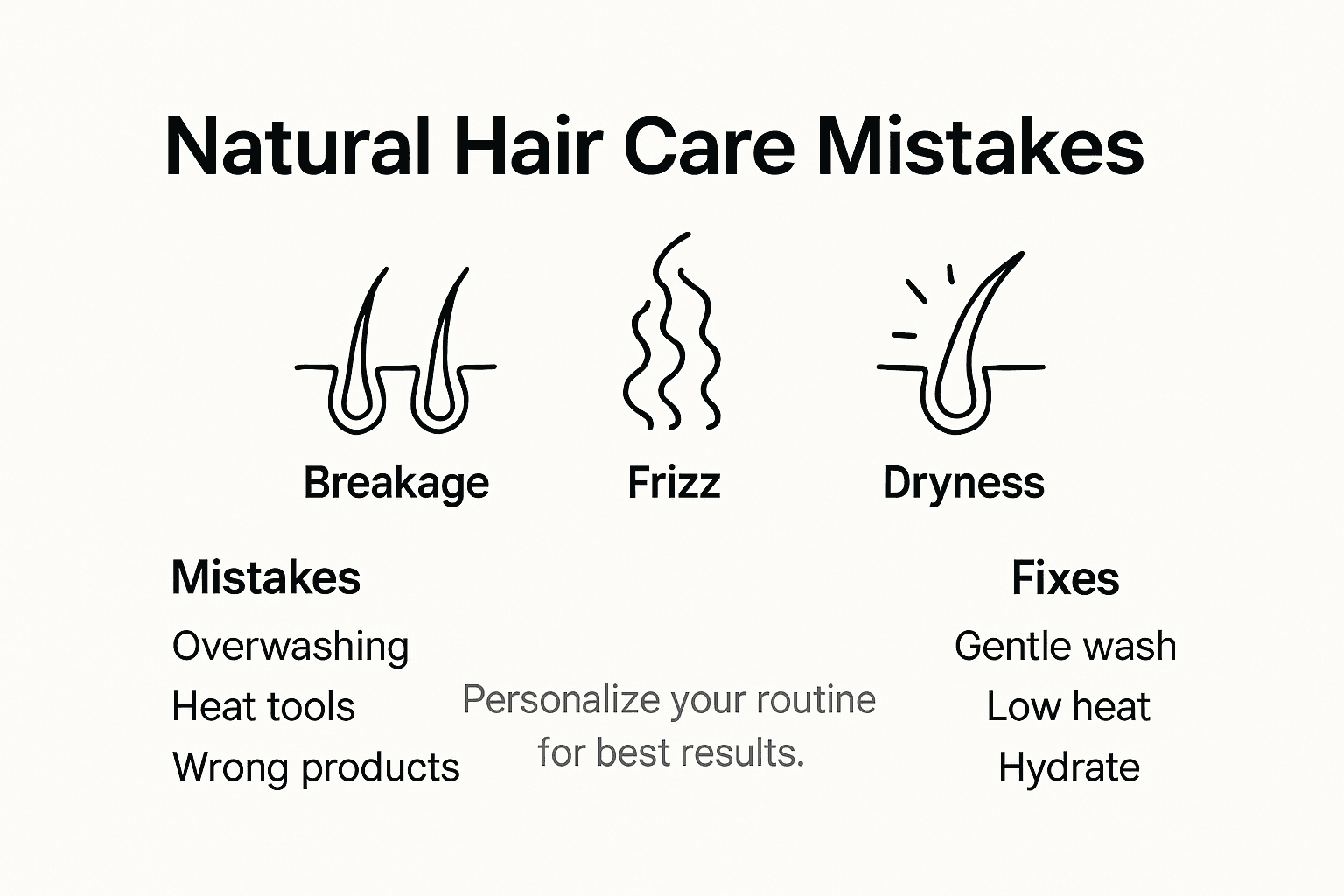
Most frequent natural hair care mistakes include:
- Overwashing: Stripping natural oils through excessive cleansing
- Product misuse: Applying incompatible products for your specific curl type
- Heat damage: Using high-temperature styling tools without thermal protection
- Neglecting moisture: Failing to maintain proper hydration balance
- Rough handling: Aggressive brushing or combing that causes breakage
Understanding these mistakes requires a holistic approach. Successful natural hair care involves recognising individual hair characteristics and implementing targeted maintenance strategies, acknowledging that universal solutions rarely address the complex, unique needs of diverse curl patterns. Personal hair journeys demand patience, continuous learning, and adaptable care techniques that respect natural hair’s intrinsic structure and requirements.
Pro tip: Create a personalised hair care journal documenting product responses, styling techniques, and monthly hair health observations to systematically identify and eliminate recurring maintenance errors.
Unlock the Full Potential of Healthy Natural Hair Today
Struggling to maintain moisture retention or navigate the unique needs of your natural curls can be frustrating. This article highlights key challenges such as understanding your curl pattern, avoiding common care mistakes, and choosing eco-friendly products tailored to your hair’s biology. If you want to embrace defined curls and resilient hair health without guesswork, addressing these concerns with the right tools and knowledge is essential.
Discover effective solutions designed to support your hair’s strength and beauty at Stomart.co.uk. From hydrating conditioners to protective styling accessories, our wide product selection complements the detailed care strategies discussed here. Don’t wait to transform your hair routine and experience personalised care that honours your natural texture. Explore our curated range now and take the next step towards stronger, healthier curls with trusted products and expert guidance.
Frequently Asked Questions
What are the signs of healthy natural hair?
Healthy natural hair shows consistent moisture retention, minimal breakage, defined curl patterns, and resilient structural integrity.
How can I improve moisture retention in my curls?
To enhance moisture retention, use deep conditioning treatments weekly, incorporate protective styling, and apply products in a layering technique from lightest to heaviest.
What are common mistakes in natural hair care?
Common mistakes include overwashing, using incompatible products, applying high heat without protection, neglecting moisture, and rough handling when detangling.
How do I determine my hair’s curl type?
Determine your curl type by observing your hair’s natural texture when air-dried and comparing it against established curl classification charts to understand your specific hair characteristics.