

Harness daily habits to shape your destiny in 2026
on Mar 13, 2026Nearly 40% of daily actions are habits, not deliberate decisions. You brush your teeth, check your phone, grab coffee without thinking. These automatic routines quietly steer your life whilst you believe you’re in control. Understanding the science behind habit formation gives you the power to redesign these patterns intentionally. This article reveals how the habit loop works and shares practical strategies rooted in cutting-edge research to help you transform your daily routines and shape your destiny through deliberate habit design.
Key takeaways
| Point | Details |
|---|---|
| Habit loop structure | Habits follow a predictable loop: cue, routine, reward that automates behaviour. |
| Awareness reduces unwanted habits | Noticing triggers reduces habit frequency by 30% through conscious interruption. |
| Implementation intentions work | Creating specific if-then plans significantly increases habit success rates. |
| Motivation type matters | Autonomous motivation predicts better long-term success than controlled motivation. |
| Context beats willpower | Habit formation depends on contextual cues and system design, not willpower alone. |
Understanding how habits control your behaviour
Your brain runs on efficiency. Every time you repeat a behaviour in response to a specific cue, your basal ganglia encode that sequence into an automated routine. Habits are rooted in basal ganglia, freeing your prefrontal cortex for complex thinking whilst your autopilot handles the mundane.
The habit loop operates through three phases: cue, routine, and reward. The cue triggers the behaviour. The routine is the action itself. The reward satisfies a craving, reinforcing the loop. Brain scans reveal activity spikes during the cue and reward phases, whilst the routine runs with minimal conscious engagement.
This neurological efficiency explains why you reach for your phone the moment you feel bored or why you automatically grab biscuits when stressed. Your brain has learned these patterns so thoroughly that they operate below conscious awareness. The power of small daily habits compounds over time, shaping your health, productivity, and relationships without you noticing.
Consider these common habit loops:
- Morning coffee: alarm rings (cue), brew coffee (routine), alertness boost (reward)
- Stress eating: anxiety spike (cue), eat crisps (routine), temporary comfort (reward)
- Exercise avoidance: gym time arrives (cue), scroll social media instead (routine), immediate relief from discomfort (reward)
- Evening wind-down: finish work (cue), watch television (routine), relaxation (reward)
Evolution hardwired this system to conserve mental energy for survival threats. Your ancestors who automated foraging routes and shelter building had cognitive resources left for spotting predators. Today, that same mechanism automates driving routes, morning routines, and work processes.
Emotions supercharge habit persistence. When a routine delivers emotional satisfaction, your brain stamps that pattern with neurochemical approval. Stress triggers cortisol, which your brain associates with comfort foods. The temporary relief reinforces the loop, making it harder to break even when you consciously want healthier responses.
“Understanding the habit loop is the difference between being dragged around by behaviours and designing them deliberately.”
The basal ganglia cannot distinguish beneficial habits from destructive ones. It simply automates whatever you repeat consistently. This neural democracy means you can hijack the same mechanism that created bad habits to build empowering ones. Recognising your habit formation science gives you the blueprint for intentional change.
How awareness and motivation unlock habit change
Consciousness disrupts automaticity. When you notice the cue before the routine kicks in, you create a choice point. Awareness of triggers reduces habit frequency because recognition interrupts the autopilot sequence. You spot the boredom before reaching for your phone, the stress before grabbing chocolate.
Self-efficacy, your belief in your ability to succeed, predicts habit change success better than knowledge alone. Self-efficacy is a pivotal motivational correlate in behaviour change research. When you trust you can complete a morning jog, you’re more likely to lace up your trainers despite resistance.
Motivation quality matters more than quantity. Autonomous motivation, driven by personal values and genuine interest, sustains habits far longer than controlled motivation based on external pressure or guilt. Someone exercising because they genuinely enjoy the energy boost will outlast someone forcing themselves to avoid criticism.
Pro Tip: Track your motivation source by asking, “Am I doing this because I want to or because I should?” Reframe obligations around personal values to shift from controlled to autonomous motivation.
Consider these motivation contrasts:
- Autonomous: reading because you love learning new perspectives
- Controlled: reading because your book club expects it
- Autonomous: cooking healthy meals because you enjoy experimenting with flavours
- Controlled: cooking healthy meals because your doctor demanded it
- Autonomous: meditating because it genuinely calms your mind
- Controlled: meditating because everyone says you should
Micro-temporal processes, the moment-to-moment decisions affecting physical activity habits, reveal how motivation fluctuates throughout the day. You might feel motivated at 6am but face entirely different triggers and energy levels by 6pm. Successful habit builders recognise these patterns and design routines around high-motivation windows.
Shifting from willpower thinking to habit design thinking transforms your approach. Instead of asking, “How can I force myself to do this?” you ask, “How can I make this easier to start and harder to avoid?” This mindset acknowledges that relying on daily willpower battles exhausts mental resources.
Regaining self-efficacy and confidence starts with small wins that prove capability. Each successful habit completion strengthens your belief in future success. The person who maintains a two-minute meditation habit builds more self-efficacy than someone who attempts hour-long sessions and quits.
External accountability and motivation and habit success strategies provide scaffolding whilst internal motivation develops. Share your habit goals with trusted friends, join communities pursuing similar changes, or use apps that track streaks. These supports bridge the gap between initial enthusiasm and genuine autonomous motivation.
Practical strategies to build and sustain powerful daily habits
Implementation intentions transform vague goals into concrete action plans. Instead of “I’ll exercise more,” you specify, “If it’s Monday at 7am, then I’ll do 20 press-ups in my bedroom.” This if-then format significantly increases habit success by removing decision-making friction at the moment of action.
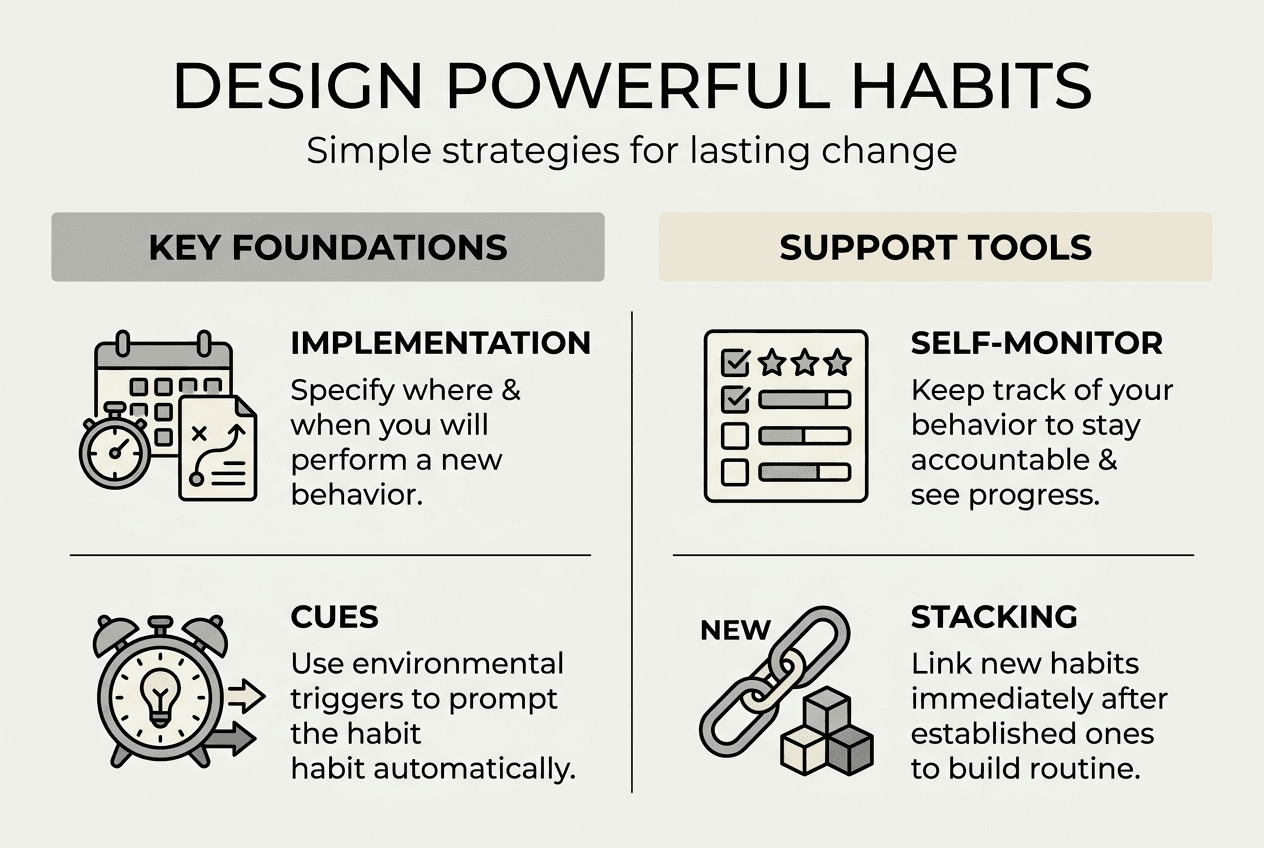
Self-monitoring creates accountability through visibility. Self-monitoring interventions show modest but significant behaviour improvements across diverse populations. Track your habits using journals, apps, or simple tick sheets. The act of recording completion reinforces the behaviour and reveals patterns you might otherwise miss.
Pro Tip: Place your tracking system where you’ll see it immediately after completing the routine. A tick sheet on your bathroom mirror for teeth flossing creates instant visual feedback.
Reward selection determines habit sustainability. The reward must satisfy the actual craving driving the routine, not what you think should satisfy it. If stress eating provides emotional comfort, replacing crisps with carrot sticks fails unless carrots deliver similar emotional relief. Better solutions address the emotional need directly through breathing exercises, brief walks, or talking with friends.
Follow these steps to redesign any habit:
- Identify the routine you want to change and observe it without judgement for three days
- Pinpoint the exact cue triggering the behaviour (time, location, emotion, preceding action, or people present)
- Clarify the reward by experimenting with different responses to the same cue
- Design a new routine that delivers a similar reward but aligns with your values
- Create an implementation intention specifying when and where you’ll execute the new routine
- Track your progress daily and adjust based on what you learn
- Celebrate small wins to reinforce the new pattern neurologically
Common habit errors versus evidence-based fixes:
| Common Error | Evidence-Based Fix |
|---|---|
| Relying on motivation alone | Design environmental cues that trigger desired behaviour automatically |
| Setting vague intentions | Create specific if-then implementation intentions with time and location |
| Ignoring actual cravings | Identify the true reward driving behaviour and find healthier ways to satisfy it |
| Attempting massive changes | Start with small daily habit strategies that build confidence |
| Skipping self-monitoring | Track completion daily to maintain awareness and spot patterns |
| Using punishment as motivation | Apply positive reinforcement explained principles to reward progress |
Habit stacking leverages existing routines as cues for new behaviours. After you pour your morning coffee (existing habit), you read one page of a book (new habit). The established routine provides a reliable trigger, reducing the mental effort required to remember the new behaviour.
Environmental design removes obstacles and adds friction strategically. Place your gym clothes beside your bed to reduce morning exercise resistance. Delete social media apps from your phone to increase the effort required for mindless scrolling. Small environmental tweaks compound into significant behaviour shifts over weeks.

Consistency trumps intensity for habit formation. The person who walks 10 minutes daily builds a stronger habit than someone who runs for an hour once weekly. Your brain recognises patterns through repetition frequency, not duration. Focus on showing up consistently before worrying about optimising performance.
Why habit design beats willpower: insights and expert tips
Willpower functions like a muscle that fatigues with use. Decision fatigue explains why you resist doughnuts easily at breakfast but succumb by afternoon. Relying on willpower for habit change sets you up for failure because you’re fighting your brain’s efficiency system rather than working with it.
Habit formation depends on contextual cues and system design, not willpower reserves. Your environment constantly broadcasts cues that trigger automatic responses. The biscuit tin on your counter cues snacking. Your phone beside your bed cues late-night scrolling. Your running shoes buried in the wardrobe cue exercise avoidance.
Environmental cues trigger unwanted habits invisibly. You might believe you choose to check email constantly, but the notification sound (cue) triggers the checking routine automatically. The visible television remote cues evening viewing. The smell of coffee cues your morning routine. Recognising these triggers reveals opportunities for redesign.
Expert tips for environmental habit redesign:
- Remove cues for unwanted habits: hide the biscuit tin, delete tempting apps, unplug the television
- Amplify cues for desired habits: place books on your pillow, set out exercise clothes, prep healthy snacks visibly
- Reduce friction for good habits: keep a water bottle filled, store meditation cushion in plain view, bookmark favourite workout videos
- Increase friction for bad habits: require password entry for social media, store junk food in hard-to-reach places, add steps between trigger and unwanted routine
- Batch similar habits together: combine morning stretching with coffee brewing, pair audiobook listening with walking
Mastering the habit loop transforms you from passenger to driver. Instead of reacting to cues unconsciously, you design cues deliberately. Instead of defaulting to convenient routines, you install routines aligned with your values. Instead of accepting whatever reward arrives, you engineer rewards that reinforce your identity.
“Understanding the habit loop is the difference between being dragged around by behaviours and designing them deliberately.”
The morning routines power demonstrates deliberate habit design. Successful people don’t rely on willpower to meditate, exercise, or plan their day. They’ve automated these behaviours through consistent cues and satisfying rewards until the routines run effortlessly.
Context switching helps break stubborn habits. If you always snack whilst watching television in your living room, that environment becomes a powerful cue. Changing where you watch (different room, different chair) or what you do (knitting, stretching) disrupts the automatic pattern. Your brain loses the familiar cue-routine connection, creating space for new choices.
Identity-based habits outlast outcome-based habits. Someone who identifies as “a runner” maintains the habit more consistently than someone focused on “losing 10 pounds.” The identity creates intrinsic motivation and aligns daily actions with self-concept. Each run reinforces the runner identity, creating a positive feedback loop.
Systematic habit design importance cannot be overstated. You’re already running on habits, whether you designed them or they formed accidentally. Taking control of this process means consciously choosing which behaviours to automate based on the life you want to build.
Explore personalised tools to master your daily habits
Transforming your understanding of habits into lasting change requires ongoing support and practical resources. Stomart offers a curated collection of tools designed to help you build consistency in your daily routines, from journals and planners to wellness products that support healthy habit formation.
Whether you’re establishing morning routines, improving sleep hygiene, or creating spaces that encourage positive behaviours, you’ll find products and inspiration to support your journey. Explore articles on small habit power strategies that break down complex goals into manageable daily actions.
Start reshaping your habits today by identifying one routine you want to change and applying the strategies you’ve learned. Small, consistent actions compound into remarkable transformations when you understand the science behind habit formation and design your environment intentionally.
Frequently asked questions about daily habits and destiny shaping
What is the key to breaking bad habits?
The key lies in identifying the cue and reward driving the unwanted routine, then designing a new routine that delivers a similar reward. Simply trying to stop the behaviour without addressing the underlying craving leads to failure. Replace the routine whilst keeping the same cue and reward structure.
How does motivation affect habit success?
Autonomous motivation, driven by personal values and genuine interest, predicts long-term success far better than controlled motivation based on external pressure. When you pursue habits because they align with your identity and interests, you maintain them through challenges. Controlled motivation fades quickly when external pressure disappears.
Can habits really shape my future?
Absolutely. Since 40% of your daily actions occur automatically, habits determine how you spend nearly half your waking hours. These repeated behaviours compound over months and years, shaping your health, relationships, skills, and opportunities. Deliberate habit design gives you control over this compounding effect.
What practical steps start a new habit?
Create a specific implementation intention using the if-then format: “If it’s [time/location], then I’ll [specific action].” Start ridiculously small to build consistency before intensity. Track your progress daily. Design your environment to make the desired behaviour easier and unwanted behaviours harder. Link the new habit to an existing routine through habit stacking.
How important is self-monitoring in habit change?
Self-monitoring creates awareness and accountability that significantly improve behaviour change success. Tracking completion helps you spot patterns, maintain consistency, and celebrate progress. The simple act of recording whether you completed a habit reinforces the behaviour neurologically. For inspiration on maintaining consistency, explore strategies for building lasting reading habits that apply to any routine you want to establish.