

Predictive Maintenance: Reducing Downtime for Homes
on Jan 12, 2026
Most British homeowners and small business owners are unaware that predictive maintenance can cut their appliance and equipment costs by as much as 25 percent. Constant repairs and unexpected breakdowns drain time and money, yet many believe advanced technology is out of reach for smaller budgets. This clear guide brings predictive maintenance down to earth, showing how modern monitoring tools protect british assets, reduce downtime, and keep expenses predictable.
Key Takeaways
| Point | Details |
|---|---|
| Predictive Maintenance Redefines Management | Transitioning from reactive to proactive maintenance enables organisations to forecast failures and minimise downtime. |
| Technological Integration is Key | Advanced technologies like AI, IoT, and machine learning enhance equipment monitoring and prediction capabilities. |
| Benefits for All Sizes of Business | Predictive maintenance not only benefits large industries but also significantly aids small businesses and homeowners by reducing costs and improving equipment longevity. |
| Challenges and Considerations | Organisations must address high initial costs and training needs while carefully planning technology adoption to avoid common pitfalls. |
Predictive Maintenance Defined and Debunked
Predictive maintenance (PdM) represents a transformative approach to equipment management that shifts traditional reactive maintenance strategies towards proactive, data-driven solutions. Comprehensive machine learning analysis reveals PdM as an intelligent system designed to forecast potential equipment failures before they disrupt operations.
At its core, predictive maintenance utilises advanced technologies like artificial intelligence and sensor networks to monitor equipment performance in real-time. Data-driven fault prediction strategies enable businesses to estimate an asset’s remaining useful life, allowing for strategic maintenance interventions that minimise unexpected downtime and reduce overall repair costs.
Contrary to popular misconceptions, predictive maintenance is not exclusively reserved for large industrial operations. Small businesses and homeowners can equally benefit from these technologies. Key advantages include:
- Early detection of potential equipment failures
- Significant cost savings through targeted maintenance
- Reduced unexpected interruptions in daily operations
- Extended equipment lifespan
- More efficient resource allocation
Predictive maintenance fundamentally transforms how we approach equipment management, moving from reactive emergency repairs to strategic, anticipatory maintenance planning. By integrating intelligent monitoring systems, organisations can transform potential vulnerabilities into opportunities for enhanced operational efficiency.
Pro tip: Start small by investing in basic sensor technologies for your most critical home or business equipment, enabling you to gradually build a predictive maintenance strategy without overwhelming initial investment.
Key Types and Technologies Explained
Predictive maintenance technologies represent a sophisticated ecosystem of interconnected approaches designed to monitor and anticipate equipment performance. Advanced machine learning methodologies have revolutionised how organisations track and prevent potential equipment failures across multiple industrial domains.
The technological landscape of predictive maintenance encompasses several key approaches, including diagnostics, prognostics, and hybrid monitoring systems. Sophisticated learning architectures like support vector machines, neural networks, and deep learning models enable precise fault detection and classification. These technologies leverage multiple data collection strategies:
- Sensor-based monitoring: Real-time equipment performance tracking
- IoT integration: Continuous data collection and analysis
- Machine learning algorithms: Anomaly detection and predictive modelling
- Cloud computing platforms: Scalable data processing and storage
- Robotics and AI: Enhanced maintenance scheduling and intervention
The primary technologies driving predictive maintenance can be categorised into three primary domains: condition monitoring, fault detection, and remaining useful life estimation. By combining supervised and unsupervised learning techniques, these systems can interpret complex equipment behaviour patterns, providing unprecedented insights into potential maintenance requirements.
See how predictive maintenance technologies improve business outcomes:
| Technology | Core Function | Business Impact |
|---|---|---|
| Sensor-Based Monitoring | Tracks equipment health | Enables early fault detection |
| Machine Learning Algorithms | Analyses performance data | Forecasts equipment breakdown |
| IoT Integration | Connects devices for data | Streamlines maintenance planning |
| Cloud Computing | Stores and processes data | Improves scalability, cuts costs |
Pro tip: Consider implementing a pilot predictive maintenance project with one critical piece of equipment to understand the technology’s potential before scaling across your entire operational infrastructure.
How Predictive Maintenance Actually Works
Predictive maintenance transforms equipment management through a sophisticated data-driven process that continuously monitors and anticipates potential failures. Advanced sensor monitoring techniques enable organisations to collect critical performance data in real-time, tracking multiple parameters like temperature, vibration, and operational stress.
Machine learning algorithms analyse these sensor inputs through a comprehensive workflow involving several key stages:
- Data Acquisition: Installing sensors on critical equipment
- Signal Processing: Filtering and normalising raw sensor data
- Feature Extraction: Identifying meaningful performance indicators
- Anomaly Detection: Recognising deviations from normal operational patterns
- Predictive Modelling: Forecasting potential equipment failures
- Maintenance Recommendation: Generating targeted intervention strategies
The core mechanism involves comparing current equipment performance against established baseline metrics. When sensors detect subtle changes that might indicate impending failure, the system generates early warnings. This approach allows maintenance teams to schedule interventions precisely when needed, avoiding both premature replacements and unexpected breakdowns.

Modern predictive maintenance systems leverage artificial intelligence to continuously improve their predictive accuracy. By analysing historical maintenance records, failure patterns, and real-time performance data, these intelligent systems become increasingly sophisticated at anticipating potential equipment issues.
Pro tip: Begin your predictive maintenance journey by identifying one or two mission-critical pieces of equipment and installing comprehensive sensor networks to gather baseline performance data.
Benefits for Homeowners and Small Businesses
Smart home predictive maintenance technologies offer transformative advantages for homeowners and small businesses seeking to optimise their equipment management strategies. By implementing intelligent monitoring systems, individuals can dramatically reduce unexpected repair costs and enhance overall operational efficiency.
Small business maintenance approaches deliver multiple compelling benefits across different operational domains:
- Cost Reduction: Minimising emergency repair expenses
- Equipment Longevity: Extending asset operational lifespan
- Operational Continuity: Preventing unexpected system failures
- Energy Efficiency: Optimising system performance and consumption
- Safety Enhancement: Early detection of potential critical malfunctions
Predictive maintenance empowers homeowners and small business operators to transition from reactive to proactive management approaches. By leveraging IoT sensors and artificial intelligence, these technologies provide real-time insights into equipment performance, enabling precise interventions before significant failures occur. This approach transforms maintenance from a potentially expensive emergency response into a strategic, controlled process.
The financial implications are particularly significant for smaller organisations with limited maintenance budgets. Predictive maintenance can reduce overall maintenance costs by up to 25%, prevent unexpected downtime, and provide granular insights into equipment health that were previously unavailable to smaller enterprises.
Pro tip: Start by installing sensors on your most critical and expensive home or business equipment to gather baseline performance data and understand potential predictive maintenance benefits.
Comparing Predictive, Preventive, and Reactive Approaches
Maintenance strategy comparison reveals three distinct approaches to equipment management, each with unique characteristics and operational implications. Understanding these methodologies helps organisations select the most appropriate strategy for their specific needs.
Maintenance approach differences can be summarised through their core operational principles:
-
Reactive Maintenance:
- Repairs equipment after failure occurs
- Lowest initial investment
- Highest long-term repair costs
- Minimal planning required
-
Preventive Maintenance:
- Scheduled regular inspections
- Predetermined intervention intervals
- Moderate cost predictability
- Limited real-time performance insights
-
Predictive Maintenance:
- Real-time equipment monitoring
- Data-driven failure prediction
- Lowest unexpected downtime
- Highest initial technology investment
The evolutionary progression from reactive to predictive maintenance represents a strategic shift towards more intelligent, efficient operational management. While reactive approaches rely on emergency interventions and preventive methods follow rigid schedules, predictive maintenance leverages advanced technologies to anticipate potential failures with remarkable precision.
Each approach carries distinct cost and operational implications. Reactive maintenance might seem cost-effective initially but leads to higher long-term expenses, whereas predictive maintenance requires substantial upfront investment but delivers significant returns through reduced downtime and optimised equipment performance.
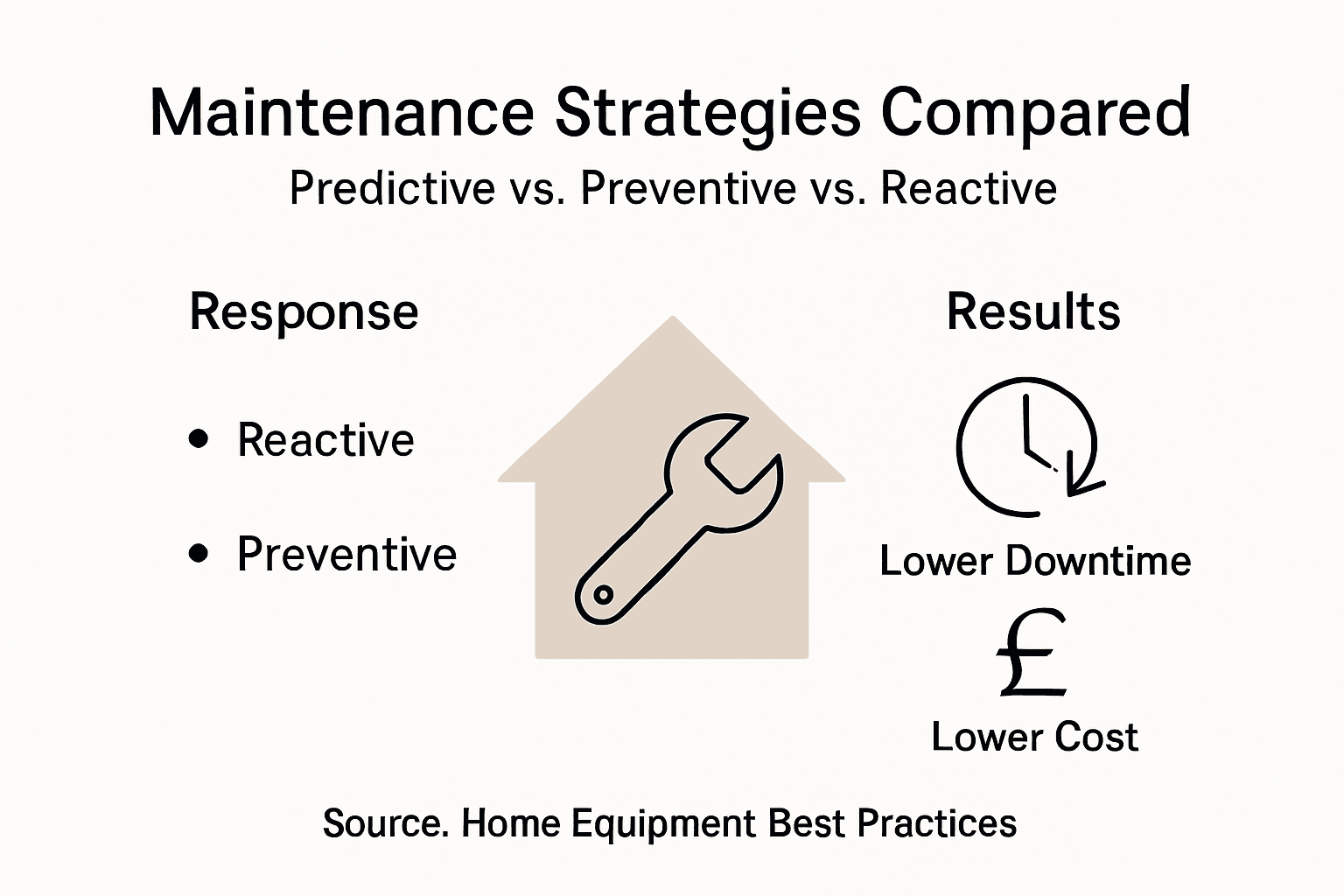
Here’s a side-by-side overview of maintenance strategies for quick reference:
| Strategy | Response Method | Upfront Cost | Long-term Impact |
|---|---|---|---|
| Reactive Maintenance | Repairs after failure | Lowest | High downtime, costly overtime |
| Preventive Maintenance | Routine scheduled fixes | Moderate | Some downtime, scheduled costs |
| Predictive Maintenance | Monitors, predicts | Highest | Minimises downtime, optimises performance |
Pro tip: Assess your organisation’s equipment criticality and budget constraints to determine the most suitable maintenance strategy, potentially starting with a hybrid approach that combines elements of preventive and predictive methodologies.
Costs, Risks, and Common Pitfalls
Predictive maintenance implementation challenges reveal a complex landscape of technological, financial, and organisational obstacles that can derail successful deployment. Understanding these potential pitfalls is crucial for organisations considering predictive maintenance strategies.
Risks in predictive maintenance systems manifest across several critical domains:
-
Technological Challenges:
- High initial investment costs
- Complex sensor network integration
- Data quality and heterogeneity issues
- Advanced computational requirements
-
Organisational Barriers:
- Workforce training and skill gaps
- Cultural resistance to technological change
- Limited digital readiness
- Insufficient change management strategies
-
Operational Risks:
- False positive/negative prediction errors
- Misinterpretation of predictive analytics
- Over-reliance on imperfect data models
- Potential system complexity leading to implementation failure
The financial implications of predictive maintenance can be particularly challenging. While the long-term benefits are significant, organisations must carefully navigate the substantial upfront costs associated with sensor technologies, data infrastructure, and specialised workforce training. Small businesses and homeowners, in particular, need to conduct thorough cost-benefit analyses before implementation.
Successful predictive maintenance requires a holistic approach that balances technological investment, workforce capability, and strategic planning. Organisations must be prepared to invest not just in technology, but in comprehensive training, cultural transformation, and continuous learning.
Pro tip: Conduct a pilot project with a small, non-critical system to understand implementation challenges and validate potential benefits before full-scale deployment.
Take Control of Home Equipment with Smart Predictive Maintenance Solutions
Unexpected breakdowns and costly repairs create stress and disrupt daily life for many homeowners. The article highlights how predictive maintenance uses real-time sensor monitoring and data analysis to detect faults early and extend the life of vital home equipment. If you want to stop guessing and start knowing when your appliances or systems need attention, embracing this technology can make a huge difference.
Discover essential home goods, intelligent tech accessories, and energy-saving devices at Stomart.co.uk that help you implement smarter maintenance routines. From sensor-enabled gadgets to reliable household essentials, our range supports reducing downtime and avoiding last-minute repair costs. Start now with easy-to-use products designed to bring peace of mind and enhanced efficiency to your home.
Explore practical solutions today and transform your approach to home maintenance with Stomart.co.uk products. Take the first step toward a worry-free home environment and experience the benefits of predictive maintenance firsthand.
Frequently Asked Questions
What is predictive maintenance?
Predictive maintenance is a proactive approach to equipment management that uses advanced technologies, such as artificial intelligence and sensor networks, to forecast potential equipment failures before they disrupt operations.
How does predictive maintenance benefit homeowners?
Predictive maintenance can help homeowners reduce unexpected repair costs, extend the lifespan of their appliances, and ensure operational continuity by allowing for timely interventions before significant failures occur.
What technologies are involved in predictive maintenance?
Key technologies include sensor-based monitoring, IoT integration, machine learning algorithms for anomaly detection, cloud computing for scalable data processing, and AI to enhance maintenance scheduling and interventions.
How does predictive maintenance compare to preventive and reactive maintenance?
Predictive maintenance uses real-time data to anticipate equipment issues, unlike preventive maintenance, which follows a scheduled approach, or reactive maintenance, which only addresses problems after failures occur. This makes predictive maintenance the most efficient and least disruptive strategy in the long run.