

Quantum Dot Displays: Transforming Home Entertainment
on Dec 26, 2025
Most british tech enthusiasts are drawn to home entertainment upgrades that promise true-to-life visuals. With quantum dot displays technology increasing in popularity, a bold shift is underway in living rooms across the globe. Studies reveal some quantum dot screens deliver colours nearly identical to human vision, elevating movies and games to new heights. If you crave richer colour accuracy and clearer images, discover how these advanced displays transform ordinary viewing into a cinematic experience.
Key Takeaways
| Point | Details |
|---|---|
| Quantum Dot Benefits | Quantum dot technology provides superior colour accuracy and brightness compared to traditional displays. |
| Display Variants | Key types include photoluminescent QD-LCDs, electroluminescent QLEDs, and QD-OLEDs, each with unique characteristics. |
| Safety Concerns | Potential toxicity from cadmium in some quantum dots necessitates careful disposal and manufacturing considerations. |
| Cost Considerations | Prices for quantum dot displays are decreasing, making them more accessible while providing long-term value through enhanced performance. |
What Quantum Dot Display Technology Means
Quantum dot display technology represents a groundbreaking advancement in visual display systems, offering unprecedented colour accuracy and picture quality for home entertainment. These nanoscale semiconductors, typically measuring between 2-10 nanometres, enable remarkable colour reproduction capabilities that traditional display technologies struggle to achieve.
At the core of quantum dot technology lies a fascinating scientific principle of quantum confinement. Fundamental quantum dot optoelectronic properties demonstrate how these microscopic semiconductor particles can emit precise wavelengths of light when excited by electrical signals. This means manufacturers can engineer dots that produce extremely pure and saturated colours across the entire visible spectrum, creating image displays with exceptional vibrancy and detail.
The technological breakthrough emerges from quantum dots’ unique ability to manipulate light emission at the atomic scale. By carefully controlling the size of these semiconductor nanocrystals, engineers can precisely tune their light emission characteristics. Smaller quantum dots produce shorter wavelengths (bluer colours), while larger dots generate longer wavelengths (redder colours). This precise controllability represents a quantum leap forward in display technology, enabling screens that can reproduce colours with scientific accuracy previously unimaginable.
Pro tip: When shopping for quantum dot displays, look for specifications mentioning colour gamut coverage and peak brightness to ensure you’re getting the most advanced visual performance.
Main Types and How They Differ
Quantum dot display technologies are not uniform, but comprise several distinctive approaches that offer unique performance characteristics for home entertainment systems. Comprehensive research on quantum dot display architectures reveals three primary variants: photoluminescent QD-LCDs, electroluminescent QLEDs, and QD-OLEDs.
In photoluminescent QD-LCDs, quantum dots act as a colour conversion layer, enhancing traditional liquid crystal displays by improving colour saturation and brightness. These displays use blue LED backlighting with quantum dots that convert some of this blue light into precise red and green wavelengths, resulting in significantly expanded colour ranges. The key advantage here is cost-effectiveness, as manufacturers can retrofit existing LCD manufacturing processes with quantum dot technology.
Electroluminescent QLEDs represent a more advanced approach, where quantum dots themselves function as the light-emitting elements. Unlike photoluminescent designs, QLEDs generate light directly when electrical current passes through the quantum dot semiconductor material. This approach enables potentially higher efficiency, more precise colour control, and the possibility of creating thinner display panels with enhanced energy performance.
QD-OLEDs combine quantum dots with organic light-emitting diode technologies, offering a hybrid approach that leverages the strengths of both technologies. By integrating quantum dots into OLED structures, manufacturers can achieve extraordinary colour reproduction, improved energy efficiency, and potentially longer display lifespans compared to traditional display technologies.
Pro tip: When comparing quantum dot displays, pay attention to colour gamut percentages and peak brightness measurements to understand the true performance potential of each display type.
How Quantum Dots Enhance Picture Quality
Quantum dot colour emission technologies represent a revolutionary approach to transforming visual display performance, enabling unprecedented levels of colour accuracy and brightness that traditional display technologies struggle to achieve. The fundamental mechanism behind this enhancement lies in the unique quantum mechanical properties of these nanoscale semiconductor particles.

The most remarkable feature of quantum dots is their ability to produce pure, precise colours through size-dependent light emission. When quantum dots are engineered to specific nanometre dimensions, they can generate extremely narrow-bandwidth light wavelengths, resulting in extraordinarily vibrant and saturated colours. Smaller quantum dots generate shorter wavelengths (blue spectrum), while larger dots produce longer wavelengths (red spectrum), allowing manufacturers to craft displays with colour reproduction that approaches the complexity of natural human vision.
Technological advances in quantum dot display engineering have dramatically improved luminance efficiency and contrast ratios. By converting broad-spectrum light into incredibly precise colour wavelengths, quantum dot displays can achieve significantly higher brightness levels and more nuanced colour gradations compared to conventional display technologies. This means viewers experience images with greater depth, more realistic colour transitions, and enhanced visual clarity across different lighting conditions.
Pro tip: When evaluating quantum dot displays, look for specifications mentioning wide colour gamut percentages and peak luminance ratings to ensure you’re selecting a truly high-performance visual experience.
Comparing Quantum Dot, OLED, and LCD Displays
Comprehensive display technology comparisons reveal significant differences between quantum dot, OLED, and traditional LCD displays that impact visual performance, energy efficiency, and overall viewing experience. Each technology offers unique strengths and limitations that consumers should carefully consider when selecting a home entertainment display.
Traditional LCD displays operate by using liquid crystal molecules to control light passage through colour filters, resulting in relatively good picture quality but limited colour reproduction and contrast. OLED technologies represent a significant leap forward, with each pixel generating its own light, enabling perfect black levels and exceptional contrast ratios. Quantum dot displays build upon LCD technology, introducing nanoscale semiconductor particles that dramatically enhance colour accuracy and brightness by converting light with unprecedented precision.
Technological performance analyses demonstrate that quantum dot displays typically outperform standard LCDs in several critical areas. They offer wider colour gamuts, higher peak brightness levels, and more energy-efficient performance. While OLEDs excel in contrast and black levels, quantum dot displays provide superior colour volume and can achieve higher sustained brightness, making them particularly effective for well-lit environments where OLED screens might struggle.
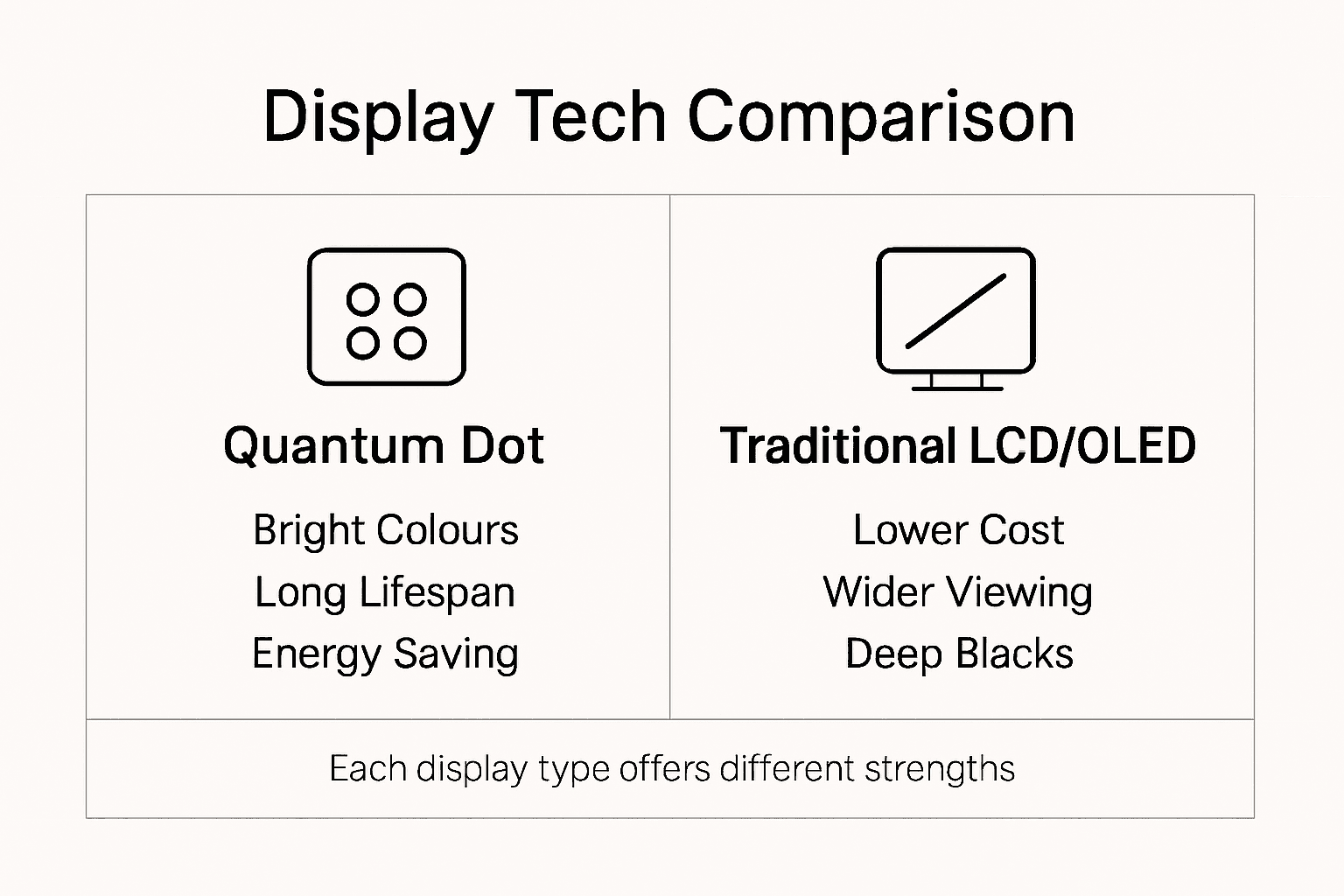
To help you understand the main differences among quantum dot, OLED, and traditional LCD displays, here is a concise comparison table:
| Technology | Colour Reproduction | Energy Efficiency | Panel Thickness |
|---|---|---|---|
| Quantum Dot | Extremely wide gamut | High, especially in QLED | Very slim designs |
| OLED | Excellent colour depth | Moderate to high | Ultra-thin possible |
| Traditional LCD | Moderate colour range | Moderate | Thicker than others |
Pro tip: When comparing display technologies, prioritise viewing the screens in person under various lighting conditions to understand their real-world performance differences.
Common Drawbacks and Safety Concerns
Comprehensive scientific assessments of quantum dot safety reveal several critical challenges that consumers and manufacturers must carefully consider. Despite the remarkable visual performance of quantum dot displays, underlying material science and environmental concerns present potential limitations to widespread adoption.
The primary safety concern revolves around the heavy metal composition of quantum dots, particularly those containing cadmium. These semiconductor nanoparticles can potentially release toxic materials if damaged or improperly manufactured. Some quantum dot variants incorporate cadmium selenide, which poses significant environmental and health risks if the display screen is broken or disposed of incorrectly. Manufacturers are increasingly developing cadmium-free quantum dot alternatives to mitigate these potential hazards.
Material stability research highlights additional technical drawbacks, including quantum dot degradation over time. These nanomaterials can experience reduced performance through prolonged exposure to humidity, temperature fluctuations, and intense light conditions. Unlike traditional display technologies, quantum dots may experience colour shifts and reduced brightness as they age, potentially compromising long-term visual performance. Ongoing scientific research focuses on improving quantum dot stability and developing more robust manufacturing processes to address these inherent material limitations.
Here’s a summary of common drawbacks and safety concerns associated with quantum dot displays:
| Drawback | Cause | Impact on Users |
|---|---|---|
| Potential toxicity | Cadmium content in some dots | Environmental/health risk |
| Performance degradation | Exposure to humidity/light | Colour shift, loss of brightness |
| Disposal challenges | Hazardous material composition | Special recycling requirements |
Pro tip: When purchasing quantum dot displays, always check manufacturer warranties and request specific information about the display’s expected lifespan and potential material composition.
Cost, Upgrading, and Consumer Considerations
Quantum dot display market dynamics reveal a complex landscape of technological advancement and economic considerations that potential buyers must carefully evaluate. While quantum dot displays offer remarkable visual performance, their adoption remains influenced by pricing structures, manufacturing complexity, and consumer value perception.
Initially, quantum dot displays commanded premium pricing due to advanced manufacturing processes and complex material engineering. However, technological improvements and increased production scale are gradually driving down costs, making these high-performance displays more accessible to mainstream consumers. The price differential between quantum dot displays and traditional LCD screens has been steadily narrowing, with manufacturers investing heavily in more efficient production techniques that reduce overall manufacturing expenses.
Consumers considering an upgrade should assess several critical factors beyond initial purchase price. Quantum dot displays typically offer longer operational lifespans, superior energy efficiency, and significantly enhanced visual quality compared to traditional displays. These long-term benefits can offset the potentially higher upfront investment, providing better value for discerning buyers who prioritise visual performance and technological longevity. Additionally, the rapid pace of technological development means that quantum dot display prices are likely to continue decreasing as manufacturing processes become more streamlined and materials more readily available.
Pro tip: Compare the total cost of ownership by considering energy efficiency ratings, expected lifespan, and potential replacement costs alongside the initial display purchase price.
Elevate Your Home Entertainment with Cutting-Edge Display Technology
Discover how quantum dot displays can transform your viewing experience by delivering vibrant colours and exceptional brightness that standard screens cannot match. If you value precise colour reproduction and long-lasting performance, you understand the challenge of finding technology that truly brings visuals to life while maintaining energy efficiency and durability. Quantum dot technology solves these issues with nanoscale engineering that unlocks richer colour gamuts and sharper images.
Ready to upgrade your home setup with products that embrace these advanced display innovations? Explore our diverse range of electronics and home goods at Stomart. Benefit from exclusive deals on cutting-edge tech accessories and lifestyle essentials designed to enhance your everyday living. Don’t wait to experience brilliant clarity and eye-catching visuals — visit our store now and take the first step toward an immersive entertainment upgrade.
Frequently Asked Questions
What is quantum dot display technology?
Quantum dot display technology utilises nanoscale semiconductor particles to produce incredibly accurate colours and superior picture quality, significantly enhancing home entertainment experiences.
How do quantum dots improve picture quality compared to traditional displays?
Quantum dots enable pure and precise colour emission through size-dependent light production, resulting in greater brightness, contrast ratios, and colour accuracy compared to traditional LCD and OLED displays.
What are the different types of quantum dot displays, and how do they differ?
The main types of quantum dot displays are photoluminescent QD-LCDs, electroluminescent QLEDs, and QD-OLEDs, each offering unique technologies and performance characteristics affecting brightness, colour reproduction, and panel design.
What are some common drawbacks of quantum dot displays?
Common drawbacks include potential toxicity from cadmium-containing dots, performance degradation over time due to environmental exposure, and disposal challenges related to hazardous materials.
Recommended
- Role of LED Lighting: Complete Guide for Consumers - STOMART.CO.UK
- Transform Your Space with a Night Starry Galaxy Projector - STOMART.CO.UK
- LED Beauty Devices: Do They Work? - STOMART.CO.UK
- Transform Your Living Space with LED Strip Lights - STOMART.CO.UK
- HP’s Quantum Leap: New Printers Designed to Protect Against Future Quantum Computing Threats (Already but Not Yet) - CinchOps, Inc.