

How social media algorithms reshape 70% of digital identities
on Mar 05, 2026Social media platforms have quietly transformed how we see ourselves. Algorithms prioritise content based on engagement metrics, exposing users to homogenous content clusters that shape identity without conscious awareness. These digital feedback loops influence everything from self-esteem to cultural belonging, creating fragmented personas across platforms. This article reveals the hidden mechanisms driving identity formation online and offers practical steps to reclaim authentic self-expression in 2026’s hyperconnected landscape.
Key takeaways
| Point | Details |
|---|---|
| Algorithmic filtering | Content curation creates echo chambers reinforcing specific identity traits and behaviours unconsciously. |
| Fragmented digital selves | Multiple online personas emerge through performative pressure and platform-specific audience expectations. |
| Misconceptions debunked | Social media reshapes collective identity rather than promoting isolation or pure individualism. |
| National identity evolution | Mediated communication accelerates cultural belonging and identity negotiation beyond traditional boundaries. |
| Practical authenticity balance | Recognising algorithmic influence and grounding offline activities reduces emotional volatility and identity confusion. |
How social media algorithms shape identity construction
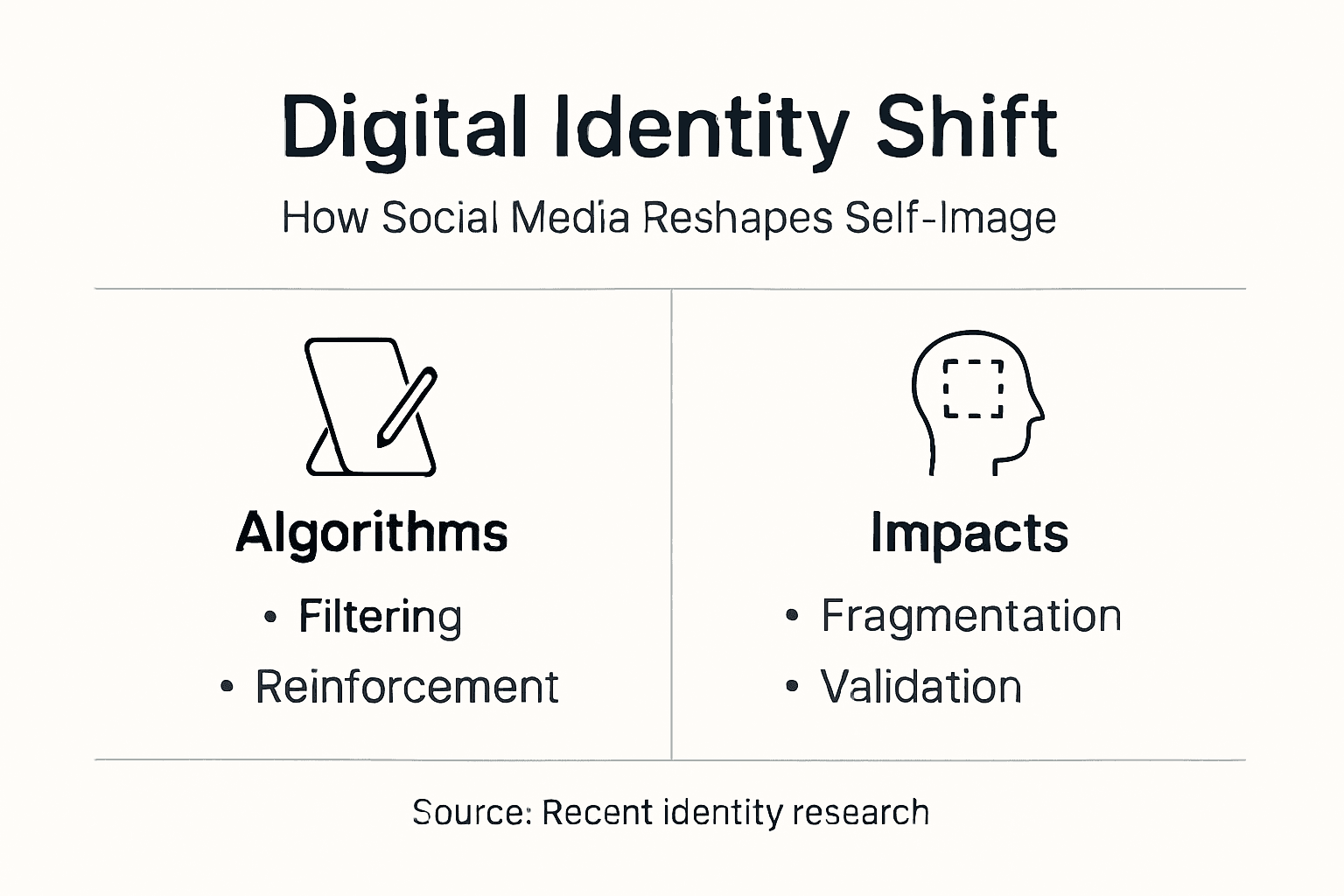
Every scroll through your feed involves invisible decisions made by algorithms. These systems analyse your clicks, likes, and viewing time to curate what appears next. Algorithms prioritise content based on engagement metrics, creating homogenous content clusters that subtly guide your worldview.
This filtering creates echo chambers where certain behaviours and identity traits receive constant reinforcement. Young users especially feel this impact, as exposure to filtered and idealised social media content increases self-criticism and social anxiety. The pressure to conform becomes overwhelming when your entire feed suggests everyone else has perfected their lives.
Beyond individual effects, algorithms reinforce content conformity, amplifying harmful ideologies under the guise of cultural democracy. What feels like freedom of expression often masks algorithmic manipulation pushing extreme views for engagement.
Understanding these mechanisms is essential for recognising how platforms shape your identity formation. The first step towards authentic self-expression involves seeing the invisible hand curating your digital experience.
“Algorithms don’t just show you content; they construct the lens through which you understand yourself and the world, creating identity narratives that feel natural but are carefully engineered for engagement.”
Consider how algorithms affect your identity:
- They limit exposure to diverse perspectives by prioritising familiar content patterns
- They create pressure to perform for engagement rather than express genuine thoughts
- They amplify comparison by showing curated highlights from others’ lives
- They reward conformity to trending behaviours over authentic individuality
- They shape emotional responses through strategic content timing and sequencing
Recognising these patterns helps you step back from automatic reactions. Understanding your teen’s world becomes crucial as younger generations navigate these influences during formative years. Similarly, avoiding social media burnout requires awareness of how algorithmic exposure affects mental wellbeing.
The fragmentation and performance of the digital self
Your online identity isn’t singular. Instead, you maintain multiple personas across different platforms, each shaped by audience expectations and feedback mechanisms. This phenomenon reflects Bauman’s liquid modernity theory, where identity becomes fluid and constantly shifting rather than stable.

Social media facilitates fragmented identity expression, encouraging multiple mutable selves instead of consistent offline identity. You might present professionally on LinkedIn, casually on Instagram, and anonymously on Reddit, creating distinct personas for each context.
This fragmentation intensifies through feedback loops. Users’ self-esteem and mood closely link to digital feedback such as likes and comments, creating emotional volatility tied to validation metrics. A post with low engagement can trigger self-doubt, while viral content produces euphoria, both disconnected from genuine self-worth.
Performance pressures drive curated presentations that sometimes distort authentic identity. You edit photos, craft witty captions, and time posts for maximum reach, transforming self-expression into strategic performance. This constant curation exhausts mental resources and blurs boundaries between genuine and performed identity.
Several factors drive digital self-fragmentation:
- Platform norms dictating acceptable content styles and presentation formats
- Audience diversity requiring different personas for family, friends, colleagues, and strangers
- Feedback mechanisms rewarding specific behaviours while penalising others
- Algorithmic amplification of content matching platform engagement patterns
- Social comparison triggering identity adjustments to match perceived standards
Pro Tip: Schedule regular offline activities with people who know your unfiltered self. This grounding practice helps maintain identity consistency despite digital fragmentation pressures.
The connection between mood and digital validation creates concerning patterns. When self-worth depends on external approval metrics, identity becomes unstable and reactive. Recognising this link empowers you to separate authentic self-perception from performative digital feedback.
Digital fashion and self-presentation illustrates how online identity extends into virtual spaces, where curated appearances replace physical reality entirely. These trends accelerate identity fluidity, making conscious self-awareness more critical than ever.
Common misconceptions about social media and identity
Popular narratives about social media often miss nuanced realities revealed by research. Understanding these misconceptions helps you navigate digital spaces more critically and avoid oversimplified thinking about identity formation.
Many believe social media makes people more individualistic and isolated. However, social media does not increase individualism but reshapes social behaviour through collective identity negotiation. Platforms actually promote new forms of collective belonging and shared cultural practices rather than fragmenting society.
Another common myth suggests likes and comments have minimal impact on self-esteem. Research proves otherwise, showing digital feedback strongly influences mood and identity development. The validation economy shapes how you view yourself, often more powerfully than offline interactions.
Perhaps the most persistent misconception claims social media directly causes negative mental health effects related to identity. Reality is more complex. Establishing direct causality between social media use and identity changes is methodologically challenging, as social factors often precede or influence usage patterns rather than resulting from them.
| Misconception | Expert Insight | Example |
|---|---|---|
| Social media isolates individuals | Platforms create new collective identity spaces | Online communities forming around shared interests |
| Digital feedback has little real impact | Likes and comments strongly shape self-esteem and mood | Post engagement affecting daily emotional states |
| Social media directly causes identity problems | Causality is complex with multiple confounding factors | Pre-existing social anxiety influencing usage patterns |
| Online identity is fake, offline is real | Both are authentic expressions in different contexts | Professional networking requiring different presentation |
These misconceptions matter because they shape policy, parenting approaches, and personal strategies for digital engagement. Recognising nuanced realities allows more effective responses to genuine challenges while avoiding social media burnout through balanced understanding.
The research challenges simplistic narratives, revealing that identity formation in digital spaces involves complex interactions between individual psychology, social context, platform design, and cultural factors. This complexity demands sophisticated thinking rather than reactionary responses.
The broader social and national identity effects of social media
Social media’s impact extends beyond personal identity to reshape collective and national belonging. Platforms create new spaces where cultural narratives evolve and communities negotiate shared identities across geographical boundaries.
Social media enhances national and personal identities but complicates identity with evolving mediated expressions. Traditional face-to-face identity formation processes now compete with rapid mediated communication that crosses borders instantly.
Migrant and diasporic communities particularly benefit from platforms enabling cultural identity maintenance across distances. WhatsApp groups, Facebook communities, and Instagram accounts help preserve traditions while adapting to new contexts, creating hybrid identities that blend heritage with contemporary experiences.
However, tensions emerge between mediated self-expressions and offline interpersonal identities. What you present online might conflict with how family or local community members perceive you, creating fragmentation between digital persona and physical presence.
Social media impacts collective identity through:
- Creating virtual gathering spaces that transcend physical boundaries and enable new community formations
- Accelerating cultural narrative evolution through rapid information sharing and collective discussion
- Enabling marginalised groups to build solidarity networks and amplify voices traditionally excluded from mainstream discourse
- Complicating national identity by facilitating transnational connections that challenge territorial belonging concepts
- Shifting generational identity patterns as younger cohorts prioritise digital community over geographical proximity
These changes reshape social cohesion fundamentally. Traditional institutions like churches, civic groups, and neighbourhood associations compete with online communities offering immediate connection and validation. This shift affects how societies maintain shared values and collective purpose.
Understanding national and personal identity requires recognising these platform-mediated transformations. The speed of change creates generational gaps as older cohorts struggle to comprehend identity formation processes fundamentally different from their experiences.
Emerging phenomena: virtual influencers and digital identity evolution
Virtual influencers represent the cutting edge of digital identity complexity. These computer-generated personas gain emotional engagement from real users, blurring boundaries between human and artificial identity presentation.
Users anthropomorphise virtual influencers, blurring lines between real and digital identities, influencing engagement and brand narratives in unprecedented ways. Over 50% of marketers now deploy virtual influencers, recognising their power to shape consumer behaviour and identity aspirations.
Emotional connections to digital avatars affect how you conceive your digital self. When virtual personas model lifestyles, fashion choices, and values, they create aspirational templates disconnected from human possibility. This intensifies the performance pressure already present in social media while introducing entirely fabricated standards.
The challenge becomes distinguishing authentic identity from marketing-driven digital constructs. Virtual influencers exist purely to drive commercial engagement, yet users form genuine emotional bonds with them. This phenomenon reveals how easily identity formation processes can be manipulated through sophisticated digital presentation.
Pro Tip: Approach virtual influencer content with heightened scepticism. Recognise that computer-generated personas serve marketing objectives entirely, protecting your identity integrity from commercial manipulation.
Digital fashion and virtual influencers intersect as both phenomena push identity expression into entirely virtual realms. Clothing that exists only digitally, modelled by personas that never lived, creates layers of abstraction from physical reality that previous generations never encountered.
These trends accelerate as technology improves. Deepfakes, AI-generated content, and increasingly realistic virtual humans will continue blurring boundaries between authentic and constructed identity. Developing critical awareness now prepares you for even more complex identity landscapes emerging in coming years.
Practical reflections: navigating authentic identity in the age of social media
Understanding how social media shapes identity matters little without practical strategies for navigating these influences consciously. These steps help you balance curated presentation with authentic self-expression.
Recognising algorithmic shaping and balancing online personas with offline authenticity promotes healthier digital identities. Start by auditing your feed to identify patterns in recommended content and how these align with or diverge from your genuine interests.
Follow this process to navigate authentic digital identity:
- Track which content triggers comparison or negative self-perception, then adjust follow lists accordingly
- Set specific times for social media use rather than constant scrolling, creating boundaries between digital and offline life
- Practice posting without editing or curating occasionally, normalising imperfection in your online presentation
- Engage with diverse perspectives intentionally to counteract algorithmic echo chambers
- Regularly assess whether online behaviour reflects genuine values or performative pressure
- Cultivate offline relationships and activities that reinforce consistent identity independent of digital validation
Identify social comparison triggers by noting when scrolling leaves you feeling inadequate. These moments reveal where algorithmic content conflicts with authentic self-perception. Addressing triggers might mean unfollowing accounts, adjusting privacy settings, or taking extended breaks.
Accept that identity fluidity is normal while maintaining offline consistency. Your digital personas can adapt to different contexts without fragmenting your core sense of self. The key involves conscious choice rather than reactive performance.
Critically assess emotional reliance on likes and comments. When validation metrics drive mood, you’ve surrendered identity control to external approval. Reclaiming autonomy requires separating self-worth from engagement statistics.
Pro Tip: Dedicate at least one hour daily to screen-free activities involving physical movement, face-to-face conversation, or creative expression. This grounding practice supports mental wellbeing and identity integration.
Avoiding social media burnout and avoiding digital overload require intentional boundaries protecting your authentic identity from constant performative pressure. These practices become essential mental health strategies in 2026’s hyperconnected environment.
Finally, regaining confidence and self-esteem often involves reducing digital validation dependence and strengthening offline self-perception. Your worth exists independent of engagement metrics, follower counts, or algorithmic approval.
Conclusion: towards conscious digital self-awareness
Social media has transformed human identity through subtle mechanisms operating largely outside conscious awareness. Algorithms filter content, creating echo chambers that reinforce specific traits and behaviours. Digital selves fragment across platforms, shaped by performative pressures and feedback loops linking self-esteem to validation metrics.
Yet understanding these processes empowers conscious engagement. Recognising algorithmic influence, questioning emotional reliance on likes, and balancing online personas with offline authenticity promotes healthier digital identities. The challenge involves ongoing self-reflection about how digital and offline selves interact and evolve.
Foster balanced, authentic digital engagement by prioritising awareness over automatic reactivity. Your identity formation deserves conscious attention rather than passive acceptance of platform-driven narratives. Navigate evolving digital landscapes with critical thinking, protecting authentic self-expression whilst enjoying social media’s genuine benefits.
Explore smart home and lifestyle essentials with Stomart
Managing your digital identity works best when your physical environment supports wellbeing and authentic living. Creating spaces that encourage offline connection and mindful technology use helps balance curated online presence with genuine self-expression.
Stormart offers carefully selected tech gadgets for modern lifestyle that enhance daily life without overwhelming you with unnecessary digital noise. From wellness products supporting mental health to practical accessories simplifying everyday tasks, our curated collections help you build environments promoting authentic identity.
Explore tech accessories for students balancing productivity with wellbeing, or discover strategies for avoiding social media burnout tips whilst maintaining meaningful connections. Your personal space should support conscious digital engagement and offline grounding equally.
How social media changed human identity without us noticing: frequently asked questions
What role do algorithms play in shaping my online identity?
Algorithms filter and prioritise content based on your interactions, subtly guiding your self-view by showing similar ideas and lifestyles repeatedly. This creates echo chambers reinforcing certain behaviours and identity traits unconsciously. Understanding these patterns helps you recognise when your feed shapes rather than reflects your authentic interests.
How can I tell if my digital self is authentic?
Look for consistency between your offline values and online behaviour, paying attention to how much you curate posts to seek approval. Authentic digital identity feels comfortable rather than performative, expressing genuine thoughts without constant editing. If you find yourself exhausted by maintaining online personas, that signals inauthenticity worth addressing.
Why do I feel anxious after using social media?
Social media exposes you to idealised portrayals that can increase self-criticism and social anxiety, amplified by algorithms showing similar content repeatedly. This comparison triggers feelings of inadequacy when your life doesn’t match curated highlights. Limiting exposure to triggering content and practising offline grounding activities reduces this anxiety effectively.
Are virtual influencers affecting how I see myself?
Virtual influencers can emotionally engage users and shape identity narratives, sometimes blurring real and digital boundaries in concerning ways. These computer-generated personas create aspirational standards disconnected from human possibility, intensifying performative pressure. Approaching their content with critical awareness protects your identity from marketing-driven manipulation.
How can I balance online personas with my offline life?
Set boundaries on social media use and prioritise offline relationships to maintain a grounded, authentic sense of self. Schedule regular screen-free time for activities reinforcing consistent identity independent of digital validation. Avoiding social media burnout requires conscious effort to separate self-worth from engagement metrics whilst enjoying genuine connection benefits.