

Why Modern Life Makes Us Forget Our Humanity
on Feb 25, 2026You wake up in London, Manchester or Edinburgh, surrounded by people yet feeling oddly isolated. The faster life moves, the harder it becomes to define what being human even means. Modern technology and relentless societal speed blur boundaries, leaving many urban millennials battling loneliness and anxiety. If you long for genuine connection and a sense of purpose beyond endless digital notifications, this guide offers ways to regain your humanity in a world that rarely gives you time to breathe.
Key Takeaways
| Point | Details |
|---|---|
| Humanity Is Shifting | The definition of humanity is evolving due to technological advancements, affecting our connections and sense of self. |
| Real Connection Over Digital | Genuine human connection requires physical presence and mutual vulnerability, which digital interactions cannot provide. |
| Impact on Wellbeing | The fast-paced modern lifestyle erodes wellbeing and authenticity, leading to chronic loneliness and anxiety. |
| Actionable Reclamation Strategies | Prioritising slow, meaningful interactions, engaging with nature, and allowing boredom can significantly enhance personal wellbeing and connection. |
Defining Humanity in a Fast-Paced World
What does it actually mean to be human anymore? That question feels harder to answer than ever before.
Most of us assume we know what humanity is. But the truth is messier. Philosophers and academics wrestle with this constantly because what counts as humanity shifts depending on what you value about being human in the first place.
In your daily life, humanity might mean compassion, connection, or the ability to feel deeply. But in a world of artificial intelligence, virtual relationships, and constant technological disruption, those definitions start to blur.
Why This Matters Right Now
You’re living through unprecedented change. Technology evolves faster than our understanding of it. Fast-paced technological and societal shifts challenge what we thought was fixed about human identity.
Consider what’s happened in just the past decade:
- Social media replaced face-to-face friendships for many
- Work moved into your bedroom via Zoom
- Dating became algorithmic through apps
- Information arrives in fragments rather than thoughtful narratives
- Physical presence feels optional when virtual presence exists
Each shift slightly erodes something we once considered fundamentally human. The constant acceleration means you rarely pause to notice it happening.
The Core Problem: We’ve Lost the Reference Point
Your grandparents could define humanity by pointing to shared experiences everyone had. Work. Family gatherings. Community rituals. Meals together. Boredom.
Now? Those anchors are gone or scattered. Your experience of being human looks nothing like someone else’s, even across your own generation.
Without a shared understanding of what humanity means, we can’t recognise when we’re losing it.
This fragmentation leaves you feeling untethered. You notice something’s missing but can’t quite name it.
What Humanity Actually Requires
Strip away the noise and humanity needs several non-negotiable elements:
- Genuine connection: real people, real presence, not algorithmic approximations
- Vulnerability: the capacity to be hurt, uncertain, and imperfect
- Purpose beyond productivity: meaning that doesn’t attach to your economic output
- Sensory experience: touch, taste, physical space, not just screens
- Autonomy: choices that feel like yours, not optimised by corporate interests
- Reflection time: space to think without external input demanding your attention
Most modern systems actively work against these. That’s not accidental.
The Mismatch You Feel
You sense this disconnect constantly. Exhaustion that sleep doesn’t fix. Loneliness despite constant digital contact. Achievement that feels hollow. Busyness that produces nothing meaningful.
This isn’t laziness or weakness. This is your humanity reacting to an environment designed to suppress it.
Pro tip: Start by naming one specific way modern life has eroded your humanity—whether it’s replacing dinner conversations with phone scrolling or trading sleep for productivity. Name it first, before you can reclaim it.
How Technology Reshapes Human Connection
Technology promised to bring us closer. Video calls would replace distance. Social media would unite the world. Messaging apps would keep us in constant contact.
Instead, you’re lonelier than ever.
The problem isn’t the technology itself. It’s what the technology actually does to connection when you examine it closely. Real human connection requires something tech fundamentally cannot provide: mutual vulnerability in shared space.
The Illusion of Closeness
You can message someone instantly across continents. You can see their face on screen. You can know what they ate for lunch through their Instagram story.
None of that builds genuine connection.
Why? Because connection isn’t about information transfer. When you sit across from someone, your nervous systems synchronise. Your breath patterns align. Micro-expressions trigger empathy. These biological realities don’t transmit through screens.
Technology gave you proximity without presence.
How Digital Interaction Changes Your Brain
Your brain evolved for face-to-face connection. But how technology transforms human values in digital spaces means you’re constantly mismatching expectation with reality.
Consider what happens when you:
- Message a friend instead of calling: you lose vocal tone, pace, and emotional weight
- Use dating apps instead of meeting naturally: you reduce humans to swipeable profiles
- Text during dinner: you signal that the person across from you is less important than distant notifications
- Curate your online presence: you fragment yourself into a performance rather than authenticity
- Scroll instead of having awkward silences: you eliminate the space where actual connection happens
Each choice seems minor. Together, they reshape how your brain processes relationships.
The Bigger Picture
Technology doesn’t just change how you connect. Digital tools reshape how society addresses challenges collectively, meaning your entire understanding of community gets rewritten.
You’re now expected to solve loneliness through more technology. Feel anxious? There’s an app. Need connection? Join an online community. Miss meaningful work? Start a side hustle on social media.
More connection products cannot fix disconnection caused by connection products.
What’s Actually Lost
When connection becomes digital, certain irreplaceable elements vanish:
- Physical touch: the most powerful bonding mechanism humans have
- Spontaneous moments: unplanned conversations that reveal who people really are
- Shared struggle: working through difficulty together, not just discussing it
- Being truly known: beyond curated profiles to the messy, real version of you
- Time without purpose: hanging out with no agenda, no productivity metric
Technology can connect you to millions. It cannot make you feel less alone.
This isn’t poetic—it’s neurological. Your brain knows the difference between digital and real presence.
To clarify how technology influences human connection, here is a comparison between digital and physical interactions:
| Interaction Type | Emotional Depth | Presence Quality | Potential for Vulnerability |
|---|---|---|---|
| Digital | Superficial or fragmented | Lacks full sensory synchrony | Often limited and curated |
| Physical (Face-to-Face) | Rich and multi-layered | Complete sensory alignment | High, possible genuine sharing |
This helps highlight what is lost when connection shifts from real spaces to screens.
Why This Matters for Your Humanity
Connection is what makes you human. When technology replaces it with simulation, you lose a core part of yourself. The exhaustion you feel, the anxiety that sleep doesn’t fix, the sense that relationships lack depth—these are signals that your humanity is being eroded.
You cannot outsource connection to an algorithm and expect to feel whole.
Pro tip: Set one phone-free hour daily with someone you care about. No screens, no distractions, just presence. Notice how different the conversation feels compared to texting—that difference is what real connection actually is.
The Erosion of Wellbeing and Authenticity
You wake up stressed. You end your day exhausted. Yet you’ve accomplished nothing that feels meaningful.

This isn’t normal tiredness. This is your wellbeing eroding in real time, driven by systems designed to extract your attention and reshape who you are.
Most people blame themselves. They think they’re not organised enough, not disciplined enough, not productive enough. But the real problem is structural. Modern life’s frenetic pace damages wellbeing in ways that willpower cannot fix.
The Efficiency Trap
Technology promised to save time. Apps would streamline work. Automation would create leisure. Optimisation would reduce stress.
Instead, you have less free time than your parents did, despite owning devices that theoretically handle everything.
Why? Because efficiency doesn’t save time. It creates expectations to fill whatever time you save. Work expands. Obligations multiply. Rest becomes guilty.
You’re trapped in what researchers call the productivity paradox: the harder you optimise your life, the less time you actually have.
How Speed Destroys Authenticity
Authenticity requires something modern life actively prevents: slowness.
When you rush, you operate from habit and fear rather than genuine preference. You say yes to things you don’t want. You perform versions of yourself tailored to algorithms. You make choices based on what’s efficient rather than what matters.
Your subjective experience of time becomes distorted, meaning you lose presence in your own life. You’re physically present but mentally elsewhere, constantly optimising for the next moment.
This fractured existence isn’t authenticity. It’s survival mode.
What Happens to Your Mental Health
Your nervous system cannot sustain this pace. Signs of erosion appear gradually:
- Constant low-level anxiety that feels normal
- Difficulty enjoying things you once loved
- Sleep problems despite exhaustion
- Emotional numbness mixed with sudden overwhelm
- Inability to sit alone without distraction
- Relationships that feel shallow despite frequency of contact
- Work that pays well but feels hollow
These aren’t personal failures. They’re symptoms of a system designed against your wellbeing.
The Cost of Constant Curation
Modern life requires you to manage multiple identities. Work version. Social media version. Family version. Dating app version. Each curated, optimised, performed.
Maintaining these fractured selves is exhausting. Your brain expends enormous energy keeping them separate, worrying about consistency, managing what each audience sees.
Authenticity dies when you’re always performing for someone else’s perception.
You lose track of who you actually are beneath the performance. Preferences blur. Values shift based on context. You become a collection of responses rather than a coherent person.
Why Productivity Culture Makes It Worse
Productivity culture doesn’t just demand your time. It demands meaning be tied to output.
You’re encouraged to:
- Monetise your hobbies to justify enjoying them
- Optimise relaxation into self-improvement
- Frame rest as investment in future productivity
- Measure your worth by your accomplishments
- Treat leisure as laziness unless it serves a goal
This destroys wellbeing because genuine rest, genuine pleasure, genuine connection—these have no measurable output. Yet they’re what actually sustains you.
When everything must justify itself through productivity, you become hollow.
Pro tip: Choose one activity this week that serves absolutely no purpose. Not exercise disguised as fun. Not networking disguised as friendship. Something genuinely pointless—a long walk, a meal with no agenda, an afternoon reading fiction. Notice how guilt arises and observe it without acting on it.
Risks: Loneliness, Anxiety, and Identity Loss
You’re not imagining it. The mental health crisis among British millennials is real, measurable, and worsening.
Loneliness has become epidemic. Anxiety disorders have tripled in a decade. Identity confusion leaves people unable to articulate who they actually are beneath the performance.
These aren’t separate problems. They’re interconnected symptoms of a system that erodes your humanity.
The Loneliness Paradox
You have 500 social media connections. You message people daily. You’re constantly in contact.
Yet you’ve never felt more alone.
This paradox exists because connection without depth is not connection. You can be surrounded by people and still feel profoundly isolated. Digital proximity creates the illusion of closeness while preventing genuine intimacy.
The result? You’re lonely in crowds. You feel unseen despite constant visibility.
How Anxiety Becomes the Default State
Anxiety isn’t just a mental health problem anymore. For many millennials, it’s become baseline existence.
Why? Because modern systems are designed to keep you slightly off-balance. Uncertainty about jobs. Precarity in housing. Information overload. Comparison culture. Algorithmic manipulation. Each element activates your threat response.
Your nervous system never fully relaxes. You exist in a state of low-level panic dressed up as productivity and ambition.
Identity Loss: Who Are You Really?
Identity formation requires something modern life prevents: coherent self-expression across time.
Instead, you fragment yourself. Work requires one persona. Social media requires another. Dating apps require another still. Family expects yet another version.
Modern individuals navigate competing inclinations and identities without guidance on how to integrate them into a coherent self. You become a collection of personas rather than one person with multiple facets.
Over time, you lose track of your authentic preferences, values, and desires.
The Specific Risks You Face
These psychological consequences compound over time:
- Chronic loneliness: isolation despite constant contact, leading to depression
- Generalised anxiety: persistent worry that infiltrates every aspect of life
- Identity diffusion: inability to know who you are or what you want
- Imposter syndrome: feeling fraudulent in your own life
- Emotional numbness: disconnection from your own feelings
- Relationship dysfunction: difficulty with genuine intimacy due to fear and fragmentation
- Meaning crisis: achievement feels hollow because values feel foreign
None of these develop overnight. They accumulate gradually, normalised by culture until you don’t recognise them as problems.
Why Education Matters Here
The decline of humanities education relates to increasing loneliness and identity confusion in contemporary life. Humanities foster ethical thinking, character formation, and the ability to explore what makes life meaningful.
Without this, you’re left with technical skills but no framework for understanding yourself or your place in the world.
You can optimise your life without ever asking whether the life you’re optimising is worth living.
Loneliness, anxiety, and identity loss aren’t personal failures. They’re predictable outcomes of systems designed to prevent genuine humanity.
The Long-Term Cost
These risks accumulate. Chronic anxiety damages your physical health. Loneliness shortens your lifespan as much as smoking. Identity loss makes you vulnerable to exploitation and manipulation.
You’re not just uncomfortable. You’re being harmed.
Pro tip: Write down three core values that matter to you, independent of productivity or social approval. Then audit your week: how much time actually aligns with these values? The gap reveals where you’ve lost yourself.
Effective Ways to Reclaim True Human Experience
Reclaiming your humanity isn’t about radical life changes or abandoning modern life entirely. It’s about deliberate choices that prioritise depth over speed, presence over productivity, authenticity over performance.
This is entirely within your control. You don’t need permission. You just need to start.
Slow Down Intentionally
Slowing down and re-evaluating pace restores authenticity and wellbeing, yet modern culture relentlessly pushes acceleration.
Slowness is radical resistance in a world that profits from your speed. When you slow down, you regain agency. You notice what actually matters. You make choices rather than react to obligations.
Start small. Choose one daily activity to do slowly. Make tea without checking your phone. Walk to work without podcasts. Eat a meal without screens. Notice the discomfort that arises—that’s the speed addiction surfacing.
Prioritise Real Connection
This means intentional, technology-light time with real people. Not group chats. Not watching their stories. Actual presence in shared physical space.
What this requires:
- Weekly time with someone you care about, device-free
- Phone calls instead of messages for people who matter
- Showing up physically when possible rather than accepting digital alternatives
- Conversations without an agenda or productivity outcome
- Vulnerability that goes beyond surface-level pleasantries
Start with one person. Commit to one hour weekly together, no screens. Quality matters more than quantity.
Reconnect with Nature
Nature engagement restores fractured perception of time and wellbeing, counteracting the mental strain of modern pace.
Nature operates on different rhythms. Trees grow slowly. Seasons change gradually. Water flows without hurrying. Exposure to these patterns recalibrates your nervous system.
You don’t need wilderness. A park works. A garden works. Even consistent window time with plants creates measurable shifts in stress hormones.
Reclaim Boredom
Boredom is where creativity, self-reflection, and genuine thought happen. Modern life treats boredom as a disease to cure with constant stimulation.
Stop. Sit with boredom. Let your mind wander without direction. No podcast. No book. No phone. Just you and your thoughts.
This feels terrible initially. Your brain screams for input. Persist. After 20 minutes, something shifts. Ideas emerge. Problems become clear. You remember who you are.
Defend Your Identity
Stop fragmenting yourself for different audiences. Choose one version of yourself and stand in it consistently.
This means:
- Curate social media less or delete it entirely
- Stop performing for people who don’t matter
- Express opinions even when unpopular
- Make choices based on your values, not algorithmic preference
- Accept that some people won’t like the real version of you
Coherence feels unsafe at first because you’ve been rewarded for flexibility. Persist anyway.
Measure Worth Differently
Reclaiming humanity requires valuing relational depth and presence over productivity metrics.
Stop counting achievements. Start noticing moments. How many meaningful conversations did you have? How present were you with people you love? Did you do something pointless and enjoy it anyway?
These metrics don’t generate LinkedIn posts. They generate a life worth living.
Pro tip: This week, identify one activity that serves absolutely no productive purpose but brings genuine pleasure. Protect that time fiercely. This single practice rewires your brain away from constant optimisation back toward authentic experience.
To summarise potential strategies for reclaiming authentic human experience, consider the following approaches and their effects:
| Strategy | Intended Outcome | Example Practice |
|---|---|---|
| Intentional Slowness | Greater self-awareness | Mindful tea, slow walking |
| Real Connection | Emotional fulfilment | Device-free hour with a friend |
| Nature Engagement | Reduced stress | Visit local park, garden time |
| Boredom Embracement | Creative thinking | Unstructured quiet moments |
| Identity Coherence | Increased authenticity | Express consistent self |
These targeted actions can support lasting wellbeing and connection.
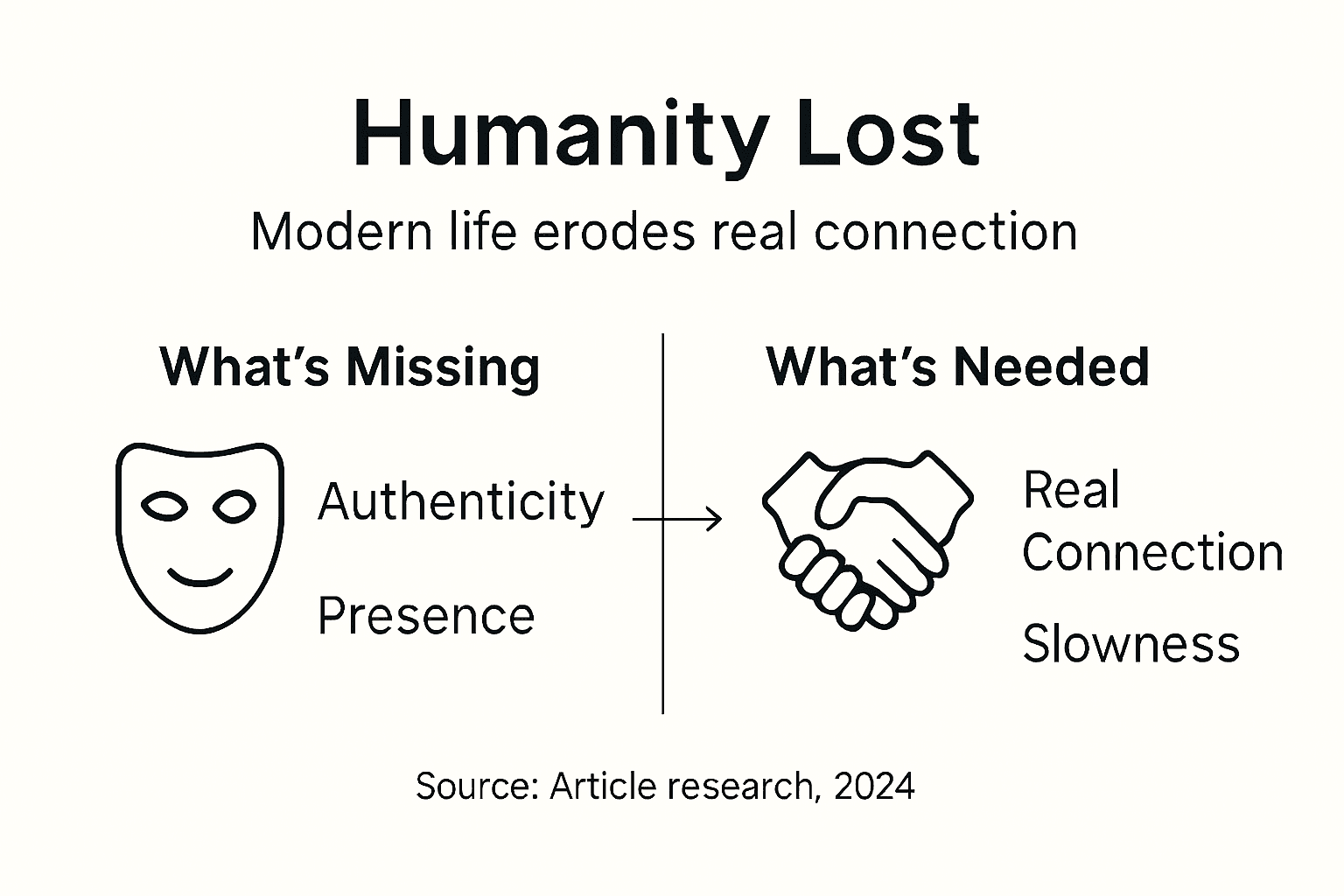
Rediscover Your Humanity with Thoughtful Choices and Meaningful Living
Modern life can leave you feeling exhausted, disconnected and overwhelmed by constant productivity demands and digital noise. You deserve real connection, restorative slowness and authentic self-expression that nurture your wellbeing and spirit. The article highlights how small intentional changes such as device-free time with loved ones, embracing boredom and reclaiming your identity can rebuild what technology and speed have eroded.
At Stomart.co.uk, we understand the importance of creating a home and lifestyle space that supports these values. Explore our diverse range of products including health and beauty items, soothing home goods and lighting and personal wellness gadgets designed to help you prioritise presence and wellbeing. Now is the perfect time to shop with intention and start restoring your humanity through simple yet powerful everyday choices.
Take the first step to reclaim your true self today by visiting Stomart.co.uk and discovering products that bring calm, connection and authenticity into your life.
Frequently Asked Questions
What are the core elements that define humanity in modern life?
Humanity requires several non-negotiable elements including genuine connection, vulnerability, a sense of purpose beyond productivity, sensory experiences, autonomy, and time for reflection.
How does technology impact our ability to form genuine human connections?
Technology often provides proximity without true presence, leading to superficial relationships and preventing mutual vulnerability essential for deep connections.
What are the psychological effects of a fast-paced modern life on individuals?
Modern life can lead to chronic loneliness, generalised anxiety, identity confusion, emotional numbness, and relationship dysfunction due to the demands of productivity and constant connectivity.
How can individuals reclaim their humanity in today’s world?
Individuals can reclaim their humanity by slowing down intentionally, prioritising real connections, engaging with nature, embracing boredom, defending their identity, and measuring worth based on relational depth rather than productivity.