

How Voice Assistants Work – Enhancing Smart Homes
on Feb 01, 2026
Many modern homes now feature a voice assistant ready to answer questions, adjust the lights, or control digital devices with a simple command. As these intelligent systems become more common around the world, they raise fresh questions about how they work and what really happens when you speak. By deepening your knowledge of how voice assistants process, interpret, and act on your words, you can unlock smarter ways to enjoy seamless convenience at home. Understanding the true capabilities and privacy features of voice assistants sets the foundation for a more connected, secure living space.
Key Takeaways
| Point | Details |
|---|---|
| Voice Assistants Enhance Interaction | Voice assistants leverage natural language processing and contextual understanding to facilitate advanced human-technology interactions. |
| Privacy and Security Are Critical | Users must be aware of privacy settings and potential data vulnerabilities associated with voice assistants to protect personal information. |
| Choose Wisely for Optimal Integration | Selecting the right voice assistant depends on compatibility with existing devices and individual privacy preferences, ensuring a seamless setup. |
| Understand the Voice Processing Journey | Familiarising oneself with the steps involved in voice command processing can help improve interaction effectiveness and recognition accuracy. |
Voice Assistants Defined And Common Misconceptions
Voice Assistants are intelligent software interfaces enabling seamless human-technology interactions through voice commands. These digital companions transform how we manage information and complete tasks across multiple devices and environments.
At their core, voice assistants represent sophisticated technological systems designed to interpret and execute spoken instructions. Academic research reveals complex interaction dynamics that go far beyond simple command recognition.
Key characteristics of modern voice assistants include:
- Natural language processing capabilities
- Ability to learn and adapt to user preferences
- Integration across multiple smart home and digital platforms
- Contextual understanding of complex verbal instructions
Privacy and ethical considerations remain significant challenges in voice assistant development. Systematic reviews highlight critical ethical concerns surrounding continuous listening technologies and data management practices.
Common misconceptions about voice assistants frequently emerge from limited understanding of their technological sophistication. Many people mistakenly believe these systems are either infinitely intelligent or completely unintelligent, when the reality is far more nuanced.
Misunderstandings often centre around three primary areas:
- Actual intelligence capabilities
- Data processing mechanisms
- Privacy protection strategies
Technological limitations mean voice assistants are not omniscient beings but carefully engineered tools designed to simplify human interactions with digital systems.
Pro tip: Always review your voice assistant’s privacy settings and understand exactly what data is being collected and stored to maintain optimal personal information security.
Types Of Voice Assistants And Their Capabilities
Voice assistants represent a diverse ecosystem of digital technologies designed to simplify human interactions with digital platforms. Comprehensive research highlights their evolving capabilities across multiple domains and use cases.
The primary categories of voice assistants include:
- Smartphone-based assistants: Siri, Google Assistant, Alexa Mobile
- Smart home assistants: Amazon Echo, Google Home, Apple HomePod
- Car integration systems: Android Auto, Apple CarPlay voice controls
- Enterprise and professional assistants: Microsoft Cortana, specialised business tools
Intelligent capabilities vary significantly between different voice assistant platforms. Academic literature demonstrates their extensive functional range, from basic task automation to advanced contextual understanding.
Key performance metrics for comparing voice assistants include:
- Answer accuracy
- Language processing speed
- Number of supported languages
- Device and platform integration
- Privacy and security features
Performance variations mean each voice assistant offers unique strengths. Google Assistant leads in answer precision, while Siri maintains the largest user base among Apple ecosystem users.
Here’s a comparison of the main categories of voice assistants and their distinguishing features:
| Assistant Type | Typical Environment | Unique Capability | Common Limitation |
|---|---|---|---|
| Smartphone-based | Mobile, on-the-go | Seamless integration with apps | Often limited by hardware |
| Smart home assistants | Domestic, stationary | Full ecosystem device control | May struggle with accents |
| Car integration systems | Vehicles | Hands-free navigation support | Connectivity drops in tunnels |
| Enterprise solutions | Workplaces | Business productivity tools | Privacy concerns in offices |
Contextual intelligence represents the next frontier in voice assistant development. Modern systems increasingly understand nuanced instructions, learn user preferences, and provide personalised interactions.
Pro tip: Experiment with multiple voice assistants to discover which best matches your specific technological needs and personal workflow requirements.
The Step-By-Step Process: From Voice To Action
Voice interactions transform human communication with technology through a sophisticated multi-stage process. AI voice agents utilise complex architectural frameworks to convert spoken language into precise digital actions.
The comprehensive voice processing journey involves multiple critical stages:
- Audio capture: Recording spoken commands
- Speech-to-text conversion: Transforming audio into readable text
- Natural language processing: Interpreting user intent
- Contextual analysis: Understanding nuanced instructions
- Action execution: Performing requested tasks
- Response generation: Providing spoken feedback
Technical architectures demonstrate intricate voice interaction mechanisms, breaking down complex communication into measurable computational steps.
Detailed processing stages include:
- Sound wave digitisation
- Phonetic pattern recognition
- Semantic meaning extraction
- Intent verification
- System command translation
- Feedback generation
Automatic Speech Recognition (ASR) plays a crucial role in translating acoustic signals into comprehensible text. Advanced machine learning algorithms continuously improve accuracy by learning from millions of speech samples.

Contextual understanding represents the most sophisticated element of voice assistant technologies. Modern systems can interpret indirect language, understand user preferences, and provide increasingly personalised responses.
Pro tip: Speak clearly and precisely when using voice assistants to maximise recognition accuracy and reduce potential misunderstandings.
Everyday Uses And Home Integration Scenarios
Smart home technologies are transforming domestic environments through seamless voice-controlled interactions. Voice assistants now manage comprehensive home ecosystems by providing intuitive control across multiple household systems.
Typical smart home integration scenarios encompass multiple functional domains:
- Lighting control: Adjusting brightness and colour
- Security management: Monitoring cameras and alarm systems
- Climate regulation: Controlling temperature and heating
- Entertainment coordination: Managing music and media devices
- Appliance automation: Scheduling and remote operation
Voice assistant applications revolutionise home interaction methods, enabling hands-free management of complex domestic environments.
Advanced integration capabilities include:
- Multi-device synchronisation
- Personalised user recognition
- Predictive routine development
- Energy consumption optimisation
- Cross-platform compatibility
Contextual intelligence allows voice assistants to understand nuanced instructions, learning individual household preferences and creating increasingly sophisticated automated environments.
Modern voice-controlled systems can coordinate intricate sequences, such as preparing morning routines by simultaneously adjusting lighting, brewing coffee, and providing personalised weather updates.
Pro tip: Start with integrating two or three compatible smart home devices to build confidence in voice assistant ecosystem management.
Privacy, Security Risks And Data Protection Issues
Voice assistant technologies introduce complex privacy challenges that extend far beyond traditional digital security concerns. Comprehensive research identifies multiple security vulnerabilities in contemporary voice-controlled systems, revealing intricate risks to personal data protection.
Key privacy and security challenges include:
- Continuous background audio recording
- Potential unauthorized data access
- Cloud storage vulnerability
- Algorithmic profiling risks
- Potential third-party data sharing
Virtual assistants raise significant privacy concerns through their complex data collection and processing mechanisms. Modern voice technologies collect extensive personal information, creating potential breach points across multiple interaction channels.
Major security vulnerabilities encompass:
- Acoustic signal manipulation
- Hardware exploitation techniques
- Unauthorized voice authentication
- Unintended background recording
- Cross-platform data aggregation
Adversarial attacks represent a sophisticated threat, where malicious actors can potentially manipulate voice recognition systems through carefully constructed audio inputs designed to trigger unintended responses.
Cybersecurity experts recommend implementing robust protection strategies that balance technological convenience with comprehensive data safeguarding protocols, including encryption, strict access controls, and transparent user consent mechanisms.
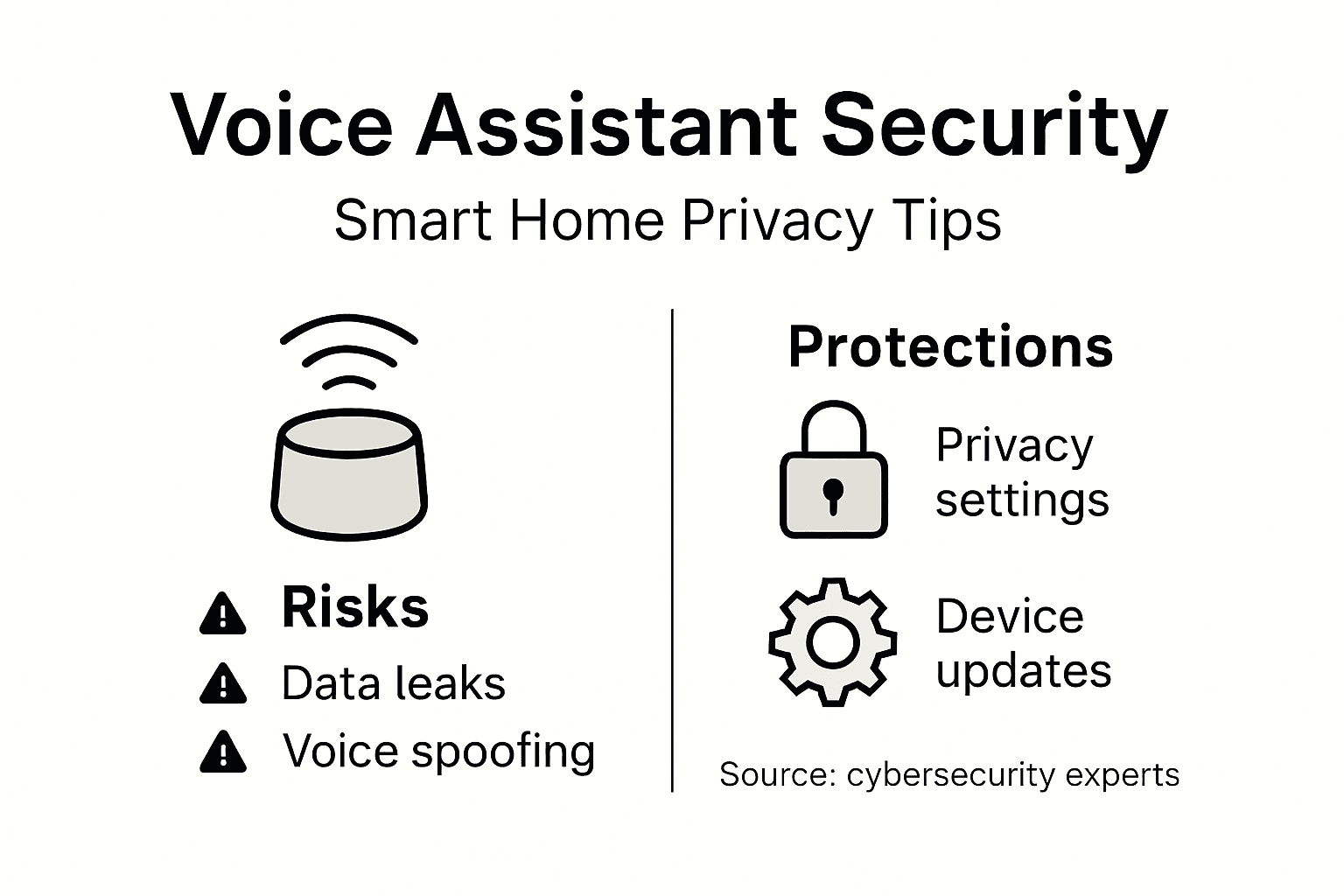
For quick reference, here are key strategies to protect your privacy when using voice assistants:
| Protection Strategy | How It Works | Impact on Security |
|---|---|---|
| Encryption of voice data | Scrambles audio records | Prevents eavesdropping |
| Limiting data retention | Shortens storage times | Reduces exposure risk |
| Multi-factor authentication | Adds extra access layer | Blocks unauthorised logins |
| Local processing options | Keeps data on device | Minimises cloud vulnerabilities |
Pro tip: Regularly review and adjust privacy settings on your voice assistant, limiting data collection and ensuring minimal background recording permissions.
Choosing And Setting Up A Voice Assistant For Home
Voice assistant selection requires careful consideration of multiple technological and personal requirements. Comprehensive setup strategies ensure optimal smart home integration, helping users navigate the complex landscape of digital home management.
Key factors to consider when choosing a voice assistant include:
- Compatibility with existing smart home devices
- Language and accent recognition capabilities
- Privacy and data protection features
- Integration ecosystem
- Cost and long-term support
Home automation platforms offer diverse voice control solutions that cater to different technological preferences and home environments. Understanding these nuanced differences helps users make informed decisions.
Detailed setup considerations involve:
- Assessing home network stability
- Identifying primary usage scenarios
- Checking device compatibility
- Configuring privacy settings
- Planning strategic device placement
Internet connectivity plays a crucial role in voice assistant performance. Robust, stable wireless networks with sufficient bandwidth ensure seamless voice recognition and rapid command execution.
Strategic device placement maximises voice recognition accuracy, considering factors like room acoustics, background noise, and proximity to primary interaction zones.
Pro tip: Test your voice assistant’s performance in different room locations before finalising its permanent installation to ensure optimal sound capture and responsiveness.
Elevate Your Smart Home Experience with Trusted Solutions
Understanding how voice assistants work reveals the incredible potential they offer to simplify and personalise your home environment. The article highlights key challenges such as privacy concerns, integration complexities, and the importance of device compatibility. If you want to truly harness the power of voice-controlled technology, addressing these pain points with the right products and thoughtful setup is essential.
Explore a wide selection of smart home essentials and reliable tech accessories at Stomart.co.uk. From lighting solutions to innovative gadgets designed for seamless integration, you can start building your smart home ecosystem confidently. Don’t miss the chance to protect your privacy while enjoying convenience by checking out our curated range of home goods and electronics.
Ready to transform your living space into a smarter, safer, and more connected environment? Visit Stomart.co.uk now and discover products that align perfectly with your voice assistant needs. Take control today and experience the future of home automation with solutions tailored for you.
Frequently Asked Questions
How do voice assistants enhance smart home functionality?
Voice assistants enhance smart home functionality by enabling voice-controlled interactions with various devices, allowing users to manage lighting, climate, security, and entertainment systems seamlessly and hands-free.
What are the typical types of voice assistants used in smart homes?
Typical types of voice assistants used in smart homes include Google Assistant, Amazon Alexa, and Apple Siri, each with unique strengths in terms of compatibility and functionality within a home ecosystem.
What steps are involved in the process of using a voice assistant?
Using a voice assistant involves several steps: audio capture, speech-to-text conversion, natural language processing to interpret intent, contextual analysis, action execution, and generating spoken responses to the user.
How can privacy concerns be addressed when using voice assistants?
Privacy concerns can be addressed by regularly reviewing privacy settings, limiting data retention, using encryption for voice data, and opting for local processing options when available to safeguard personal information.