

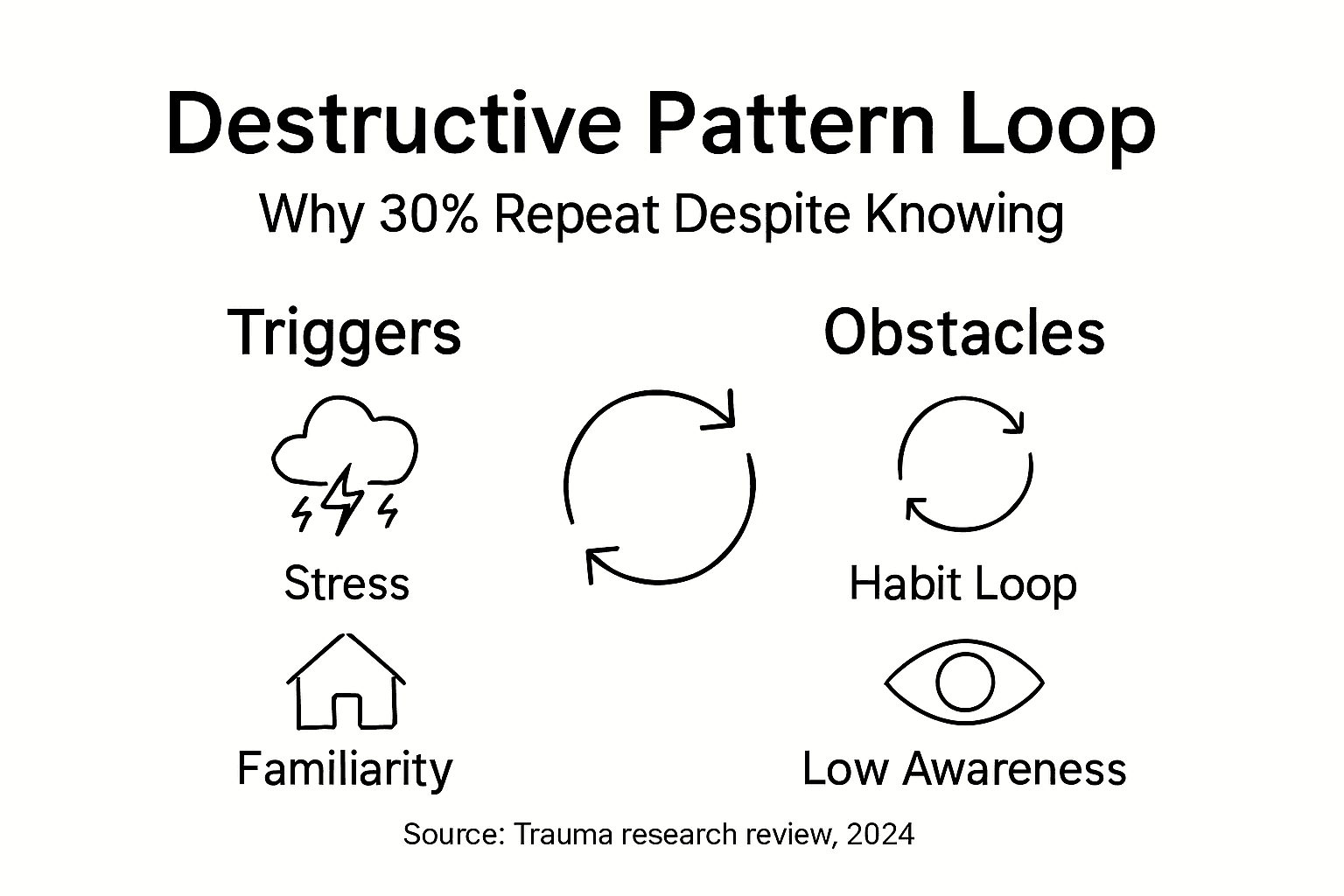
Why 30% Repeat Destructive Patterns Despite Knowing
on Mar 04, 2026Approximately 30% of individuals exposed to adverse childhood experiences go on to unconsciously repeat harmful patterns in adulthood. This isn’t weakness or poor willpower. It’s repetition compulsion, a complex psychological mechanism driven by unresolved trauma and neurobiological conditioning. Despite recognizing the harm, you find yourself drawn back to the same toxic relationships, self-sabotaging behaviors, or painful situations. This article unpacks why your brain keeps pulling you toward familiar pain and provides evidence-based strategies to finally break free.
Key Takeaways
| Point | Details |
|---|---|
| Unconscious repetition compulsion | Destructive patterns stem from unconscious attempts to master unresolved childhood trauma, not character flaws. |
| Neurobiological conditioning | Trauma rewires stress response systems, creating automatic behavioral loops that resist conscious control. |
| Emotional familiarity trap | The brain seeks familiar emotional states, even painful ones, creating deceptive comfort in harmful situations. |
| Awareness isn’t enough | Knowing a behavior is harmful doesn’t change it without addressing deeper psychological and neurological mechanisms. |
| Therapeutic intervention works | Structured approaches combining awareness, emotional processing, and habit replacement enable lasting change. |
Understanding Repetition Compulsion: The Psychological Mechanism
Repetition compulsion is an unconscious phenomenon where you reenact traumatic experiences despite knowing they cause harm. Your subconscious mind drives you to recreate familiar painful scenarios in a misguided attempt to resolve or master the original wound. Someone who experienced emotional neglect as a child might repeatedly choose emotionally unavailable partners. A person with an abusive parent might unconsciously seek controlling relationships.
This isn’t deliberate self-destruction. Your mind believes that by recreating the situation, you can somehow achieve a different outcome or gain control over the uncontrollable. The pattern operates below conscious awareness, which explains why willpower alone rarely breaks the cycle. You might logically understand that a relationship is toxic or a behavior is self-sabotaging, yet find yourself powerless against the compulsion.
Key traits of repetition compulsion include:
- Operates entirely outside conscious awareness and intent
- Rooted in unresolved childhood or developmental trauma
- Perpetuates objectively harmful outcomes despite recognition
- Creates compelling emotional pull toward familiar pain
- Resists change through standard motivation or willpower
“The compulsion to repeat represents the psyche’s attempt to achieve mastery over traumatic experiences by unconsciously recreating them, hoping this time the outcome will differ.”
Understanding this psychological foundation helps you recognize that breaking these patterns requires more than deciding to change. It demands addressing the unconscious drivers and trauma residue that fuel the repetition.
Trauma and Its Role in Behavioral Patterns
Early trauma doesn’t just create painful memories. It fundamentally shapes how your nervous system responds to stress and relationships. People with unresolved childhood trauma are more likely to engage in abusive adult relationships, recreating past dysfunctional dynamics unconsciously. The original trauma conditions behavioral templates that become your default response patterns.
The data reveals the scope of this challenge:
| Population | Repetition Compulsion Prevalence | Key Driver |
|---|---|---|
| General population | 15-20% | Various stressors |
| ACE exposure (moderate) | 30% | Childhood trauma |
| ACE exposure (severe) | 45-50% | Complex developmental trauma |
| Clinical populations | 60-70% | Multiple trauma types |
Trauma sensitizes your stress response systems, particularly the amygdala and hypothalamic-pituitary-adrenal axis. When faced with situations that echo original trauma, your body triggers automatic survival responses. These neurobiological changes reinforce repetitive patterns by making familiar emotional states feel safer than unknown alternatives, even when the familiar is objectively harmful.
Pro Tip: Recognizing that trauma created these patterns, not personal failure, reduces shame and opens the door to compassionate healing work.
The conditioning runs deep. Your nervous system learned early that certain relational dynamics or emotional states represent normal, creating a baseline expectation. Anything different triggers anxiety, pushing you back toward the familiar painful pattern.
Neurobiological Bases of Repetitive Patterns
Neurobiological changes caused by trauma heighten stress susceptibility and condition you to respond repetitively to familiar emotional cues. Your brain builds neural pathways around trauma responses that become highways for automatic behavior. The more you travel these pathways, the stronger they become.

Habit formation mechanisms compound this challenge. Environmental cues trigger automatic behavioral sequences that bypass conscious decision-making entirely. You might not even realize you’ve fallen into the pattern until you’re already deep in it. The basal ganglia, responsible for habit formation, prioritizes efficiency over accuracy, reinforcing familiar responses regardless of outcome quality.
| Mechanism | Repetition Compulsion | Standard Habit Formation |
|---|---|---|
| Primary driver | Unresolved trauma attempting mastery | Learned behavioral efficiency |
| Consciousness level | Deeply unconscious, psychodynamic | Can be conscious or automatic |
| Emotional component | High emotional charge, pain seeking | Neutral or reward seeking |
| Change difficulty | Requires trauma processing | Responds to routine modification |
| Outcome awareness | Often aware but compelled anyway | May lack awareness of triggers |
Neurological challenges that maintain destructive patterns:
- Impaired prefrontal cortex inhibitory control reduces ability to override automatic responses
- Heightened amygdala reactivity creates hair-trigger emotional responses to perceived threats
- Rigid behavioral loops resist cognitive attempts at modification
- Dopamine dysregulation in reward pathways reinforces familiar patterns despite negative outcomes
Pro Tip: Identifying specific environmental and emotional triggers allows you to interrupt automatic patterns before they gain momentum, creating space for new behavioral responses to take root.
The brain’s neuroplasticity offers hope. While trauma creates strong pathways, consistent new experiences can build alternative routes that eventually become your new automatic responses.
The Disconnect Between Awareness and Behavior
Some individuals fail to connect their destructive actions with negative consequences, continuing harmful behavior even after understanding the harm intellectually. This awareness-behavior gap frustrates many people trying to change. You know the relationship is toxic, you understand the job is destroying your health, you recognize the pattern, yet you can’t seem to stop.
Research on compulsive behavior types shows that individuals with compulsive repetition tendencies continue harmful choices even when explicitly shown logical evidence of negative outcomes. The intellectual understanding lives in your prefrontal cortex, but the compulsion originates in deeper limbic structures that don’t respond to logic.
Causes of the awareness-behavior disconnect:
- Emotional avoidance mechanisms override rational understanding to prevent facing painful feelings
- Impaired insight from trauma-induced dissociation creates literal blindness to pattern connections
- Habit strength exceeds willpower capacity, making automatic responses dominant
- Cognitive dissonance allows simultaneous holding of contradictory beliefs about behavior
- Implicit memory drives behavior without conscious recall of original trauma
Motivation alone fails because it operates at the conscious level while the compulsion runs on unconscious fuel. You can desperately want to change and still find yourself repeating the pattern. This isn’t moral failure. It’s the natural outcome of trying to solve a limbic system problem with a cortical solution.
The gap explains why New Year’s resolutions and promise-making rarely create lasting change in trauma-driven patterns. Surface-level commitment can’t override deep neurobiological conditioning without addressing the underlying mechanisms.
Emotional Drivers Behind Repetitive Destructive Patterns
Familiarity with trauma-derived emotional patterns creates a deceptive sense of comfort, causing you to seek out similar harmful relationships or situations repeatedly. Your nervous system interprets familiar as safe, even when familiar means painful. The unknown triggers more anxiety than known suffering.
Psychodynamic perspectives reveal how you unconsciously reenact emotional roles learned in childhood. If you experienced the role of peacemaker in a chaotic family, you might repeatedly enter relationships where you must manage others’ emotions at your own expense. The role feels like identity rather than choice.
Hope for different outcomes provides powerful emotional fuel. Each time you repeat the pattern, part of you believes this time will be different. This person will finally validate you. This job will finally fulfill you. This behavior will finally bring relief. The hope keeps you engaged despite mounting evidence to the contrary.
Key emotional drivers maintaining cycles:
- Comfort in known pain feels safer than the vulnerability of unfamiliar healthy dynamics
- Emotional role reenactment provides false sense of identity and purpose
- Hope for corrective emotional experience keeps you trying to fix the past through present situations
- Fear of abandonment or rejection drives acceptance of harmful treatment
- Unconscious loyalty to family patterns creates guilt when attempting different choices
The emotional pull operates through implicit memory and conditioned responses. You feel drawn toward certain people or situations without understanding why. The attraction isn’t rational; it’s your trauma recognizing itself in another person or circumstance.
Common Misconceptions About Repetitive Destructive Patterns
Myth 1: Repeating destructive patterns means you’re weak or lazy. Correction: Repetition compulsion is not a sign of weakness but a psychological attempt to resolve unhealed wounds by reenacting familiar emotional roles. It’s an unconscious survival strategy, not a character flaw. The pattern demonstrates your psyche’s persistent hope for healing, however misguided the method.
Myth 2: People who repeat harmful patterns want to hurt themselves or others. Correction: The repetition operates unconsciously as an attempt to master trauma, not to cause deliberate harm. You’re not choosing pain; you’re following deeply conditioned neural pathways that promise resolution. The intent is healing, even when the method creates more wounds.
Myth 3: Breaking free is just about deciding to change or having enough motivation. Correction: Understanding behavior change requires addressing neurobiological and psychological barriers through structured intervention. Willpower depletes quickly when fighting against trauma-conditioned automatic responses. Lasting change demands rewiring neural pathways through consistent new experiences and therapeutic support.
Common misconceptions and corrections:
- Misconception: Awareness automatically leads to change. Reality: Intellectual understanding is necessary but insufficient without emotional processing and behavioral practice.
- Misconception: Strong people don’t have these patterns. Reality: Pattern repetition correlates with trauma exposure, not strength or intelligence.
- Misconception: You can think your way out. Reality: Trauma lives in the body and nervous system, requiring somatic and experiential approaches alongside cognitive work.
- Misconception: Quick fixes exist. Reality: Rewiring decades of conditioning takes time, patience, and consistent therapeutic engagement.
Clearing these myths creates realistic expectations for the change process and reduces the shame that often prevents people from seeking help.
Breaking Free: Therapeutic Interventions and Strategies
Therapeutic approaches such as psychodynamic therapy help break repetitive cycles by making unconscious patterns conscious, enabling recognition and emotional processing of underlying needs. When you can see the pattern clearly and understand its origins, you gain power to choose differently.
Practical steps to disrupt destructive cycles:
-
Identify your specific destructive patterns through mindful awareness and journaling. Track situations, emotions, and behaviors to spot recurring themes. Notice what triggers the pattern and what reinforces it.
-
Explore the roots in childhood or developmental trauma with qualified therapeutic support. Understanding where the pattern originated removes shame and reveals the adaptive function it once served.
-
Develop emotional recognition and processing skills to work through feelings rather than avoiding them. Learn to sit with discomfort without immediately acting to relieve it through familiar destructive behaviors.
-
Apply cognitive-behavioral techniques to challenge automatic thoughts and create new behavioral responses. Replace catastrophic thinking with realistic assessment. Practice new responses in low-stakes situations first.
-
Build new routines and environmental supports to override automatic habits. Change your physical environment to remove triggers. Schedule regular breaks for self-reflection. Establish consistent supportive practices that reinforce your new identity.
Pro Tip: Small consistent changes, reinforced through therapeutic support and accountability, create lasting transformation more effectively than dramatic overhauls that overwhelm your nervous system.
The change process isn’t linear. You’ll have setbacks and moments when old patterns resurface. These aren’t failures; they’re opportunities to practice responding differently and to deepen understanding of what still needs healing. Compassionate persistence, not perfection, drives lasting change.
Explore More to Support Your Journey
Breaking free from destructive patterns requires comprehensive support across multiple life areas. STOMART.CO.UK offers practical guides that complement your psychological work with lifestyle improvements. Explore our life-changing daily routine strategies to create structure that supports new behavioral patterns. Learn how small daily habits compound into significant transformation over time. Discover approaches for regaining confidence and self-esteem as you build your new identity. These resources provide the practical foundation that makes therapeutic insights actionable in daily life, supporting your journey toward lasting change.
Frequently Asked Questions
Why do I keep repeating bad habits even when I want to stop?
Your brain operates on deeply conditioned neural pathways created by early experiences and trauma. These automatic responses bypass conscious decision-making, making the behavior feel compulsive rather than chosen. Breaking the pattern requires addressing the unconscious drivers and neurobiological conditioning, not just increasing willpower.
Can therapy really help break unconscious destructive patterns?
Yes, therapeutic approaches that make unconscious patterns conscious enable real change. Psychodynamic therapy, trauma-focused cognitive behavioral therapy, and somatic approaches help you process underlying wounds, recognize triggers, and build new response patterns. The key is working with qualified professionals who understand trauma’s role in repetition compulsion.
What role does self-awareness play in stopping harmful behavior?
Self-awareness is the essential first step but not sufficient alone. Recognizing your patterns allows you to catch them earlier and create space for different choices. However, awareness must combine with emotional processing, nervous system regulation, and consistent behavioral practice to rewire automatic responses.
How long does it usually take to change ingrained patterns?
Timeline varies based on trauma severity, pattern duration, and intervention consistency. Most people notice initial shifts within three to six months of focused therapeutic work, but deep rewiring often takes one to three years. The process isn’t linear; you’ll experience progress, setbacks, and gradual integration of new patterns.
Is it normal to relapse back into old cycles during recovery?
Completely normal and expected. Relapse doesn’t mean failure; it reveals areas needing more attention and healing. Stress, life transitions, or encountering familiar triggers can temporarily activate old patterns. Each relapse offers valuable information about what still needs processing and which new skills require strengthening.