

Why 70% of UK Professionals Face Energy Depletion Now
on Mar 03, 2026Burnout affects around 70% of UK professionals due to existential energy depletion, not just physical tiredness. Conventional explanations for fatigue often overlook philosophical and existential causes that drive modern exhaustion. This article explores the deep roots of energy depletion and offers practical strategies to help you reclaim your vitality through an integrated understanding of philosophy, psychology, and lifestyle factors.
Key Takeaways
| Point | Details |
|---|---|
| Burnout prevalence | 70% of UK professionals experience burnout linked to existential fatigue. |
| Philosophical lens | Philosophical concepts reveal energy depletion beyond physical tiredness. |
| Modern pressures | Social and technological demands intensify mental fatigue daily. |
| Common myths | Misconceptions about fatigue hinder proper understanding and recovery. |
| Holistic solutions | Integrated strategies combining philosophy and practical steps restore energy. |
Understanding Energy and Vitality: A Philosophical Foundation
Vitality refers to your lived experience of energy, engagement, and presence in the world. It’s not just about having enough fuel in the tank. Philosophers like Hans-Georg Gadamer conceptualize energy depletion as a disruption in vitality, the felt sense of being energized and engaged with life.
This existential perspective shifts how we understand tiredness. Chronic fatigue in working adults correlates strongly with existential stress arising from perceived meaninglessness and lack of control in modern work. When your daily tasks feel disconnected from deeper purpose, your energy drains faster than any physical exertion could cause.
Energy is not merely biological; it is fundamentally existential. The vitality you feel each day reflects how meaningfully you engage with your world and whether your actions align with your deeper sense of purpose.
Understanding energy philosophically provides a new lens beyond physical tiredness. You begin to see that restoring vitality requires addressing not just sleep or nutrition but also your relationship with meaning, control, and engagement. This foundation prepares you to recognize energy depletion as multifaceted, encompassing physical, psychological, and existential dimensions.
For instance, decision fatigue insights show how cognitive overload compounds existential stress. When you’re constantly making trivial choices without meaningful direction, both mental resources and existential energy deplete rapidly. Exploring philosophical insights on vitality deepens this understanding further.
Pro Tip: Reflect weekly on which activities genuinely energize you versus those that drain you, regardless of physical effort involved.
Modern Life and Energy Drain: Social and Technological Factors
UK workplace culture often normalizes prolonged stress and inadequate restorative breaks, creating chronic energy deficits. Digital overload increases mental fatigue by up to 40%, as constant connectivity demands continuous cognitive switching and attention management. This isn’t abstract theory; it’s your daily reality if you check emails before breakfast or stay glued to screens until bedtime.

Social pressure for constant productivity saps energy reserves in ways that rest alone cannot replenish. When society equates busyness with worth, slowing down feels like failure. Technology can blur work boundaries, extending energy drain well beyond office hours. Remote work, while flexible, often means you never truly leave work behind.
Recognizing these factors is key to addressing non-physical causes of tiredness:
- Constant notifications fragment attention and prevent deep focus, multiplying cognitive load
- Social media comparison triggers stress responses that deplete psychological resources
- Always-on work culture eliminates recovery periods essential for vitality restoration
- Digital multitasking creates illusion of productivity while actually diminishing mental energy
- Lack of clear work boundaries means recovery time becomes infiltrated by work-related thoughts
The modern tech impact extends beyond convenience to fundamentally reshape how you allocate attention and energy. Smart technology effects include subtle energy drains through continuous partial attention to devices. Modern life’s social pressures compound these technological stressors, creating a perfect storm for energy depletion.
You likely experience this daily: the mental exhaustion after hours of video calls, the subtle anxiety of unanswered messages, the difficulty disconnecting even during supposedly restful evenings. These aren’t character flaws; they’re predictable responses to an environment designed to extract continuous engagement.
Common Misconceptions About Why People Are Tired
More sleep does not always equate to more energy. Quality matters far more than quantity. You can sleep nine hours and wake exhausted if that sleep is fragmented, anxious, or occurs during misaligned circadian rhythms.
Fatigue is not purely physical. Psychological and existential factors play equally large roles. When your work feels meaningless or your relationships lack depth, no amount of vitamins will restore genuine vitality.
Several persistent myths hinder effective fatigue management:
- Myth: Tiredness always signals physical deficiency requiring medical intervention
- Reality: Most chronic fatigue stems from psychological stress and existential disconnection
- Myth: Productivity hacks and efficiency tools reduce energy drain
- Reality: These often increase cognitive load and decision fatigue instead
- Myth: Technology inherently improves life quality and reduces effort
- Reality: Digital tools frequently create new energy drains through constant connectivity
- Myth: Weekends and holidays fully replenish depleted energy reserves
- Reality: True restoration requires addressing root causes, not temporary escape
Overreliance on physical remedies overlooks root causes and holistic solutions. You might optimize sleep hygiene, take supplements, and exercise regularly yet still feel drained if existential and psychological needs remain unmet. Technology is often wrongly seen only as positive, ignoring its cognitive energy drain through fragmented attention and boundary erosion.
Correcting these misconceptions enables more effective, integrated approaches to restore energy. When you recognize that tiredness often signals misalignment between daily activities and deeper values, you can address the actual problem rather than masking symptoms.
Pro Tip: Track your energy levels alongside activities for two weeks, noting not just what you did but how meaningful it felt. Patterns often reveal surprising drains.
Philosophical and Psychological Depths of Energy Depletion
Existential fatigue arises from perceived meaninglessness and lack of control in daily life. When your work feels like mere task completion without purpose, or when decisions feel imposed rather than chosen, vitality drains at an accelerated rate. This differs fundamentally from physical tiredness.
Burnout prevalence among UK professionals links directly to these deeper psychological causes. Quantified data reveals up to 70% affected, highlighting a widespread systemic issue rather than individual weakness. Understanding this depth shifts focus from treating symptoms to addressing root problems in how modern work is structured and experienced.
| Factor | Prevalence | Energy Impact |
|---|---|---|
| Existential stress from meaninglessness | 60-70% of professionals | Severe, chronic depletion |
| Lack of autonomy and control | 55-65% in structured roles | Moderate to severe drain |
| Social pressure for productivity | 70-80% across sectors | Continuous background drain |
| Digital connectivity overload | 75-85% of knowledge workers | Acute cognitive fatigue |
Awareness of existential burnout informs more comprehensive interventions. You cannot solve existential fatigue purely through physical rest or productivity optimization. The UK burnout study demonstrates that professionals reporting high meaninglessness scores experience fatigue levels comparable to those with chronic physical illness, despite normal medical markers.
This psychological depth explains why traditional advice often fails. When tiredness stems from feeling like a cog in a machine rather than an agent shaping your life, sleeping more or eating better provides only marginal relief. The energy depletion operates at a different level entirely, requiring interventions that restore sense of purpose, autonomy, and meaningful engagement.
Frameworks for Understanding and Addressing Energy Depletion
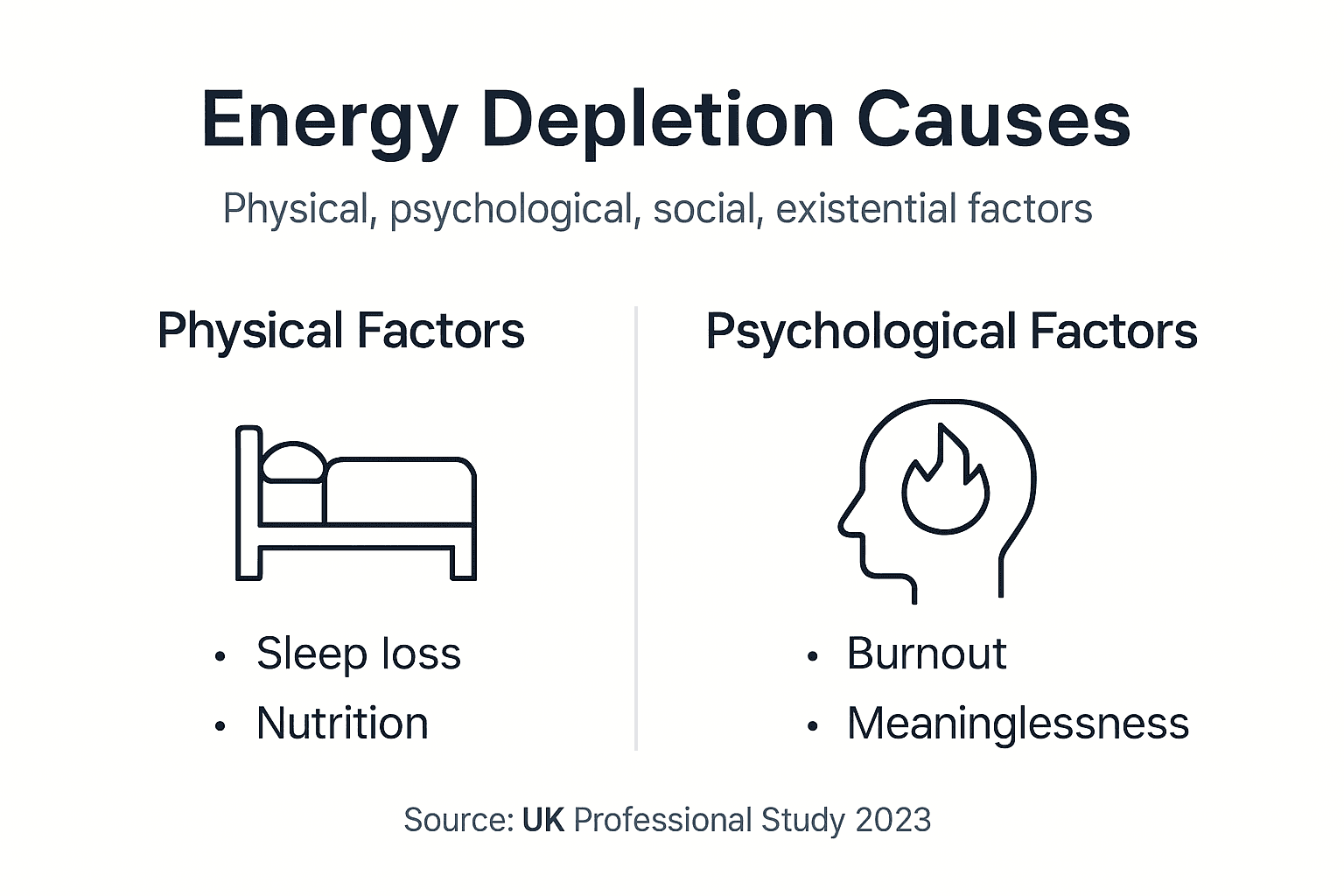
A biopsychosocial-philosophical framework integrates physical vitality, mental health, social pressures, and existential meaning into one comprehensive model. This approach recognizes that energy depletion rarely has a single cause. Your tiredness likely stems from interaction between inadequate sleep, workplace stress, social comparison, and feeling disconnected from meaningful purpose.
Comparison with simpler models shows enhanced explanatory power:
| Model | Focus | Limitations | Advantages |
|---|---|---|---|
| Physical-only | Sleep, nutrition, exercise | Ignores psychological and existential factors | Easy to measure and implement |
| Biopsychosocial | Biology, psychology, social context | Often overlooks meaning and purpose | Addresses multiple dimensions |
| Biopsychosocial-philosophical | Adds existential meaning | Requires deeper self-reflection | Comprehensive, addresses root causes |
This framework aids in identifying personalized energy depletion areas and guiding targeted recovery. You might discover that your fatigue stems primarily from existential disconnection rather than poor sleep, redirecting efforts appropriately. Integrative approaches yield better outcomes for chronic tiredness by addressing all contributing factors simultaneously.
Using mental models improves clarity and application in daily life:
- Map your energy across physical, psychological, social, and existential dimensions weekly
- Identify which dimension shows greatest depletion and prioritize interventions there
- Recognize that improvements in one area often cascade to others through systemic effects
- Adjust your framework based on life changes, as dominant depletion sources shift over time
- Share your model with close relationships to build supportive accountability
When you view energy holistically, quick fixes reveal their limitations. A weekend getaway might restore physical rest but leave existential fatigue untouched. Conversely, finding renewed purpose in work might energize you despite unchanged sleep patterns. The framework helps you diagnose accurately rather than applying generic solutions.
Practical Strategies: Applying Philosophical Insights to Restore Energy
Translating philosophical understanding into action requires concrete, sustainable steps tailored to busy professionals. Use cognitive behavioral therapy enhanced by philosophical reflection to reframe how you perceive energy and engagement. Instead of viewing tiredness as personal failure, recognize it as feedback about misalignment between activities and values.
Adopt lifestyle habits addressing social and technological drains:
- Schedule digital detoxes of at least two hours daily, creating genuine recovery periods
- Set realistic productivity goals aligned with sustainable energy rather than external pressure
- Establish firm work boundaries respecting your personal energy limits and recovery needs
- Practice mindful engagement with technology, questioning whether each use serves meaningful purpose
- Cultivate offline relationships and activities that restore rather than deplete vitality
Prioritize psychological wellbeing alongside physical rest for sustainable vitality. Boosting energy through mindset shifts often proves more powerful than purely physical interventions. When you reframe your relationship with productivity and worth, energy allocation changes fundamentally.
Improving sleep quality remains important but works best when combined with existential alignment. Sleep hygiene optimizes recovery, but only if daytime activities provide something worth recovering for. Similarly, daily mental health tips support overall wellbeing that underpins sustained energy.
Combine reflective practices with behavioral changes for empowerment and lasting results. Weekly journaling about what energized versus drained you builds awareness. Monthly reviews of whether your time allocation matches your stated values reveal misalignments before they cause burnout.
Pro Tip: Identify one activity weekly that genuinely energizes you and protect that time fiercely, treating it as non-negotiable as any work commitment.
Set achievable work boundaries by communicating your energy limits clearly to colleagues and managers. This isn’t weakness; it’s sustainable performance management. When you work within your genuine capacity rather than pushing through exhaustion, quality improves even as hours decrease.
Explore STOMART’s Curated Wellness and Lifestyle Essentials
STOMART offers expert guides and products to enhance wellness and support your energy restoration journey. Quality environment directly impacts personal vitality, from restful sleep solutions that optimize recovery to thoughtfully designed spaces that reduce daily friction.
Explore sleep aids, mental health tips, and smart tech accessories tailored to busy lifestyles seeking balance rather than mere productivity. Discover modern tech accessories that genuinely serve your needs without creating additional energy drains.
Visit related content for further empowerment in creating an environment that supports rather than depletes your vitality. Small changes in your surroundings often yield disproportionate improvements in daily energy levels.
FAQ
Why Do I Feel Tired Even After Sleeping Enough?
Sleep quality, not just duration, affects energy renewal significantly. Fragmented sleep or sleep during misaligned circadian rhythms provides inadequate restoration. Psychological and existential factors also influence tiredness despite sufficient sleep hours, as mental exhaustion operates independently of physical rest.
How Does Technology Specifically Drain My Energy?
Excessive screen time causes mental fatigue through constant cognitive switching between tasks and notifications. Digital connectivity blurs work-life boundaries, reducing restorative breaks by keeping you perpetually available. The cumulative effect depletes cognitive resources faster than physical activity.
What Are Some Simple Philosophical Practices to Help Restore Energy?
Mindful reflection on meaning and purpose replenishes existential energy by reconnecting daily activities with deeper values. Philosophical journaling or CBT-style reframing shifts exhaustion perspectives positively, helping you see tiredness as informative feedback rather than personal failure. Weekly reviews of value alignment create sustainable change.