

What Childhood Curiosity Reveals About Intelligence: 20% Boost
on Mar 02, 2026Children who engage their natural curiosity show up to 20% better memory recall than their less curious peers. This cognitive advantage isn’t coincidence. Curiosity activates specific brain regions that enhance learning, problem solving, and intelligence development. Parents and educators seeking to nurture smarter, more adaptable children need to understand how curiosity works at a neurological level and implement targeted strategies that fuel this innate drive to explore and understand the world.
Key Takeaways
| Point | Details |
|---|---|
| Brain activation | Curiosity engages hippocampus and prefrontal cortex, boosting memory and reasoning. |
| Curiosity types | Diversive and epistemic curiosity require different nurturing approaches for optimal development. |
| Executive function | Curious children develop superior working memory, cognitive flexibility, and inhibitory control. |
| Practical strategies | Open exploration, varied experiences, and tailored feedback sustain curiosity and intelligence growth. |
| Measurable outcomes | Validated tools track curiosity levels and predict academic engagement and creativity. |
Introduction to Childhood Curiosity and Intelligence
Curiosity represents an intrinsic motivation driving children to learn, explore, and seek new experiences. Intelligence encompasses cognitive abilities including memory, reasoning, problem solving, and adaptive thinking. These concepts intertwine fundamentally during childhood development, with curiosity acting as the engine powering intelligence growth.
When children ask questions, investigate objects, or pursue new knowledge, they activate neural networks essential for cognitive development. This activation strengthens connections between brain regions responsible for memory formation, executive function, and creative thinking. Parents and educators who understand this relationship can create environments that maximize cognitive potential.
Curiosity’s role extends beyond simple knowledge acquisition. It shapes how children approach challenges, process information, and develop problem solving strategies. Key developmental aspects include:
- Initiating active learning rather than passive absorption
- Building neural pathways through repeated exploration
- Enhancing retention through emotionally engaged discovery
- Developing metacognitive awareness of learning processes
Recognizing curiosity as a learnable skill rather than fixed trait empowers adults to deliberately cultivate this critical intelligence driver in children’s daily experiences.
Neuroscience Mechanisms Linking Curiosity to Intelligence
Brain imaging studies reveal that curiosity activates regions like the hippocampus and prefrontal cortex critical for learning, creating optimal conditions for intelligence development. The hippocampus handles memory encoding and retrieval, while the prefrontal cortex manages executive functions and decision making. When curiosity triggers these areas simultaneously, learning becomes dramatically more effective.
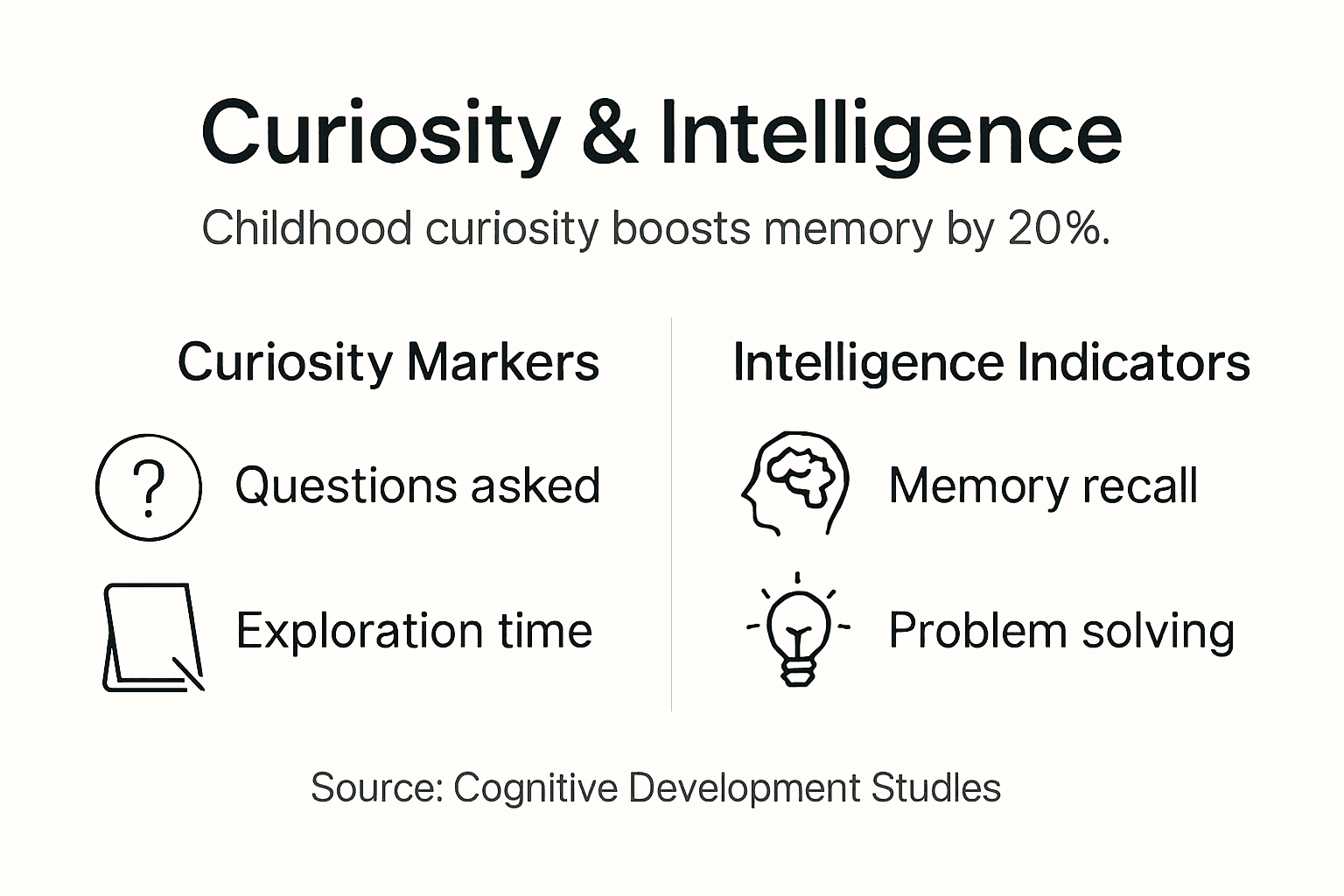
Research demonstrates curiosity enhances memory recall by up to 20% compared to passive learning states. This improvement stems from dopamine release during curious states, which primes the hippocampus to encode information more durably. Children experiencing high curiosity during learning show stronger neural responses and better long term retention.
The prefrontal cortex’s role becomes particularly significant when children encounter novel problems. Curiosity driven exploration activates working memory systems, allowing children to hold multiple concepts simultaneously while testing solutions. This mental juggling strengthens neural connections, building cognitive capacity over time. Studies tracking brain activity during curious states show increased synchronization between memory and reasoning centers, creating integrated networks that define fluid intelligence.
Curiosity boosts memory performance by 20%, transforming how children encode and retrieve information across learning contexts.

Neural plasticity research confirms these activation patterns become self reinforcing. As children exercise curiosity, their brains become more efficient at entering curious states, creating a positive feedback loop. This neurological adaptation explains why improving memory with curiosity yields cumulative benefits rather than isolated gains. The NIH study on curiosity and brain activity provides detailed imaging evidence supporting these mechanisms.
Impact of Curiosity on Executive Function and Creativity
Executive functions represent high level cognitive processes that regulate thoughts and actions. These include working memory, cognitive flexibility, and inhibitory control. Curious children demonstrate superior development across all three domains because curiosity inherently exercises these mental muscles.
Working memory allows children to manipulate information mentally while solving problems. When curiosity drives exploration, children naturally practice holding questions in mind while seeking answers, strengthening this capacity. Cognitive flexibility enables shifting between different concepts or perspectives. Curious children constantly adapt their thinking as new information emerges, making this skill second nature.
Inhibitory control helps children resist distractions and maintain focus on goals. Paradoxically, curiosity enhances this ability by making learning intrinsically rewarding. Children pursuing genuine interests require less external control because their motivation comes from within. Research shows curious children perform better on standardized executive function tests, demonstrating measurable cognitive advantages.
Creativity flourishes when children feel free to explore without predetermined outcomes. Curiosity fuels creative thinking by:
- Encouraging novel connections between disparate concepts
- Reducing fear of failure during experimentation
- Building mental libraries of diverse experiences to draw upon
- Promoting divergent thinking patterns
Pro Tip: Design activities requiring children to combine unexpected elements or solve problems with multiple solutions. These tasks simultaneously engage curiosity and build cognitive flexibility essential for intelligence and creativity.
Understanding curiosity’s role in executive functioning helps parents recognize how exploration time directly builds the mental architecture underlying academic success and adaptive intelligence.
Common Misconceptions About Curiosity and Intelligence
Many parents believe curiosity levels are fixed at birth, viewing some children as naturally curious while others aren’t. Research contradicts this assumption. Environmental factors significantly influence curiosity development, meaning adults can actively cultivate this trait through deliberate strategies and supportive contexts.
Another misconception suggests all curiosity equally benefits intelligence. Different curiosity types serve distinct developmental purposes and require tailored support approaches. Treating all exploratory behavior identically misses opportunities to maximize cognitive growth through targeted interventions.
Some educators assume more curiosity always produces better outcomes. Unguided curiosity can lead to scattered attention without deep learning. Effective curiosity nurturing balances freedom with structure, allowing exploration within frameworks that promote meaningful discovery rather than superficial novelty seeking.
Common false beliefs limiting curiosity development include:
- Curiosity distracts from structured learning goals
- Only academically gifted children benefit from curiosity cultivation
- Curiosity naturally fades as children mature and should be accepted
- Measuring curiosity is too subjective to guide interventions
Addressing myths about curiosity helps parents recognize their power to shape this critical intelligence driver. Environmental enrichment, responsive questioning, and permission to explore safely all demonstrably increase curiosity levels regardless of baseline temperament. Understanding these truths empowers adults to take active roles in cognitive development rather than passively accepting limitations.
Frameworks for Understanding Curiosity’s Multifaceted Role
Psychologists categorize curiosity into two primary types with different cognitive impacts. Diversive curiosity drives novelty seeking and broad exploration, while epistemic curiosity motivates deep knowledge acquisition about specific topics. Research shows epistemic curiosity correlates more strongly with academic achievement, with correlation coefficients around 0.55 compared to 0.30 for diversive curiosity.
| Curiosity Type | Characteristics | Intelligence Impact | Support Strategies |
|---|---|---|---|
| Diversive | Novelty seeking, broad interests, quick shifts | Builds general knowledge, creative connections | Provide varied experiences, encourage exploration |
| Epistemic | Deep investigation, sustained focus, knowledge depth | Develops expertise, critical thinking, mastery | Support deep dives, provide resources, scaffold inquiry |
Recognizing these types in children requires observing exploration patterns. Diversive curiosity manifests as jumping between topics, trying new activities frequently, and expressing interest in varied subjects. Epistemic curiosity shows through persistent questions about specific topics, repeated engagement with favored subjects, and dissatisfaction with surface level answers.
Both forms contribute to intelligence development but through different pathways. Diversive curiosity builds broad knowledge networks and creative thinking by exposing children to diverse concepts. Epistemic curiosity develops analytical skills and deep understanding by promoting sustained investigation.
Pro Tip: Balance both curiosity types in learning environments. Schedule time for open exploration alongside opportunities for deep focus on individual interests. This combination builds both breadth and depth of cognitive capability.
Frameworks from the study on curiosity types and cognition help parents and educators design interventions matching children’s natural tendencies while expanding their curiosity repertoire for comprehensive intelligence development.
Practical Strategies for Fostering Curiosity
Developing curiosity requires systematic approaches tailored to individual children and contexts. Follow these steps to create curiosity enhancing environments:
- Identify the child’s dominant curiosity type through observation
- Design spaces encouraging safe exploration and discovery
- Ask open ended questions that spark investigation rather than delivering answers
- Scaffold learning by providing just enough structure to prevent frustration
- Celebrate questions and curiosity driven behavior explicitly
Specific actions supporting curiosity development include:
- Modeling curious behavior by expressing your own questions and interests
- Creating curiosity supportive environments with accessible materials and organized spaces
- Allowing controlled risk taking during exploration to build confidence
- Providing diverse experiences across domains to broaden knowledge networks
- Using positive reinforcement to encourage curiosity through genuine enthusiasm
Feedback quality matters enormously. Respond to children’s discoveries with specific observations rather than generic praise. Instead of saying “good job,” try “I noticed you figured out how those gears connect.” This approach validates the exploration process while highlighting what made the investigation valuable.
Combine diversive and epistemic activities throughout the week. Monday might involve trying a new craft, while Tuesday allows deeper investigation of last week’s favorite topic. This rhythm prevents both scattered attention and narrow focus, building balanced cognitive capabilities.
Consistency matters more than intensity. Brief daily curiosity exercises outperform occasional intensive sessions because they establish exploration as a natural part of life rather than special events requiring unusual effort or resources.
Case Studies on Educational Interventions Boosting Curiosity
Global education programs demonstrate curiosity’s measurable impact on cognitive development. Schools implementing curiosity driven curricula report substantial gains in student engagement, creativity, and academic performance. Studies document up to 35% improvement in creativity scores after sustained curiosity focused interventions.
A Finnish primary school restructured its curriculum around student generated questions rather than predetermined lesson plans. Teachers facilitated investigations stemming from children’s curiosity, providing resources and guidance while allowing students to direct their learning paths. After two years, students showed significant gains in problem solving assessments and maintained higher engagement levels than traditionally taught peers.
Singaporean schools integrated curiosity metrics into student assessments, tracking question quality and investigation depth alongside content knowledge. This shift incentivized teachers to nurture curiosity actively rather than viewing it as supplementary to core learning. Results included improved critical thinking scores and stronger performance on novel problem types.
Key success factors across OECD case studies on curiosity include:
- Teacher training emphasizing curiosity facilitation techniques
- Flexible curricula allowing student directed exploration
- Assessment systems valuing inquiry processes alongside outcomes
- Physical environments designed for hands on investigation
- Community partnerships providing diverse real world learning contexts
These interventions prove curiosity cultivation produces concrete cognitive benefits across cultural contexts and educational systems. The consistency of results suggests underlying mechanisms operate universally, making these strategies broadly applicable for parents and educators seeking to enhance intelligence development through curiosity nurturing.
Measurement and Indicators of Curiosity in Childhood Development
Assessing curiosity provides insights for tailoring interventions and tracking developmental progress. The Curiosity and Exploration Inventory II (CEI II) offers validated measurement across age groups, quantifying both curiosity breadth and depth through behavioral observation and self report items adapted for children.
Research establishes strong correlations between curiosity scores and academic engagement, with coefficients ranging from 0.40 to 0.60 depending on age groups and curiosity dimensions measured. Higher curiosity ratings predict better classroom participation, homework completion, and voluntary learning activities outside school contexts.
Using measurements effectively requires regular assessment intervals to detect trends rather than relying on single snapshots. Quarterly evaluations reveal whether interventions successfully increase curiosity or need adjustment. Compare scores against the child’s baseline rather than external norms, focusing on individual growth trajectories.
| Indicator Category | High Curiosity Signs | Low Curiosity Signs |
|---|---|---|
| Question Behavior | Frequent why/how questions, seeks explanations | Rare questions, accepts surface answers |
| Exploration Patterns | Independently investigates, tries new approaches | Waits for direction, repeats familiar activities |
| Attention Duration | Sustains focus when interested, resists distraction | Brief engagement, easily diverted |
| Response to Novelty | Approaches new situations eagerly | Avoids unfamiliar contexts, prefers routine |
Behavioral indicators supplement formal assessments:
- Frequency of spontaneous questions during conversations
- Time spent in self directed exploration versus passive entertainment
- Variety of topics or activities pursued over weekly periods
- Persistence when encountering challenging problems
Tracking these markers helps parents recognize curiosity fluctuations and identify environmental factors supporting or hindering development. Adjusting strategies based on measurement data creates responsive interventions maximizing each child’s cognitive growth potential through curiosity cultivation.
Explore Tools to Create Curiosity Enhancing Environments
Transforming knowledge into action requires practical resources supporting curiosity development at home and school. Organized learning spaces promote exploration by making materials accessible while minimizing clutter that overwhelms rather than inspires. Creative storage solutions enable children to independently access and return items, building ownership of their learning environment.
Technology serves curiosity when used intentionally. Tech accessories for students like quality headphones enable focused research, while tablets with educational apps provide interactive exploration opportunities. Balance screen time with hands on activities to engage multiple learning modalities.
Curiosity flourishes through diverse experiences beyond formal education. Explore affordable kids activities that stimulate investigation without significant investment. Nature walks, library visits, and community events expose children to varied contexts sparking new interests and questions.
What Childhood Curiosity Reveals About Human Intelligence: FAQ
What types of curiosity should I encourage?
Both diversive and epistemic curiosity contribute to intelligence development. Diversive curiosity builds broad knowledge and creativity through varied exploration, while epistemic curiosity develops deep understanding and analytical skills. Balance both types by providing time for open ended discovery alongside opportunities to investigate specific interests thoroughly.
How do I know if my child’s curiosity is developing well?
Observe question frequency, exploration duration, and response to novelty. Children with healthy curiosity ask frequent why and how questions, sustain attention on interesting topics, and approach new situations eagerly rather than avoiding them. Track these behaviors over time to identify positive trends or areas needing support.
Can curiosity be measured reliably in young children?
Validated tools like the Curiosity and Exploration Inventory II provide reliable assessment across age groups. Combine formal measurements with behavioral observation tracking question patterns, exploration variety, and attention duration. Regular assessment reveals developmental trends and guides intervention adjustments for maximum effectiveness.
What daily habits support long term cognitive growth through curiosity?
Model curious behavior by expressing your own questions and investigations. Create accessible learning spaces with organized materials children can explore independently. Ask open ended questions encouraging investigation rather than providing immediate answers. Celebrate curiosity driven discoveries with specific feedback highlighting valuable aspects of their exploration process.
Does curiosity naturally decline as children age?
Curiosity levels depend heavily on environmental support rather than inevitable developmental patterns. Children maintain or increase curiosity when adults nurture this trait through responsive questioning, exploration opportunities, and validation of investigative behavior. Apparent declines typically reflect environmental constraints rather than natural maturation, making adult intervention critical for sustaining curiosity through adolescence.
How quickly can curiosity interventions improve intelligence markers?
Measurable improvements appear within weeks for motivation and engagement, while cognitive capacity gains require sustained effort over months. Memory and problem solving enhancements become evident after consistent curiosity practice for 8 to 12 weeks. Long term intelligence development requires ongoing support, with cumulative benefits increasing over years of curiosity cultivation.