

How noise pollution damages your mind and body health
on Apr 10, 2026TL;DR:
- Chronic low-level noise exposure increases risks of heart disease, hypertension, and premature death.
- Noise disrupts sleep, cognition, and attention, especially in vulnerable groups like children and the elderly.
- Practical measures like insulating windows and using sleep accessories can significantly reduce household noise health impacts.
Noise pollution is quietly taking years off your life, and the damage starts well below the levels most people consider dangerous. Long-term noise exposure contributes to heart disease, premature death, and millions of healthy life years lost across Europe alone. Yet most of us brush off the hum of traffic, the drone of appliances, and the constant background chatter of urban living as a minor inconvenience. This article breaks down the science behind noise pollution, explains exactly how it harms your body and brain, and gives you practical steps to protect yourself and your household.
Key Takeaways
| Point | Details |
|---|---|
| Moderate noise is harmful | Even everyday noise levels below traditional thresholds can affect physical and mental health. |
| Chronic exposure raises risk | Long-term noise increases stress, cardiovascular disease, and impairs cognitive function. |
| Vulnerable populations suffer more | Children, elderly, and urban poor face amplified threats and learning difficulties. |
| Nighttime noise disrupts sleep | Noise during sleep raises blood pressure and damages health, even if you do not wake up. |
| Simple solutions can help | Mitigating noise at home and work reduces risk and improves wellbeing. |
Understanding noise pollution and its thresholds
Noise pollution is not simply about loudness. It is any unwanted or harmful sound that disrupts normal activity, rest, or health. Sound is measured in decibels (dB), but environmental health experts also use two specialist metrics: Lden (day-evening-night level) and Lnight (night-only level). These averages capture long-term exposure more accurately than a single peak reading, because it is sustained exposure that does the real damage.
The WHO recommends limits of 55 dB(A) Lden for daytime and 50 dB(A) Lnight for nighttime to protect health. To put that in perspective, a quiet conversation sits around 50 dB, and a busy road can easily reach 70 dB or more. The troubling reality is that many urban residents are exposed to levels above these thresholds every single day.
What makes this especially concerning is dose-dependency. It is not just the volume that matters; it is the pattern. Intermittent noise, such as a lorry passing every few minutes, can be more physiologically disruptive than a steady background hum, because each spike triggers a fresh stress response. Your body never fully settles.
Common sources of harmful noise include:
- Urban traffic: Roads, motorways, and flight paths are the leading contributors to environmental noise in the UK.
- Workplace noise: Open-plan offices, construction sites, and industrial settings all create chronic low-level or high-level exposure.
- Home appliances: Washing machines, extractor fans, and older boilers contribute more than most people realise. Learning about noise reduction in urban homes can help you identify the worst offenders.
- Neighbourhood noise: Music, parties, and even shared walls in flats create unpredictable spikes.
Key fact: Noise levels that feel merely annoying can still trigger measurable biological stress responses, even when you consciously tune them out.
If you are already thinking about how to create a noise reduction peaceful home, understanding these thresholds is the essential first step. Knowing your baseline exposure helps you prioritise which changes will have the greatest impact on your health.
Physical health impacts: stress and cardiometabolic risk
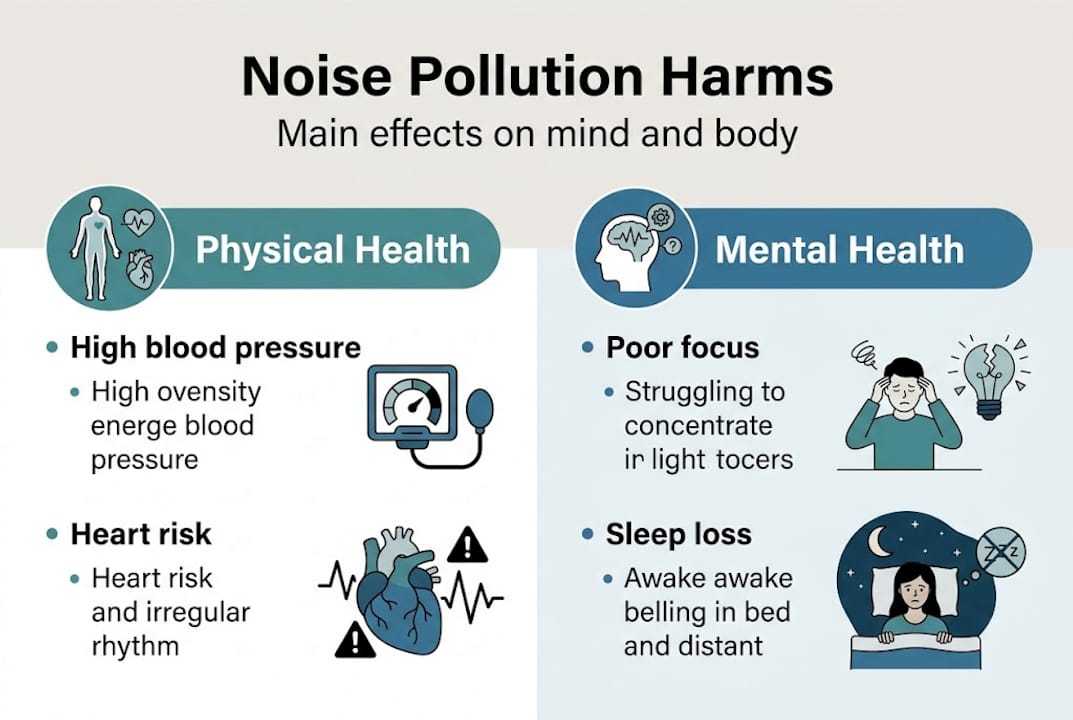
Once we know what noise pollution is and how its effects begin, we can explore the physical health risks lurking behind chronic exposure. The mechanisms are surprisingly direct. Noise activates the hypothalamic-pituitary-adrenal axis and the sympathetic-adrenal-medullary axis, which are the two primary stress pathways in your body. In plain terms, your brain treats unwanted noise as a threat, flooding your system with cortisol and adrenaline even when you are sitting still.
Over time, this chronic activation leads to inflammation, oxidative stress, and damage to blood vessels. The effects are not subtle. Road traffic noise significantly increases the risk of hypertension, atrial fibrillation, and ischaemic heart disease. These are not rare outcomes; they are measurable population-level risks.
| Health outcome | Associated noise level | Risk increase |
|---|---|---|
| Hypertension | Above 60 dB Lden | Up to 34% higher risk |
| Atrial fibrillation | Chronic road traffic noise | Statistically significant |
| Heart disease mortality | Long-term urban exposure | Elevated in multiple studies |
| Premature death | Combined daytime and night noise | Millions of life years lost |
Both daytime and nighttime exposure accumulate. You might think that eight hours of sleep cancels out the day’s noise burden, but nighttime traffic noise continues to stress the cardiovascular system even while you rest. The cumulative cardiometabolic burden builds silently over months and years.
Here is a practical approach to identifying your main noise culprits at home and work:
- Walk through each room and note which sounds you hear constantly versus intermittently.
- Identify appliances that run loudly or for long periods. Choosing energy-saving appliances often means quieter motors as well.
- Check windows and doors for gaps that let in traffic noise.
- Consider whether compact multi-function appliances could replace several noisy single-use devices.
- Record your observations over a week to spot patterns.
Pro Tip: A free smartphone decibel metre app can give you a rough sense of your home’s average noise level. Anything consistently above 50 dB in your bedroom warrants action.
How noise disrupts thought, attention, and memory
Physical effects are just part of the picture. Noise also chips away at your thinking and productivity in ways that are easy to overlook precisely because they feel so ordinary. You assume you are just tired or distracted, when in fact your cognitive performance is being steadily eroded.
Research shows that noise impairs cognitive performance with a standardised mean difference of -0.544 in children and adolescents, a substantial effect. In adults, occupational studies link cumulative noise exposure to lower scores on memory and executive function tests. These are not trivial differences; they translate to real-world difficulties with concentration, decision-making, and learning.
The mechanisms go beyond simple distraction. Non-auditory pathways, including neuroinflammation and alterations to the gut-brain axis, appear to play a role in how noise degrades cognitive function. In other words, your gut and your immune system are involved, not just your ears.
Vulnerable groups face the greatest burden:
- Children in noisy schools or homes show measurable delays in reading, memory, and IQ development.
- Elderly individuals experience accelerated cognitive decline with sustained noise exposure.
- Urban residents on low incomes often lack the option to move away from high-traffic areas, compounding existing health inequalities.
- People with anxiety or high noise sensitivity experience amplified cognitive disruption even at moderate levels.
Working memory, the mental workspace you use to hold and manipulate information, is particularly vulnerable. Even moderate background noise at around 65 dB can impair your ability to follow complex instructions or retain new information. Emerging noise policy consensus increasingly recognises cognitive harm as a public health priority, not just an inconvenience.
Pro Tip: If you work from home, even a basic white noise machine or well-placed bookshelf can significantly reduce the cognitive load from intermittent background sounds. Exploring home gadgets for families is a good starting point for practical solutions.
Sleep disturbance: the silent threat of nighttime noise
Beyond waking hours, the effects continue. Nighttime noise is arguably the most insidious form of noise pollution because the harm occurs while you are unconscious and entirely unable to protect yourself.

Nighttime noise raises blood pressure without waking you, disrupts sleep architecture, and is particularly harmful to children, the elderly, and those with existing cardiovascular conditions. Your body does not simply ignore sound during sleep; it processes it and responds physiologically, even when your conscious mind is unaware.
The most at-risk groups include:
- Children, whose developing nervous systems are especially reactive to nocturnal noise spikes.
- Elderly individuals, who spend more time in lighter sleep stages and are more easily disturbed.
- People with hypertension, for whom even small blood pressure elevations during sleep carry meaningful risk.
- Shift workers, who must sleep during noisier daytime hours.
Here are five practical steps to reduce nighttime noise exposure:
- Invest in heavy curtains or acoustic blinds to dampen external traffic noise.
- Use a white noise machine or a fan to mask unpredictable sound spikes.
- Seal gaps around windows and doors with draught-excluding strips.
- Explore top sleep accessories designed specifically to improve rest quality.
- Consider sleep accessories for a better rest such as quality earplugs or contoured ear cushions.
Your bedroom environment matters enormously. The best bedroom accessories for better sleep include items that address both light and sound. An eye mask for sleep quality combined with sound-dampening measures can make a measurable difference to how deeply you sleep. For a broader look at what works, solutions for a restful night’s sleep covers a range of approaches suited to different living situations.
What most guides miss about noise pollution
Most articles on noise pollution focus on dramatic examples: construction sites, airport flight paths, or nightclub districts. That framing misses the point entirely. The real risk lies in chronic, low-level exposure that sits just below the threshold of conscious annoyance. The noise you have learned to ignore is often the noise doing the most damage.
Policy frameworks still tend to concentrate on peak volumes and industrial settings, largely overlooking the cognitive and cardiometabolic harms that accumulate from moderate everyday noise. Individual sensitivity is also routinely ignored. Two people in the same flat, exposed to identical traffic noise, can have very different physiological responses depending on their stress baseline, sleep quality, and neurological sensitivity.
The practical lesson here is that personal awareness matters as much as policy. You do not need to live near a motorway to be at risk. Audit your own environment, starting with your bedroom and your most-used workspaces. Small changes, such as rearranging furniture, choosing quieter appliances, or adding soft furnishings, can meaningfully reduce your daily noise dose. Exploring noise reduction strategies for urban homes is a concrete place to start, regardless of where you live.
Protect your home and health from everyday noise
Now you know the risks and the science, the good news is that reducing your noise exposure does not require a house move or expensive renovation. At Stomart, you will find a carefully curated range of products designed to help you create a calmer, healthier home environment. From sleep accessories and white noise solutions to quieter appliances and soft furnishings that absorb sound, the right products can make an immediate difference. Protecting your hearing, your sleep, and your cognitive health is not a luxury; it is a practical investment in your long-term wellbeing. Browse the full range and take the first step towards a quieter, healthier home today.
Frequently asked questions
How loud does noise have to be to cause health problems?
Noise levels as low as 50 dB can raise health risks, particularly with repeated or sustained exposure, well below the levels most people associate with harm.
Can noise pollution affect children’s learning?
Yes, research shows that noise impairs cognitive performance in children and adolescents, affecting memory, attention, and IQ even when hearing is entirely normal.
Does nighttime noise disrupt sleep even if you do not wake up?
Nighttime noise raises blood pressure and disrupts sleep architecture without waking you, with the greatest effects seen in children and elderly individuals.
Is individual sensitivity to noise a real factor?
Absolutely. People with higher noise sensitivity or elevated stress baselines experience amplified physiological risks from noise levels that others might barely notice.
Can modern appliances or accessories help reduce noise pollution at home?
Yes, quieter appliances and well-chosen sleep accessories can meaningfully reduce your daily noise dose and support better physical and cognitive health over time.