

Understand mental pollution: protect your mind from modern overload
on Apr 04, 2026TL;DR:
- Mental pollution results from environmental and digital stressors eroding attention, memory, and empathy.
- Physical pollutants and digital overload cause neuroinflammation, stress, and cognitive fragmentation.
- Systemic changes and practical interventions can help restore mental clarity and protect well-being.
Mental pollution is quietly reshaping how millions of people think, feel, and connect. Most of us assume cognitive struggles like poor concentration, emotional numbness, or persistent anxiety are personal failings. Yet mental pollution is a recognised consequence of modern digital and environmental overload, not a character flaw. Both the air we breathe and the screens we stare at are actively eroding our cognitive ecology. This article explores what mental pollution actually is, how physical and digital sources drive it, and what practical steps you can take to restore clarity and protect your mental wellbeing.
Key Takeaways
| Point | Details |
|---|---|
| Dual sources of pollution | Mental pollution stems from both environmental toxins and digital overload, disrupting cognitive health. |
| Societal impact | These stressors hinder empathy, attention, and collective wellbeing across populations. |
| Practical interventions | Nature exposure, digital detox, and sleep hygiene help restore mental ecology and resilience. |
| Systemic roots | Mental pollution is rooted in systemic issues, requiring collective action—beyond individual solutions. |
Mapping the modern mind’s ecology: what is mental pollution?
Mental pollution is not a metaphor. It is a measurable phenomenon. At its core, mental pollution is the accumulation of negative thoughts, information overload, and modern stressors that erode attention, memory, empathy, and executive function over time. Think of it like sediment building up in a river: individually, each piece seems harmless, but collectively they block the flow.
There are two distinct sources feeding this build-up. Modern mental pollution arises from dual sources: physical pollutants that damage the brain through biological pathways, and informational or digital overload that fragments cognition through constant interruption and stimulation.
“Cognitive ecology is not just about what we think, but the environment in which thinking happens. Pollute that environment, and the mind suffers accordingly.”
Here is a quick comparison of the two primary sources:
| Source | Examples | Core cognitive impact |
|---|---|---|
| Physical pollution | Air particulates, noise, chemicals | Memory loss, depression, anxiety |
| Digital/informational pollution | Social media, notifications, news cycles | Fragmented attention, reduced empathy |
The effects are not abstract. People experiencing mental pollution often report:
- Difficulty sustaining focus on a single task
- Emotional blunting or reduced capacity for empathy
- Persistent low-level anxiety without a clear cause
- Impaired short-term memory and decision fatigue
Crucially, mental pollution is not a personal failing. It is a systemic product of the environments we inhabit and the technologies we use. Recognising this distinction is the first step towards addressing it meaningfully.
Physical environmental pollution and its effects on the mind
The link between the air outside your window and the quality of your thoughts is more direct than most people realise. Physical environmental pollutants, particularly fine particulate matter (PM2.5) and nitrogen dioxide (NO2), do not just damage the lungs. PM2.5, NO2, and noise pollution are associated with depression, anxiety, and cognitive decline through inflammation, oxidative stress, and disruption of the HPA axis, the body’s central stress response system.

The numbers are striking. Noise pollution is linked to a 0.41-point drop in cognitive scores per unit increase, according to the CHARLS study, while air pollution independently raises the risk of depression. These are not trivial effects. They compound over years of exposure.
The mechanisms work like this:
- Inflammation: Airborne pollutants trigger neuroinflammation, impairing neural communication
- Oxidative stress: Free radicals from pollution damage brain cells directly
- HPA axis disruption: Chronic noise and chemical exposure elevate cortisol, keeping the brain in a low-grade stress state
- Sleep disruption: Noise and poor air quality reduce sleep quality, compounding cognitive damage
Vulnerable groups, including children, the elderly, and those in lower-income urban areas, suffer disproportionately. Their exposure is often higher and their resources for mitigation are lower.
The good news is that practical interventions exist at the household level. Bringing indoor plants for air purification into your living space can meaningfully reduce indoor pollutants. The health benefits of house plants extend well beyond aesthetics, with several species shown to absorb volatile organic compounds. For more immediate impact, affordable air purifiers fitted with HEPA filters can significantly reduce PM2.5 levels indoors.
Pro Tip: If you live near a busy road, keep windows closed during peak traffic hours and use an air purifier in your bedroom overnight. This is when your brain consolidates memory and repairs itself, making clean air especially valuable.
Addressing calming racing thoughts is also easier when your physical environment supports recovery rather than adding to the load.
Digital overload, information fragmentation, and modern cognitive crises
While environmental pollution is a major factor, digital overload deserves equal scrutiny for its mounting role in mental pollution. We are living through an unprecedented experiment in sustained cognitive fragmentation, and the results are not encouraging.
Continuous Partial Attention Disorder (CPAD) describes a state in which constant connectivity prevents the brain from ever fully focusing on a single task. It is not laziness. It is a neurological response to relentless interruption. Digital overload causes cognitive fragmentation disorders like CPAD, with 36.4% of clinical records showing symptoms in digitally overloaded populations. That is more than one in three people.
The broader picture is even more concerning. Systemic overload erodes cognitive capacities population-wide, creating what researchers describe as civilisational cognitive decline, a collective narrowing of our capacity for sustained thought, empathy, and democratic engagement.
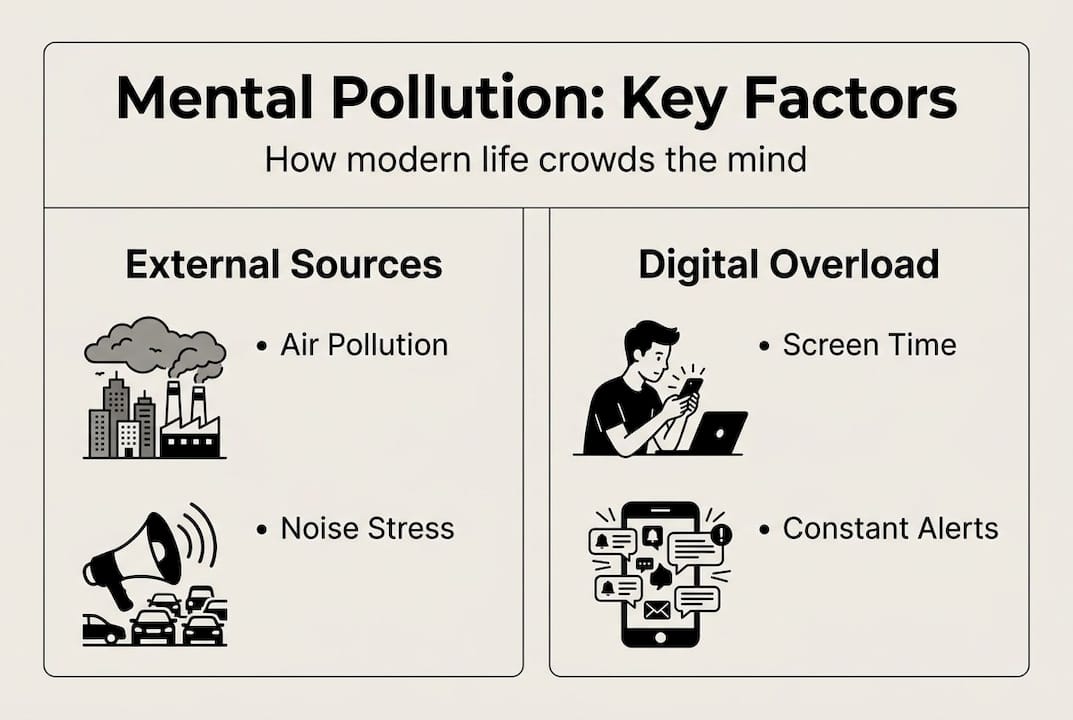
Digital platforms are not neutral tools. They are engineered for attention capture, using variable reward loops, endless scrolling, and algorithmic amplification of emotionally charged content. This is not accidental design. It is intentional.
Here are the key stressors driving digital mental pollution:
- Notification overload: Constant interruptions prevent deep work and elevate cortisol
- Doomscrolling: Prolonged exposure to negative news cycles amplifies anxiety
- Social comparison: Curated social media feeds distort self-perception and reduce wellbeing
- Multitasking pressure: Switching between tasks reduces efficiency by up to 40%
- Bandwidth poverty: Those with less digital literacy or access suffer compounded cognitive strain
“The attention economy does not just compete for your time. It actively restructures how your brain processes the world.”
Strategies to avoid digital overload are not about abandoning technology. They are about reclaiming intentional use. Equally, learning to reduce stress and relaxation techniques into your daily routine can help buffer the cognitive impact of digital noise.
Pro Tip: Set a hard boundary of no screens for the first 30 minutes after waking. This protects the brain’s natural transition from restorative sleep to alert wakefulness, a window that digital input disrupts significantly. Pair this with brain-boosting food choices to further support cognitive resilience.
Interventions: restoring the mind’s ecology with practical strategies
Understanding the causes of mental pollution naturally leads to exploring what can be done to counteract its effects. The evidence points clearly towards a combination of environmental, behavioural, and social interventions.
Reducing pollution exposure delivers co-benefits for both physical and mental health. Digital detox routines and nature exposure restore prefrontal cortex function, the part of the brain responsible for decision-making, emotional regulation, and sustained attention. Addressing social inequality also matters: bandwidth poverty amplifies the effects of mental pollution for vulnerable groups.
Restorative green spaces mitigate mental pollution through measurable prefrontal cortex changes. Even 20 minutes in a park or garden has been shown to reduce cortisol and improve attentional capacity.
Here is a practical summary of evidence-backed interventions:
- Nature exposure: Spend at least 20 minutes outdoors in green spaces daily
- Digital boundaries: Use app timers, notification silencing, and device-free zones at home
- Air quality management: Introduce plants and air purifiers to reduce indoor pollutants
- Sleep protection: Prioritise consistent sleep schedules and reduce screen use before bed
- Social connection: Genuine face-to-face interaction rebuilds empathy and reduces cognitive isolation
| Strategy | Mechanism | Ease of implementation |
|---|---|---|
| Nature walks | Prefrontal cortex restoration | Easy |
| Air purifiers | Reduces PM2.5 indoors | Easy |
| Digital detox | Reduces CPAD symptoms | Moderate |
| Sleep hygiene | Consolidates memory, reduces cortisol | Moderate |
| Social equity advocacy | Reduces bandwidth poverty | Systemic |
For sleep, the evidence is especially compelling. Protecting sleep quality is one of the most powerful interventions available. Explore sleep accessories that support deeper rest, practical solutions for restful sleep, and the fundamentals of sleep hygiene to build a nightly recovery routine.
Pro Tip: Combine two interventions at once. A short walk in a green space without your phone addresses both digital overload and nature deficit simultaneously, doubling the restorative effect on your prefrontal cortex.
A fresh perspective: the systemic roots of mental pollution
Most articles on mental pollution stop at personal responsibility. Meditate more. Use your phone less. Eat better. These are useful suggestions, but they miss the larger picture entirely.
Mental pollution is not primarily a personal problem. It is a systemic issue rooted in engineered environments, profit-driven digital platforms, and structural inequalities that determine who bears the greatest cognitive burden. Framing it as a personal failing is not just inaccurate. It is convenient for the systems that profit from your distraction.
Digital overload is not accidental. Platforms are deliberately designed to maximise engagement through neurological exploitation. The attention economy is not a side effect of technology. It is the business model. Recognising this changes how you approach solutions. Personal habits matter, but they are fighting against intentional design.
The One Health framework connects human wellbeing with environmental health, arguing that you cannot separate the two. Clean air, equitable access to green spaces, and fair digital environments are not luxuries. They are cognitive infrastructure. Strategies to avoid digital overload are a start, but systemic advocacy, supporting policies that reduce urban pollution, regulate attention-harvesting platforms, and address bandwidth poverty, is where lasting change begins.
Take action: create a healthier mind and environment
Reading about mental pollution is one thing. Acting on it is another. At Stomart, you will find a carefully curated range of home and wellness products designed to support a cleaner, calmer living environment. From air purifiers and indoor plants to sleep accessories and relaxation tools, the practical solutions are already within reach. Browse the blog for evidence-backed guidance, including detailed tips on how to reduce stress and boost relaxation at home. Your cognitive environment is worth investing in, and small, consistent changes to your surroundings can produce meaningful improvements in mental clarity, focus, and emotional resilience over time.
Frequently asked questions
What is mental pollution?
Mental pollution is the accumulation of negative thoughts, information overload, and environmental stressors that erode attention, memory, and empathy over time. It is a systemic condition shaped by modern environments, not a personal weakness.
How does air pollution affect mental health?
Air pollution increases the risk of depression, anxiety, and cognitive decline by triggering neuroinflammation, oxidative stress, and HPA axis disruption in the brain. Long-term exposure compounds these effects significantly.
What is continuous partial attention disorder (CPAD)?
CPAD is a condition resulting from digital overload, leading to fragmented attention and reduced cognitive function. 36.4% of clinical records show symptoms in digitally overloaded populations, making it far more common than most people realise.
How can nature exposure help mental health?
Nature exposure restores prefrontal cortex function, reducing cortisol and improving attention capacity, directly counteracting the cognitive erosion caused by mental pollution.
What role does social inequality play in mental pollution?
Social inequality worsens bandwidth poverty, meaning vulnerable groups suffer more from mental pollution’s cognitive effects due to higher exposure and fewer resources for mitigation.
Recommended
- Master attention in the digital age: focus and balance - STOMART.CO.UK
- How environmental harm reflects our inner disconnection - STOMART.CO.UK
- How nature heals the mind with science still catching up - STOMART.CO.UK
- Easy Ways to Boost Your Mental Health Daily - STOMART.CO.UK
- How to Calm Racing Thoughts — The Caia Journal