

Master the forgotten human skill of observation in 2026
on Mar 15, 2026Most people believe they observe the world around them, yet research reveals we often mistake passive seeing for active observation. This fundamental human skill, frequently overlooked in our distracted age, holds transformative power for personal growth, mindfulness, and communication. When you truly observe rather than simply look, you unlock deeper awareness of your environment, sharpen creative thinking, and forge stronger connections with others. The difference between seeing and observing lies in intentional engagement with sensory information, a distinction that shapes everything from professional success to everyday interactions. This article explores what genuine observation entails, why it matters more than ever, and how you can systematically develop this essential capability through evidence-backed techniques.
Key takeaways
| Point | Details |
|---|---|
| Observation is active | It requires intentional attention and cognitive interpretation, not just passive seeing. |
| Science supports benefits | Research shows observation training improves diagnostic abilities, teamwork quality, and communication effectiveness. |
| Mindfulness connection | Engaging senses fully with surroundings cultivates present-moment awareness and emotional regulation. |
| Practical exercises work | Deliberate sensory focus activities strengthen observation skills within weeks of consistent practice. |
| Professional applications | Enhanced observation improves problem-solving, collaboration, and interpersonal understanding across all fields. |
Understanding observation: more than seeing
Observation transcends the simple act of looking at something. You might glance at a busy street corner and register movement, yet miss the nuanced interactions, emotional expressions, and environmental details that tell the fuller story. True observation demands active engagement, where you deliberately direct attention towards specific stimuli and interpret what your senses capture. This process involves perception blending sensory evidence with attention, memory, expectations, and goals to construct your conscious experience. Without this active interpretation, you merely collect visual data without extracting meaning or context.
Your brain employs two complementary pathways to process sensory information. Bottom-up processing starts with stimulus features like edges, contrasts, and frequencies, building toward objects and categories, whilst top-down processing uses prior knowledge, context, and task goals to interpret ambiguous input. These mechanisms work simultaneously, creating a dynamic interplay where raw sensory data meets learned patterns and expectations. When you observe a familiar face in a crowd, bottom-up processing registers facial features whilst top-down processing matches these against stored memories, enabling instant recognition.
Attention serves as the gatekeeper for observation, filtering the overwhelming flood of sensory information competing for your awareness. You cannot observe everything simultaneously, so your attentional systems prioritise certain stimuli based on relevance, novelty, or emotional significance. This selective focus explains why two people witnessing the same event may report vastly different observations. Developing stronger observation skills means training both your sensory acuity and cognitive interpretation abilities, creating a feedback loop where enhanced attention improves perception, which in turn refines how you direct future attention.
The distinction between passive seeing and active observing becomes clearer when you consider how easily we miss details in familiar environments. Your daily commute likely contains countless elements you’ve never consciously registered because habitual pathways reduce the need for active observation. Breaking this autopilot mode requires deliberate effort to engage sensory and cognitive resources fully. Strengthening observation involves practising mastering attention and focus, creating mental habits that prioritise present-moment awareness over distracted scanning.
The science of observation: evidence from research
Scientific investigation validates observation as a learnable, measurable skill with tangible outcomes. Researchers employ observational methods to describe human behaviour in natural settings without manipulating variables, establishing baseline understanding of how people interact, communicate, and respond to environmental stimuli. This methodological foundation enables objective assessment of observation quality, moving beyond subjective impressions to quantifiable metrics. Studies across disciplines demonstrate that structured observation protocols yield more accurate, comprehensive data than casual watching.
Training programmes designed to enhance observation produce measurable improvements in professional contexts. Clinical research shows structured observation training led to significant increases in diagnostic abilities, proving the skill responds to deliberate practice. Healthcare professionals who completed observation-focused modules demonstrated superior pattern recognition, more accurate patient assessments, and enhanced ability to detect subtle clinical signs. These findings extend beyond medical settings, suggesting observation training benefits anyone requiring detailed environmental awareness or interpersonal sensitivity.
Physiological measures provide objective evidence linking observation to performance outcomes. Recent nursing simulation studies found eye movement metrics predict teamwork quality, communication effectiveness, and self-efficacy, establishing quantifiable relationships between observational patterns and collaborative success. Participants with more systematic visual scanning strategies, characterised by deliberate gaze transitions and focused attention periods, achieved better team coordination and communication clarity. This research reveals how observation operates at both conscious and unconscious levels, with measurable physiological signatures.
| Research Area | Key Finding | Practical Implication |
|---|---|---|
| Natural behaviour studies | Structured observation captures unbiased behavioural data | Systematic approaches yield more accurate insights than casual watching |
| Clinical training | Observation programmes improve diagnostic accuracy significantly | Deliberate practice enhances professional observation skills |
| Eye tracking research | Visual scanning patterns correlate with teamwork and communication quality | Training observation improves collaborative performance |
| Cognitive processing | Attention and prior knowledge shape what we observe | Understanding mental mechanisms enables targeted skill development |
These empirical findings demonstrate observation’s importance extends far beyond academic interest. Whether you’re assessing situations in retail environments like choosing the perfect clothing store or navigating complex social interactions, enhanced observation translates to better decision-making and outcomes. The measurability of observation skills means you can track your own progress through deliberate practice, using feedback to refine techniques and identify areas needing improvement.
Pro Tip: Keep a daily observation journal where you record three previously unnoticed details from familiar environments. This simple practice creates accountability whilst building awareness of your observational blind spots, accelerating skill development through consistent reflection.
Benefits of improving your observational skills
Sharpening your observation abilities creates cascading advantages across personal and professional domains. Enhanced observation increases awareness, improves memory and creativity, and deepens connection with the world, fundamentally transforming how you engage with daily experiences. When you observe more carefully, you notice patterns others miss, remember details that prove valuable later, and generate creative insights by connecting disparate observations. This heightened awareness extends beyond visual perception to encompass all sensory modalities, enriching your experiential landscape.
Memory retention improves dramatically when you observe actively rather than passively consume information. Your brain encodes observed details more deeply when attention focuses deliberately on specific elements, creating stronger neural pathways for later retrieval. This enhanced encoding explains why people with developed observation skills demonstrate superior recall for environmental details, conversations, and experiential nuances. The relationship works bidirectionally, as improved memory also strengthens future observation by providing richer contextual frameworks for interpreting new information.

Mindfulness practices and observation skills share fundamental mechanisms. Observation encourages mindfulness by engaging the senses fully with the environment, anchoring awareness in present-moment experience rather than abstract thought or future concerns. When you commit to observing your surroundings thoroughly, you naturally cultivate the non-judgemental awareness central to mindfulness traditions. This convergence explains why observation exercises often produce meditation-like benefits, including reduced stress, enhanced emotional regulation, and increased life satisfaction. Integrating observation into daily routines creates accessible mindfulness opportunities without requiring formal meditation sessions.
Interpersonal communication gains depth and effectiveness when you observe others carefully. Noticing subtle facial expressions, body language shifts, and vocal tone variations provides crucial context for understanding true meaning behind words. These non-verbal cues often convey more information than explicit statements, yet many people miss them entirely through inattentive listening. Developing observation skills transforms you into a more empathetic, responsive communicator who picks up on unspoken needs and emotional states. This sensitivity strengthens relationships, builds trust, and enables more authentic connections across personal and professional contexts.
Creative thinking flourishes when observation feeds your mental repository with diverse, detailed inputs. Artists, writers, and innovators consistently cite careful observation as essential to their creative processes, providing raw material for imagination to recombine in novel ways. You cannot create connections between ideas you haven’t observed, making enhanced observation a prerequisite for creative breakthroughs. The practice also trains cognitive flexibility, as interpreting observations from multiple perspectives builds mental agility applicable to problem-solving across domains. Whether pursuing creative hobbies or seeking innovative solutions at work, stronger observation unlocks generative potential.
Pro Tip: Practise observing familiar people during conversations without judgement, noting micro-expressions and gesture patterns. This builds empathy whilst revealing how much communication happens beyond words, enhancing your ability to connect authentically.
Practical exercises to sharpen your observation skills
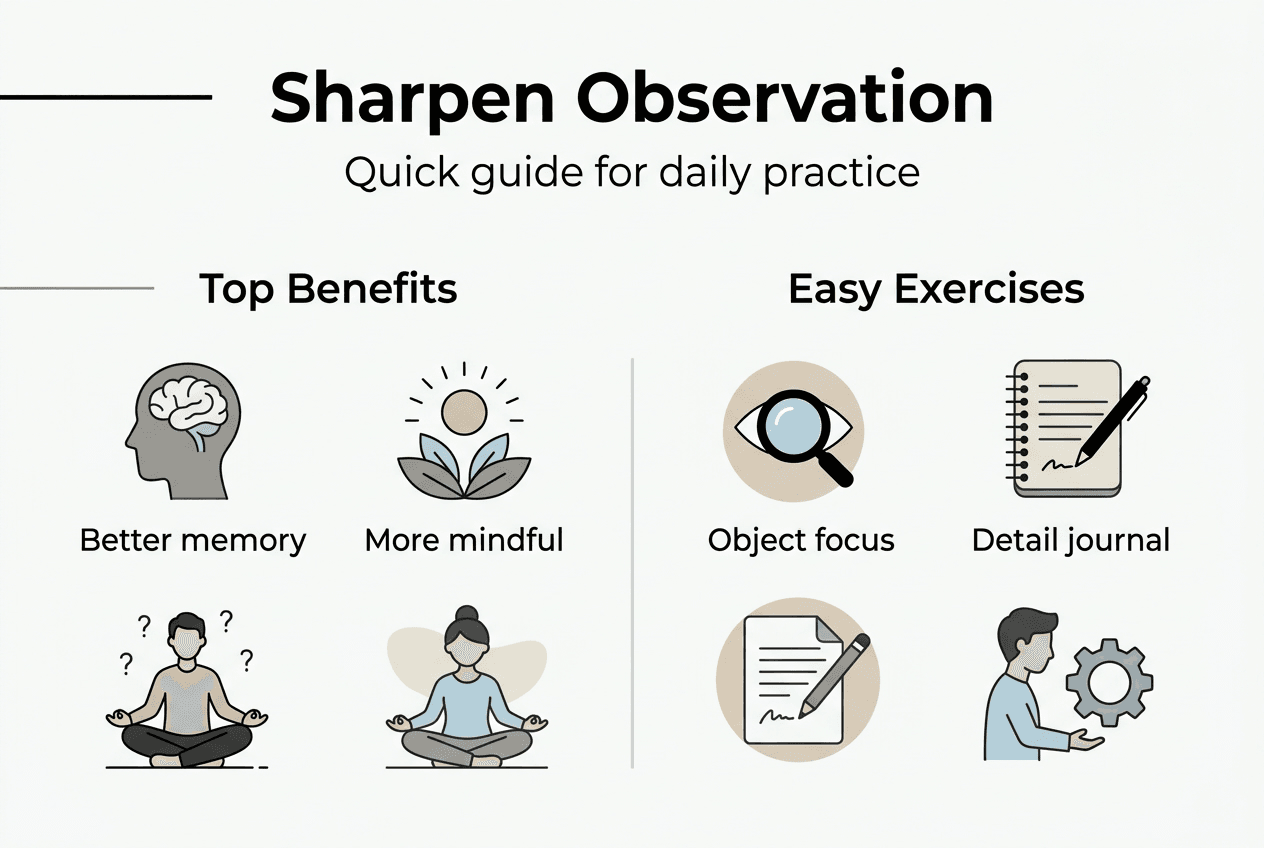
Developing observation requires consistent practice with structured exercises targeting different perceptual and cognitive faculties. These activities train your attention systems, sensory acuity, and interpretive abilities through progressive challenges. Observation is an active, intentional process of picking up sensory details and interpreting them, making deliberate practice essential for meaningful improvement. Starting with simple exercises builds foundational skills before advancing to complex, multi-sensory observations.
Progressive observation development sequence:
- Select a familiar object and observe it for five minutes, noting every detail including colour variations, texture, weight, and imperfections you’ve never consciously registered.
- Visit a public space and count specific elements, such as people wearing particular colours or architectural features, training focused attention amidst distractions.
- Close your eyes in a familiar room and mentally reconstruct every object’s location, testing spatial memory and revealing observational gaps.
- Observe a brief social interaction without sound, interpreting emotional dynamics and relationship cues purely through body language and facial expressions.
- Engage all five senses during a meal, noting taste layers, texture variations, aromas, visual presentation, and even sounds, practising multi-sensory awareness.
- Sketch an object from memory after brief observation, comparing your drawing to the original to identify missed details and perceptual biases.
These observation exercises encourage mindfulness and sensory engagement, creating present-moment awareness whilst systematically strengthening perceptual capabilities. Consistency matters more than duration, with brief daily practice producing better results than occasional intensive sessions. The exercises work by forcing attention onto stimuli you’d normally ignore, gradually expanding your observational bandwidth and reducing habitual filtering.
| Exercise Type | Primary Benefit | Time Required | Difficulty Level |
|---|---|---|---|
| Single object focus | Builds sustained attention and detail recognition | 5-10 minutes | Beginner |
| Environmental counting | Trains selective attention amidst distractions | 10-15 minutes | Beginner |
| Memory reconstruction | Reveals observational gaps and spatial awareness | 5-10 minutes | Intermediate |
| Silent interaction observation | Enhances non-verbal communication reading | 10-20 minutes | Intermediate |
| Multi-sensory engagement | Develops comprehensive perceptual awareness | 15-30 minutes | Advanced |
| Memory sketching | Identifies perceptual biases and detail retention | 15-20 minutes | Advanced |
Combining these exercises with cognitive understanding accelerates progress by creating conscious awareness of observation mechanisms. Understanding how attention, memory, and perception interact enables you to diagnose your specific weaknesses and target practice accordingly. Some people struggle with sustained focus, whilst others miss contextual cues despite noticing individual details. Tailoring exercises to your observational profile maximises improvement efficiency.
Pro Tip: Avoid rushing through observation exercises or forcing interpretations prematurely. Allow observations to accumulate before drawing conclusions, as premature judgement narrows attention and distorts perception through confirmation bias.
Supplementing structured exercises with everyday mindfulness creates continuous development opportunities. Challenge yourself to notice three new details during routine activities like commuting, eating, or conversing. This integration transforms mundane moments into observation laboratories, building skills without requiring dedicated practice time. The cumulative effect of hundreds of micro-observations throughout your day compounds into substantial skill enhancement over weeks and months. Pairing this informal practice with structured exercises from resources like attention mastering exercises creates a comprehensive development programme.
Enhance your awareness with stomart.co.uk
Developing observation skills forms part of a broader personal growth journey encompassing mindfulness, communication, and self-awareness. At Stomart, we recognise how enhanced observation enriches daily life, supporting your development through curated resources and guidance. Our platform offers articles exploring complementary skills like mindful eating, which applies observational principles to nutritional awareness, and attention and focus guidance that strengthens the cognitive foundation underlying effective observation. These interconnected capabilities build upon each other, creating synergistic improvements across multiple life domains.
We understand personal development requires ongoing support and fresh perspectives. Beyond observation-specific content, explore personal growth resources spanning wellness, creativity, and lifestyle enhancement. Our blog regularly features evidence-based strategies for cultivating awareness, improving communication, and deepening engagement with your experiences. Whether you’re beginning your observation journey or seeking advanced techniques, Stomart provides practical guidance grounded in research and real-world application, supporting your commitment to continuous growth and enhanced living.
How long does it take to improve observational skills?
Improvement timelines vary based on practice consistency and starting proficiency, yet most people notice changes within two to four weeks of daily exercises. Brief ten-minute sessions prove more effective than occasional longer practices because regular engagement builds neural pathways through repetition. Your brain adapts to prioritise observational attention when you consistently signal its importance through deliberate practice.
Combining cognitive understanding with active exercises accelerates progress significantly. Learning how perception, attention, and memory interact creates conscious awareness that enhances practice quality. This knowledge enables you to identify specific weaknesses, whether sustained focus, detail retention, or contextual interpretation, and target exercises accordingly. Measurable improvements in memory, creativity, and interpersonal sensitivity typically emerge within six to eight weeks of consistent, structured practice.
Can observation skills be applied professionally beyond clinical fields?
Observation skills enhance performance across virtually all professional contexts, from creative industries to business management. Enhanced observation improves problem-solving by revealing patterns and connections others miss, whilst superior communication stems from noticing non-verbal cues and emotional undercurrents. Research demonstrates observation skills influence teamwork, communication, and self-efficacy across professions, with measurable impacts on collaborative outcomes and individual confidence. Whether you work in education, sales, design, or leadership, stronger observation translates to better understanding of colleagues, clients, and situations, enabling more effective responses and decisions.
What are common mistakes when practising observation?
Rushing through exercises undermines their effectiveness by preventing the sustained attention necessary for deep observation. Many people also ignore contextual factors, focusing narrowly on isolated details whilst missing how elements relate to broader patterns. This tunnel vision distorts perception and limits understanding. Over-focusing on trivial details whilst missing significant patterns represents another common pitfall, as does imposing premature interpretations that bias subsequent observations. Balance requires distributing attention across details and context, allowing observations to accumulate before drawing conclusions. Effective observation maintains openness to unexpected information rather than seeking confirmation of existing beliefs.
How does mindfulness relate to observation?
Mindfulness and observation share fundamental mechanisms centred on present-moment sensory awareness without judgement. Observation exercises encourage mindfulness by fully engaging the senses with the environment, anchoring attention in immediate experience rather than abstract thought. This practice cultivates the non-reactive awareness central to mindfulness traditions, where you notice sensations, thoughts, and perceptions without immediately categorising them as good or bad. Regular observation exercises naturally develop mindful engagement with surroundings, supporting emotional regulation through enhanced awareness of internal states and external triggers. The connection explains why observation training often produces meditation-like benefits including reduced stress and increased present-moment appreciation. Integrating observation into daily routines through practices like mindfulness through observation creates accessible pathways to cultivating sustained awareness and deeper perception.