

What animals teach humans about balance and instinct
on Mar 14, 2026Standing on one leg with your eyes closed is surprisingly difficult for most humans, yet a dog can navigate rocky terrain in near darkness with ease. This stark difference reveals a fundamental truth: humans depend heavily on vision for balance, while many animals employ sophisticated neural and behavioural strategies that operate largely without visual input. Understanding how animals maintain stability and sharpen their instincts offers profound lessons for personal development. From the brainstem circuits that keep quadrupeds upright to the anticipatory movements that let cats land on their feet, the animal kingdom demonstrates balance mastery we can learn from. This article explores the neurobiological foundations, behavioural strategies, and learning mechanisms animals use to achieve remarkable balance and instinctive responses, providing practical insights you can apply to enhance your own physical awareness and decision-making.
Key takeaways
| Point | Details |
|---|---|
| Neural control | Specific brainstem neurons integrate sensory inputs to maintain posture without conscious effort. |
| Feedforward strategies | Animals preadjust limb movements before ground contact, reducing reliance on slower feedback mechanisms. |
| Sensory integration | Balance depends on combining vestibular, proprioceptive, and visual information with varying emphasis across species. |
| Learning enhances instinct | Associative learning refines innate responses, improving survival outcomes in changing environments. |
| Human potential | Reducing visual dependence through practise can strengthen alternative sensory pathways for better balance. |
Neural foundations of balance in animals
The ability to maintain balance begins deep within the brainstem, where specialised neuronal populations coordinate posture without conscious thought. Research has identified CaMKIIa-expressing reticular neurons as essential for maintaining dorsal-side-up orientation in quadrupeds, revealing how specific brain circuits control which way is up. These neurons in the caudal medulla act as master regulators, sending signals down the spinal cord to adjust limb position and muscle tone continuously.
When scientists selectively activate these neurons on one side of the brain, animals predictably shift their weight and posture towards that side. Conversely, silencing these neurons causes the opposite effect, demonstrating their direct role in balance control. This precision highlights how evolution has created dedicated neural machinery for stability that operates automatically, freeing conscious attention for other tasks like hunting or socialising.
The reticular formation integrates sensory information for postural control, combining signals from the inner ear’s vestibular system, muscle stretch receptors, and joint position sensors. This integration happens in milliseconds, allowing animals to respond to perturbations before they become falls. Consider these key neural components:
- Vestibular nuclei detect head rotation and linear acceleration
- Proprioceptive pathways relay limb position and muscle tension
- Reticulospinal neurons transmit corrective commands to trunk and limb muscles
- Cerebellar circuits fine-tune motor output based on prediction errors
Distortions in these descending motor pathways cause severe postural dysfunctions, as seen in neurological conditions affecting the brainstem. Animals with such lesions struggle to maintain upright posture, often tilting persistently to one side or showing exaggerated sway. These clinical observations confirm that balance is not a simple reflex but rather emerges from coordinated activity across multiple brain regions working in concert.
Understanding these neural mechanisms reveals that balance is an active process requiring constant computation and adjustment, not merely a passive mechanical property of body structure.
The sophistication of animal balance systems becomes even more apparent when examining how they translate neural commands into physical movement strategies.
Behavioural strategies animals use for balance
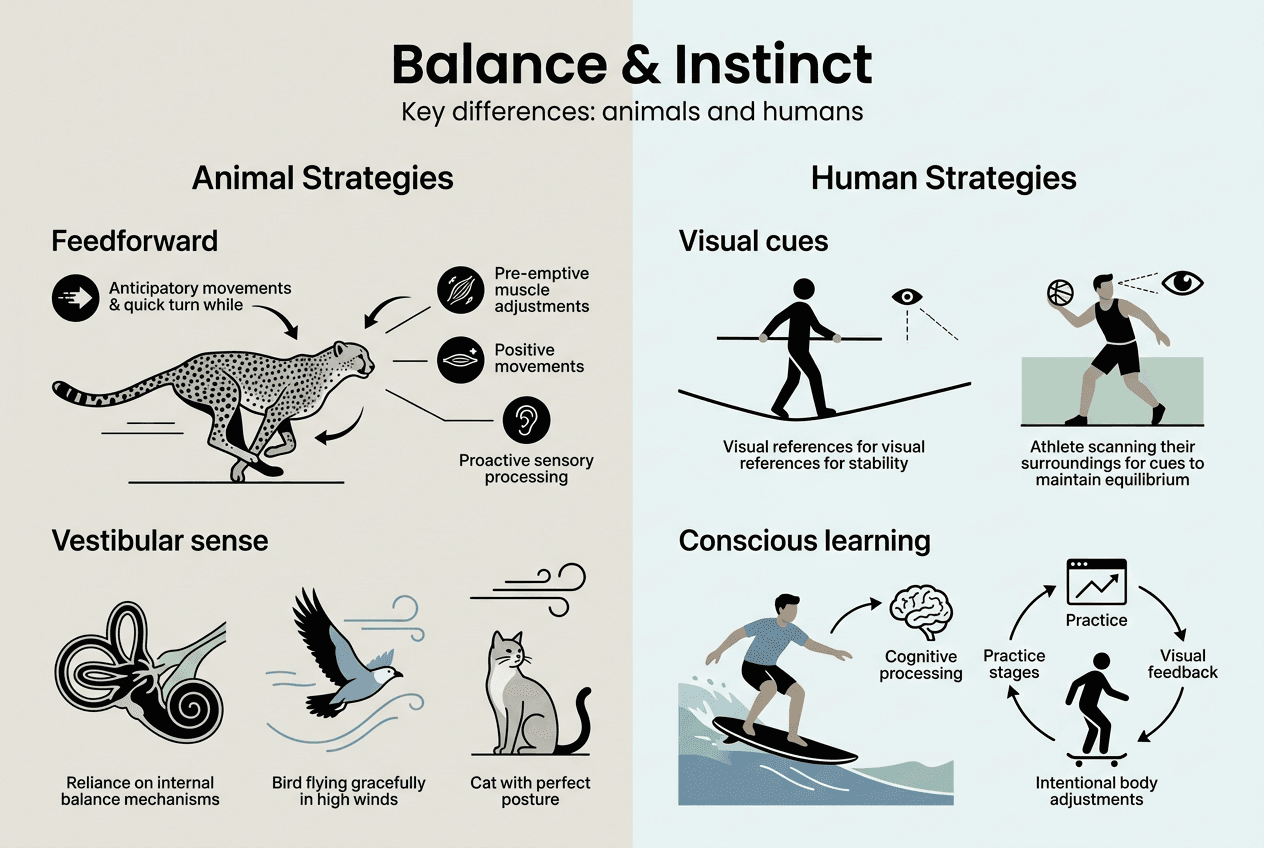
Animals don’t just react to unstable ground after their feet touch down; they anticipate and prepare. Studies show that animals preadjust limb kinematics and impedance before touchdown to negotiate uneven terrain, using feedforward control that predicts surface conditions. This anticipatory strategy proves far more effective than waiting for sensory feedback, which introduces delays that could lead to stumbles.
Watch a cat approaching a narrow fence top. Before the first paw lands, the animal has already adjusted its gait, lowered its centre of mass, and stiffened certain joints whilst loosening others. These preparations happen based on visual assessment of the upcoming surface, demonstrating how animals blend prediction with real-time adjustment. The forelimbs often probe and test whilst hindlimbs provide stable propulsion, creating a division of labour that maximises both exploration and security.
Here’s how feedforward control improves balance performance:
- Visual or tactile sensors gather information about upcoming terrain
- Brain circuits predict required limb positions and joint stiffness
- Motor commands adjust muscle activation before ground contact
- Intrinsic mechanical properties of muscles and tendons provide passive stability
- Feedback mechanisms make small corrections after touchdown
This sequence happens so rapidly that the entire cycle completes in fractions of a second. Animals blend intrinsic mechanical stability with neural adjustments for complex terrain, creating a robust system that works across diverse environments. A mountain goat on a cliff face uses both the springy properties of its tendons and active muscle control to maintain purchase on tiny ledges.
| Terrain type | Primary strategy | Secondary mechanism |
|---|---|---|
| Flat, predictable | Rhythmic pattern generation | Minimal sensory feedback |
| Uneven, visible | Feedforward adjustment | Visual guidance |
| Unstable, unpredictable | Increased limb stiffness | Rapid feedback correction |
| Narrow surfaces | Lowered centre of mass | Tail/body counterbalancing |
Pro Tip: When walking on uneven ground, look several steps ahead rather than at your feet. This allows your brain to prepare movement adjustments before each foot lands, mimicking the feedforward strategy animals use naturally.
Humans could apply anticipatory adjustment techniques to improve balance in instability, particularly in activities like hiking, climbing, or even navigating icy pavements. The key is training your nervous system to predict and prepare rather than simply reacting after the fact.
Comparing human and animal balance control
The differences between human and animal balance become strikingly clear when vision is removed from the equation. Research demonstrates that humans rely more on visual input for balance than dogs, leading to greater instability when blindfolded. In controlled experiments, humans show significantly increased body sway when standing with eyes closed, whilst dogs maintain relatively stable posture under the same conditions.
This disparity reflects evolutionary priorities. Humans evolved as visual hunters and tool users, developing exceptional hand-eye coordination and visual-spatial reasoning. Our upright bipedal stance, whilst freeing our hands, created a narrower base of support that makes balance more challenging. Dogs and other quadrupeds, by contrast, have four points of contact with the ground and a lower centre of mass, providing inherent mechanical stability that reduces the need for visual monitoring.
Dogs maintain postural stability with less visual dependence, using proprioceptive and vestibular inputs more effectively than humans typically do. Their paws contain dense concentrations of mechanoreceptors that provide detailed information about ground texture, slope, and stability. Combined with a highly developed vestibular system, this allows dogs to navigate confidently in low light conditions where humans would stumble.
| Balance parameter | Humans | Dogs |
|---|---|---|
| Visual dependence | High (60-70% weighting) | Moderate (30-40% weighting) |
| Sway with eyes closed | Increases 200-300% | Increases 50-80% |
| Base of support | Narrow (two feet) | Wide (four paws) |
| Centre of mass height | High | Low |
| Recovery time from perturbation | 400-600 milliseconds | 200-300 milliseconds |
Mediolateral and support surface compensations are comparable across species, suggesting some balance mechanisms are shared across mammals. Both humans and dogs widen their stance on unstable surfaces and shift weight more frequently to maintain stability. However, the speed and precision of these adjustments differ, with quadrupeds generally responding faster due to their distributed support system.
This reveals a potential over-reliance in humans on vision, limiting instinctive balance capabilities that other sensory systems could provide. Our nervous systems are capable of sophisticated proprioceptive and vestibular processing, but these pathways often remain underdeveloped because vision dominates our attention and balance strategies.
Key differences in balance control mechanisms:
- Humans use hip and ankle strategies for upright stance correction
- Quadrupeds distribute corrections across four limbs simultaneously
- Human balance requires constant active control even on flat surfaces
- Animals can lock joints to create passive stability during standing
Pro Tip: Practise balance exercises with your eyes closed for short periods, starting with simple standing and progressing to more challenging positions. This trains your vestibular and proprioceptive systems to take over when vision is unavailable, building more instinctive balance control.
Developing these alternative sensory pathways not only improves physical balance but also enhances overall body awareness and spatial orientation in everyday activities.
Instinct and learning: what animals teach about honing instincts
Instinct and learning are not opposing forces but complementary systems that work together to optimise survival. Animals demonstrate this beautifully through behaviours like mobbing, where birds collectively harass predators to drive them away. Research shows that associative learning enhances recognition of mobbing calls, an effective anti-predator strategy, allowing birds to learn which alarm sounds indicate genuine threats versus false alarms.
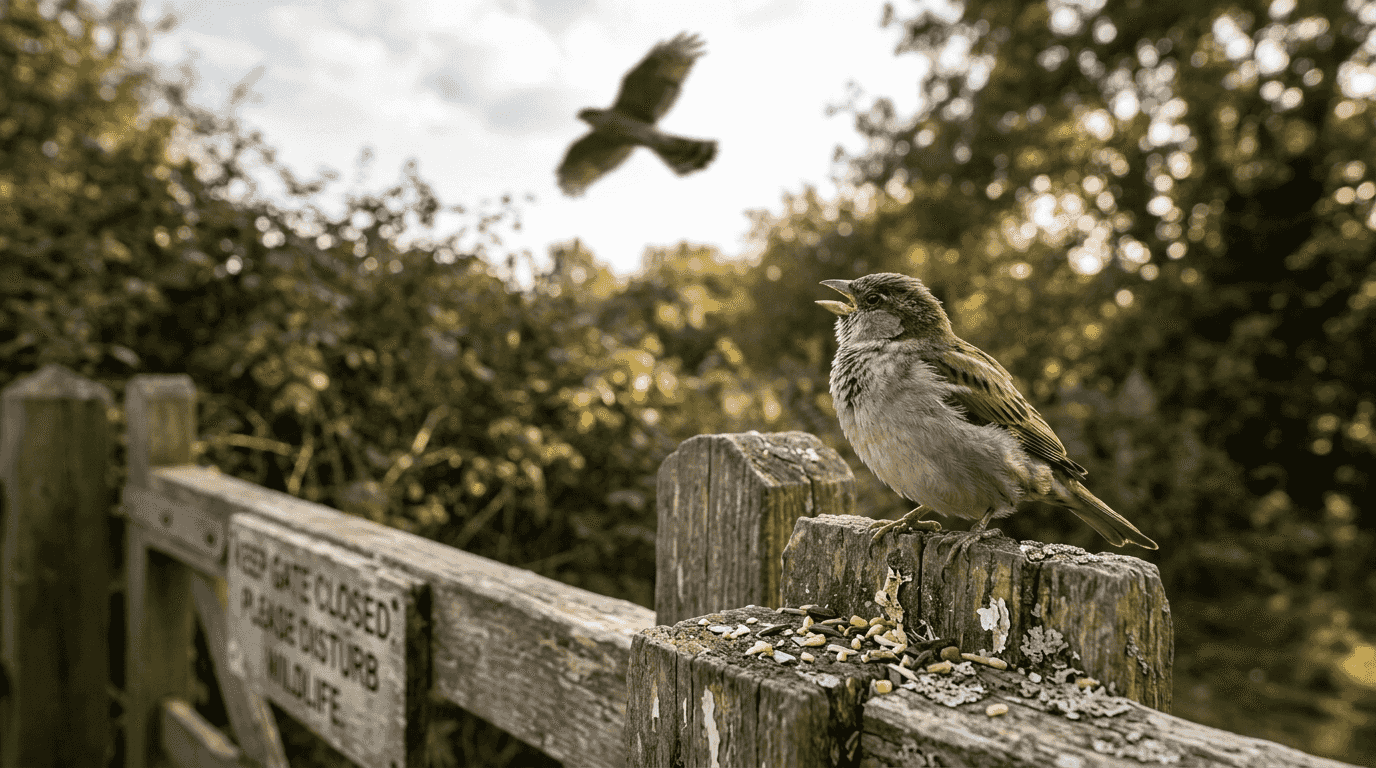
When a bird hears an unfamiliar sound followed by the appearance of a predator, it forms an association that speeds future responses. This learned component builds upon innate fear responses, creating a more nuanced and effective defence system. Young birds initially respond to many sounds with caution, but experience teaches them to discriminate between real dangers and harmless noises, reducing wasted energy on unnecessary alarm responses.
Animals learn to associate unfamiliar sounds with danger, improving response speed and accuracy over time. This process involves the amygdala and hippocampus, brain structures that link sensory experiences with emotional significance and context. The result is instinct that becomes sharper and more precisely calibrated to actual environmental threats rather than responding indiscriminately.
Mobbing calls recruit others in a coordinated defence against predators, demonstrating how individual learning benefits the entire group. When one bird recognises a threat and sounds the alarm, others join based on their own learned associations with that call type. This collective response proves far more effective than individual flight, often succeeding in driving away predators many times larger than any single bird.
Instinct is complemented by learning to improve survival outcomes in several ways:
- Initial innate responses provide a baseline defensive reaction
- Experience refines which stimuli warrant full alarm responses
- Social learning accelerates individual acquisition of threat recognition
- Memory consolidation makes learned associations increasingly automatic
Understanding this synergy can inspire humans to cultivate situational awareness and quick decision making in daily life. Just as animals refine their threat detection through experience, we can train ourselves to recognise patterns that signal opportunities or dangers in our environments. This might involve noticing subtle social cues, identifying early warning signs of problems at work, or developing intuition about which situations deserve our full attention.
The most effective instincts are not purely innate but rather innate templates refined through experience, creating responses that are both rapid and contextually appropriate.
Pro Tip: Practice associative memory techniques by consciously noting patterns in your environment, such as which traffic conditions predict delays or which interpersonal dynamics signal conflict. Over time, these conscious observations become automatic instinctive responses that guide better decisions without deliberate thought.
This approach transforms instinct from a fixed trait into a skill that can be developed and sharpened throughout life, much as animals continuously refine their survival responses.
Explore more about natural balance and instincts
The lessons from animal balance and instinct extend far beyond theoretical interest, offering practical pathways to enhance your own physical awareness and decision-making capabilities. At Stomart, we recognise that personal development often benefits from tools and resources that support natural approaches to wellness and body awareness. Our health and beauty section includes products designed to enhance sensory integration and physical coordination, from balance training equipment to ergonomic supports that encourage better posture.
Exploring how animals maintain stability and sharpen their instincts reveals principles you can apply immediately. Whether through balance exercises that reduce visual dependence, mindfulness practises that heighten proprioceptive awareness, or learning techniques that refine your pattern recognition, the animal kingdom offers a masterclass in embodied intelligence. Stomart provides guidance and products to help you cultivate these capabilities, bridging the gap between understanding animal strategies and implementing them in your daily routine for improved balance, coordination, and instinctive responses.
What animals can teach humans about balance and instinct: frequently asked questions
How do animals maintain balance on very uneven terrain?
Animals use feedforward control to preadjust their limb positions and joint stiffness before touching unstable surfaces, based on visual or tactile assessment of upcoming terrain. This anticipatory strategy, combined with rapid sensory feedback and intrinsic mechanical properties of muscles and tendons, allows them to navigate rocky or irregular ground with remarkable stability. Their lower centre of mass and wider base of support compared to humans also provides inherent mechanical advantages.
Can humans improve balance by reducing reliance on vision?
Yes, practising balance exercises with eyes closed or in low light conditions trains your vestibular and proprioceptive systems to provide stability without visual input. Regular practise strengthens these alternative sensory pathways, making them more reliable and responsive. This not only improves balance in situations where vision is compromised but also enhances overall body awareness and spatial orientation in everyday activities.
What role does associative learning play in animal instinct refinement?
Associative learning allows animals to link specific environmental cues with outcomes, refining innate responses to become more contextually appropriate and efficient. For example, birds learn to associate particular sounds with predator presence, improving their threat recognition speed and accuracy. This learned component builds upon instinctive fear responses, creating a more nuanced defence system that reduces false alarms whilst maintaining rapid reactions to genuine dangers.
Are certain animals better models than others for human balance training?
Quadrupeds like dogs and cats offer insights into feedforward control and sensory integration, whilst bipedal birds demonstrate balance strategies more similar to human upright posture. Primates provide the most directly applicable models due to their similar skeletal structure and occasional bipedalism. However, each animal group offers unique lessons: felines excel at dynamic balance during movement, canines demonstrate robust multi-sensory integration, and birds show exceptional vestibular control during rapid position changes.
How quickly do animals adapt their movements to new environments?
Most animals show initial movement adjustments within seconds to minutes of encountering new terrain or balance challenges, with refinement continuing over hours to days. The speed depends on the similarity to previously experienced conditions and the animal’s learning capacity. Neural plasticity allows continuous improvement, with movement patterns becoming increasingly efficient through repetition. This adaptability demonstrates that balance and coordination are trainable skills rather than fixed abilities, offering encouragement for human improvement efforts.