

The death of deep thinking: why everything feels shallow
on Mar 22, 2026Modern attention has collapsed to an average of just 47 seconds on any single screen, a dramatic fall from the three minutes we managed two decades ago. This isn’t just about distraction; it represents a fundamental shift in how we process information and engage with ideas. The consequences ripple through every aspect of life, from personal growth to societal connection. Digital environments fragment our focus, shallow content floods our feeds, and artificial intelligence promises shortcuts that may erode the very skills that make us human. Understanding why deep thinking is dying matters because reclaiming it determines whether we grow or stagnate.
Key Takeaways
| Point | Details |
|---|---|
| Regaining focus time | It takes about 23 minutes to regain deep focus after a distraction. |
| Notifications disrupt thinking | Smartphone notifications are a major disruption to sustained attention for many people. |
| Multitasking depletes resources | Switching between tasks depletes mental resources and weakens executive function. |
| Blockers protect attention | Using website blockers and scheduling dedicated times for communication reduces interruptions and supports sustained concentration. |
| Deep work restores engagement | Intentional deep work routines help restore focus and meaningful engagement with ideas. |
How digital distractions erode deep thinking
Your phone buzzes. You glance at the notification. Three seconds later, you’ve forgotten what you were working on. This cycle repeats dozens of times daily, fragmenting attention into useless shards. Research confirms that 49% of people identify smartphone notifications as their primary focus disruptor, whilst 71% report feeling busy all day yet accomplishing little of substance.
Every interruption costs more than the seconds spent checking your device. Your brain requires 23 minutes on average to fully regain deep focus after a distraction. When notifications arrive every few minutes, you never reach the cognitive state required for complex thinking. This creates an illusion of productivity whilst preventing genuine progress on meaningful work.
Multitasking amplifies the damage. Switching between tasks doesn’t save time; it depletes mental resources and reduces executive function. Your prefrontal cortex, responsible for planning and decision-making, struggles under constant task-switching. Quality deteriorates across everything you attempt.
Common digital distractions that fragment attention:
- Push notifications from social media, email, and messaging apps
- Auto-playing videos and infinite scroll features designed to capture attention
- Browser tabs multiplying as curiosity leads to information rabbit holes
- Background noise from always-on devices and smart home assistants
Information overload compounds these challenges. The average person encounters more data in a single day than someone in the 15th century absorbed in a lifetime. Your brain wasn’t designed to process this volume. The result? Surface-level skimming replaces deep reading, and quick reactions substitute for thoughtful analysis.
| Distraction type | Frequency | Recovery time | Cumulative daily cost |
|---|---|---|---|
| Smartphone notifications | 50-80 per day | 23 minutes each | 19-30 hours of fragmented focus |
| Email checks | 15-20 per day | 15 minutes each | 3.75-5 hours of disrupted work |
| Social media browsing | 8-12 sessions | 25 minutes each | 3.3-5 hours of shallow engagement |
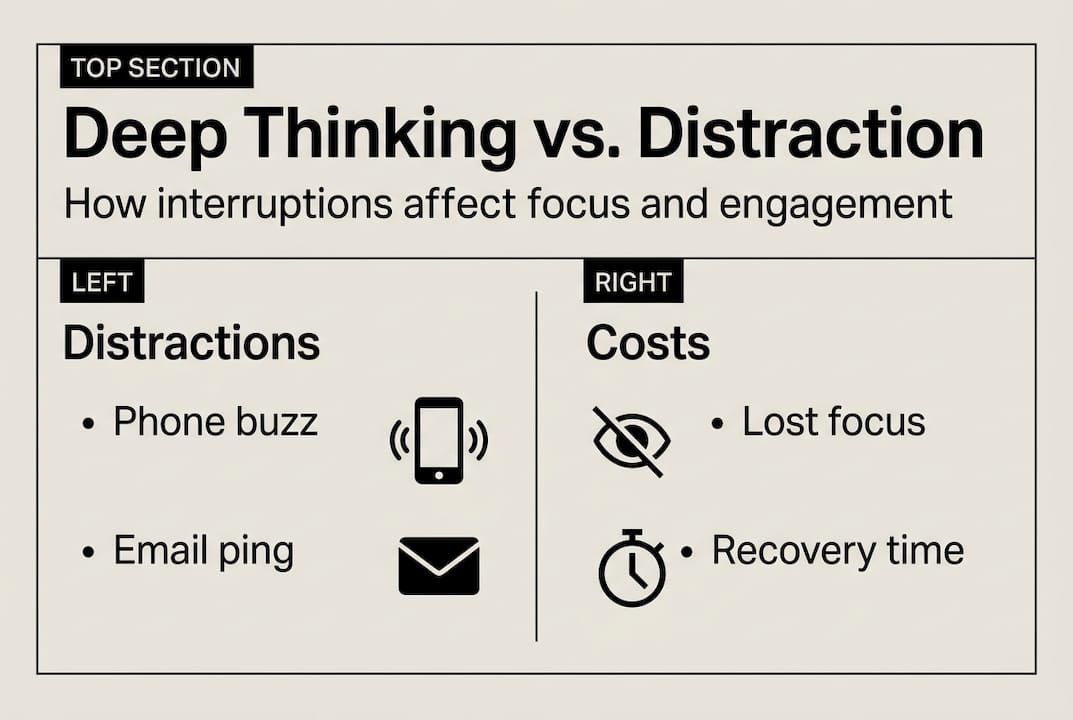
Creating barriers helps. Disable non-essential notifications completely. Schedule specific times for email and messages rather than responding instantly. Use website blockers during focused work periods. These simple changes dramatically reduce interruption frequency and restore your capacity for sustained attention.
Pro Tip: Place your phone in another room during deep work sessions. Physical distance eliminates the unconscious urge to check it, allowing your brain to settle into genuine focus. After two weeks of this practice, you’ll notice measurably improved concentration and output quality.
The path to mastering attention in the digital age requires intentional design of your environment and habits. Digital tools serve us best when we control them, not when they control us.
The cognitive costs of shallow engagement and technology dependence
Endless scrolling through low-quality content reshapes your brain in measurable ways. Studies demonstrate that excessive consumption of shallow online material causes cognitive decline, weakens memory formation, and impairs executive functions like planning and impulse control. Young people face particular vulnerability, with developing brains showing accelerated negative effects.

Emotional desensitisation follows cognitive decline. Constant exposure to rapid-fire content, outrage cycles, and superficial interactions dulls empathy. You process fewer emotional nuances, struggle to maintain deep connections, and experience reduced capacity for sustained reflection. The brain adapts to expect instant stimulation, making patience and contemplation feel uncomfortable.
Artificial intelligence introduces new complications. Research shows that AI use correlates with shallower learning compared to traditional web search and independent research. When you offload thinking to AI tools, you bypass the cognitive struggle that builds understanding. The convenience comes at a cost: reduced critical thinking, weaker analytical skills, and diminished ability to synthesise information independently.
Cognitive impacts of shallow digital engagement:
- Weakened working memory from constant task-switching and interruptions
- Reduced ability to follow complex arguments or sustained narratives
- Impaired decision-making due to information overload and choice paralysis
- Decreased emotional regulation from rapid content consumption
- Erosion of deep reading skills and symbolic logic capabilities
| Learning approach | Depth of understanding | Retention rate | Critical thinking development |
|---|---|---|---|
| Traditional research and synthesis | Deep, integrated knowledge | 70-80% after one week | Strong analytical frameworks |
| Web search with manual evaluation | Moderate understanding | 50-60% after one week | Developing comparison skills |
| AI-generated summaries | Surface-level familiarity | 20-30% after one week | Minimal independent analysis |
The nuance matters here. Not all AI use harms cognition. When you employ AI as a thinking partner rather than a replacement for thought, benefits emerge. Using AI to check your reasoning, explore alternative perspectives, or handle routine tasks whilst you focus on complex analysis can enhance learning. The key lies in maintaining cognitive engagement rather than passive consumption.
Balanced cognitive offloading actually improves outcomes in specific contexts. Research indicates that strategic use of external tools can boost self-efficacy and task persistence when applied thoughtfully. The difference between helpful and harmful offloading depends on whether you’re supplementing your thinking or replacing it.
Youth face particular risks because their cognitive patterns form during these critical years. Habits established now shape lifelong thinking styles. A generation raised on shallow content may struggle to develop the sustained attention required for complex problem-solving, creative innovation, and deep expertise.
Pro Tip: Before using AI for any task, write out your own thoughts first. This ensures you engage cognitively with the problem before seeking assistance. Compare your thinking to AI output rather than starting with AI-generated content. This approach preserves critical thinking whilst leveraging AI’s benefits.
Addressing digital overload requires conscious choices about which tools serve your growth and which undermine it. The goal isn’t rejecting technology but using it intentionally to enhance rather than replace human cognition.
Why reading, writing and deep work remain vital
Reading and writing form the foundation of symbolic logic and systems thinking. These skills train your brain to follow complex arguments, construct coherent narratives, and synthesise disparate information into unified understanding. Declining literacy weakens these capabilities, leaving individuals ill-equipped for the nuanced thinking that artificial intelligence cannot replicate.
Writing forces clarity. When you articulate ideas in writing, you discover gaps in your reasoning, refine vague concepts, and develop deeper understanding. This cognitive labour builds mental models that persist long after the writing ends. AI may automate many tasks, but it cannot replace the thinking that writing cultivates.
Deep work provides the antidote to shallow busyness. Cal Newport defines deep work as professional activities performed in a state of distraction-free concentration that push cognitive capabilities to their limit. These efforts create new value, improve skills, and prove difficult to replicate. Deep work sessions of 90-120 minutes generate significantly more high-value output than entire days of fragmented attention.
Essential elements of effective deep work practice:
- Eliminate all distractions before beginning focused sessions
- Choose cognitively demanding tasks that require full attention
- Set clear objectives for each deep work block
- Protect these periods as non-negotiable appointments
- Track progress to maintain motivation and refine approach
Scheduling matters enormously. Most people can sustain three to four hours of genuine deep work daily. Beyond this, mental fatigue reduces quality. Structure your day to protect these hours, typically during your peak cognitive periods. For many, this means morning sessions before email and meetings fragment attention.
Practical steps to establish deep work routines:
- Identify your most important cognitive work that requires sustained focus
- Block three to four hours daily in your calendar for deep work
- Create a dedicated workspace free from digital and physical distractions
- Develop a ritual to signal the start of deep work (specific location, coffee, music)
- Use a timer to maintain session boundaries and prevent burnout
- Schedule shallow work (email, admin, meetings) outside deep work blocks
- Review weekly to assess progress and adjust your approach
Environment shapes behaviour powerfully. A productive study corner with minimal visual distractions, comfortable seating, proper lighting, and organised materials dramatically improves focus quality. Your brain associates specific spaces with specific activities; leverage this by designating deep work zones.
The compound effects of deep work transform capabilities over time. Skills that seemed impossibly difficult become manageable. Projects that would have taken months compress into weeks. Most importantly, you develop the rare ability to think deeply in an age of shallow distraction, creating immense competitive advantage.
The societal ripple effects and nuances of digital use
Shallow thinking extends beyond individual cognition to reshape society itself. When millions of people engage primarily at surface level, collective discourse suffers. Reduced empathy and nuance weaken social bonds, political polarisation intensifies, and complex problems receive simplistic solutions. The depth deficit harms our intellectual and emotional fabric.
Anxiety flourishes in shallow environments. Constant stimulation prevents the emotional processing that occurs during quiet reflection. You accumulate unresolved feelings, incomplete thoughts, and fragmented experiences. This creates a persistent background stress that manifests as generalised anxiety, difficulty concentrating, and emotional volatility.
Personal identity fractures under shallow engagement. Deep thinking allows you to integrate experiences, examine values, and construct coherent self-understanding. Surface-level living produces a collection of reactions rather than a unified person. You become what you consume rather than who you choose to be.
Societal consequences of widespread shallow thinking:
- Declining capacity for nuanced debate and constructive disagreement
- Weakened ability to delay gratification and pursue long-term goals
- Reduced patience for complexity in policy, relationships, and problem-solving
- Erosion of expertise as depth becomes undervalued
- Fragmentation of shared reality as attention scatters across infinite content streams
Yet digital tools aren’t inherently harmful. The key lies in balance and intentionality. Research shows that cognitive offloading can boost self-efficacy and deepen learning when properly balanced. Using technology to handle routine tasks whilst you focus on complex thinking enhances rather than diminishes capability.
Expertise remains invaluable despite AI advances. Deep domain knowledge, cultivated through years of focused study and practice, enables pattern recognition and intuitive leaps that artificial intelligence cannot match. The future belongs to those who combine technological fluency with deep expertise, not those who substitute the former for the latter.
“The depth deficit represents more than individual cognitive decline. It signals a cultural shift away from the sustained attention, critical analysis, and emotional nuance that enable both personal flourishing and functional democracy. Reclaiming depth isn’t optional; it’s essential for human thriving.”
Community connection suffers when everyone operates at surface level. Meaningful relationships require time, attention, and emotional depth. Quick interactions and curated personas replace genuine vulnerability and understanding. Loneliness increases even as digital connectivity expands because shallow contact cannot satisfy deep human needs.
Balancing digital use means establishing clear boundaries. Designate technology-free times and spaces. Cultivate offline hobbies that demand sustained attention. Prioritise face-to-face interaction over digital communication when possible. These choices create space for the depth that shallow digital life crowds out.
Reducing clutter and distractions in your environment supports deeper thinking by minimising cognitive load. Physical and digital organisation creates mental clarity, allowing you to focus on what matters rather than managing chaos.
Explore tools to regain focus and depth
Reclaiming deep thinking requires both understanding and action. You’ve seen how digital distractions fragment attention, shallow content damages cognition, and surface-level engagement weakens society. Now comes the practical work of rebuilding focus and depth in your daily life.
STOMART offers resources designed to support this journey. Our curated collection includes products and insights that help you create environments conducive to deep work, manage digital overwhelm, and cultivate sustained attention. From organisational tools that reduce physical clutter to lighting solutions that enhance focus, we provide practical support for your cognitive health.
Explore our expert articles on mastering attention in the digital age for evidence-based strategies that restore focus. Discover simple ways to avoid digital overload and reclaim mental clarity. These resources translate research into actionable steps you can implement immediately.
Visit STOMART to find tools that support your transition from shallow busyness to meaningful depth. Your cognitive health matters, and small changes in environment and habits compound into transformative results.
Frequently asked questions about deep thinking and modern distractions
What causes the decline of deep thinking?
Digital distractions, information overload, and constant multitasking fragment attention and prevent sustained focus. Smartphone notifications interrupt concentration dozens of times daily, whilst low-quality online content trains brains for shallow processing. The environment rewards quick reactions over thoughtful analysis, gradually eroding deep thinking capacity.
How does AI affect critical thinking abilities?
AI use correlates with shallower learning when it replaces rather than supplements human thinking. Offloading cognitive work to AI prevents the mental struggle that builds understanding and analytical skills. However, using AI as a thinking partner whilst maintaining active engagement can enhance learning if balanced properly.
Can digital tools ever improve focus?
Yes, when used intentionally. Website blockers, notification management apps, and focus timers help create distraction-free environments. Digital calendars protect deep work time, whilst task management systems reduce cognitive load. The key lies in using technology to support rather than undermine sustained attention.
What are effective ways to practise deep work?
Schedule three to four hours daily for distraction-free focus on cognitively demanding tasks. Create dedicated workspaces, disable notifications, and establish rituals that signal deep work sessions. Start with 90-minute blocks, track progress, and gradually extend duration as attention muscle strengthens. Consistency matters more than perfection. For practical implementation strategies, explore guides on mastering attention and focus.
How can society address shallow thinking issues?
Education systems must prioritise deep reading, writing, and sustained analysis over test preparation. Workplaces should protect focus time and reward quality over busyness. Individuals can model deep engagement, support media literacy, and choose depth over distraction. Cultural change requires collective commitment to valuing sustained attention and complex thinking.
Why do reading and writing matter for cognitive health?
Reading develops sustained attention, vocabulary, and the ability to follow complex arguments. Writing forces clarity, reveals gaps in reasoning, and builds symbolic logic skills. Together, these practices train cognitive capabilities that AI cannot replicate, providing foundation for deep thinking that remains valuable regardless of technological advances.