

Environmental impact of fast consumerism in the UK
on Mar 07, 2026UK consumers purchase 26.7kg of clothing annually, the highest per capita rate in Europe. This staggering figure reveals just the tip of a vast environmental crisis driven by fast consumerism across fashion, electronics, and household goods. The hidden costs of this ‘fast everything’ culture extend far beyond your shopping basket, depleting natural resources, polluting ecosystems, and generating mountains of waste. You’ll discover what fast consumerism truly costs our planet and learn practical strategies to reduce your environmental footprint whilst maintaining a fulfilling lifestyle.
Key takeaways
| Point | Details |
|---|---|
| Fast consumerism depletes resources significantly | The fashion industry alone consumes 93 billion cubic metres of water and produces 10% of global carbon emissions annually. |
| Pollution mechanisms harm ecosystems directly | Textile dyeing releases 1.2 million tons of hazardous chemicals into waterways, whilst synthetic fibres shed microplastics that contaminate marine life. |
| Common myths prevent effective action | Many believe cheap products mean low environmental costs, yet fast fashion’s hidden ecological damage far exceeds its low price tags. |
| Sustainable alternatives reduce impact measurably | Doubling clothing lifespans cuts emissions by 44%, demonstrating how simple choices create substantial environmental benefits. |
| Individual and systemic changes both matter | Consumer choices drive market demand whilst policy reforms create lasting structural improvements in sustainability. |
Understanding fast consumerism and its environmental footprint
Fast consumerism describes the accelerated production and consumption cycle that prioritises quantity, novelty, and disposability over quality and longevity. This ‘fast everything’ culture emerged from business models designed to maximise sales volume through rapid trend cycles, planned obsolescence, and aggressive marketing. You see it everywhere: fashion collections refreshing weekly, electronics outdated within months, and household goods designed for replacement rather than repair.
The environmental footprint reaches staggering proportions globally. The fashion and textiles industry consumes 93 billion cubic metres of water annually and contributes to 10% of global carbon emissions. These figures translate to immense resource depletion that strains water supplies, accelerates climate change, and exhausts raw materials at unsustainable rates. The impact of fast fashion ripples through ecosystems worldwide, fundamentally altering natural resource availability.
The UK fashion market exemplifies this crisis particularly well. British consumers lead Europe in clothing purchases per capita, buying 26.7kg annually, yet discard approximately 7kg of unworn or barely worn garments each year. This purchasing pattern creates a constant demand for new production whilst generating mounting textile waste. Key industries affected extend beyond fashion to include electronics, furniture, beauty products, and household goods, each following similar rapid turnover models.
The acceleration of resource extraction depletes finite materials like metals, fossil fuels, and timber faster than ecosystems can regenerate them. Manufacturing processes require vast energy inputs, predominantly from carbon-intensive sources, compounding climate impacts. Water consumption extends beyond production to include agricultural inputs like cotton farming, which demands intensive irrigation in already water-stressed regions. This interconnected web of resource depletion creates cascading environmental consequences that threaten ecological stability.
Key resource impacts include:
- Water depletion from textile production and agricultural inputs
- Carbon emissions from manufacturing, transport, and energy-intensive processes
- Raw material extraction exceeding natural regeneration rates
- Energy consumption from production facilities and global supply chains
How fast consumerism pollutes: mechanisms of environmental damage
Fast consumerism generates pollution through multiple interconnected pathways that contaminate water, soil, and air. Understanding these mechanisms reveals why low-cost consumption carries such high environmental costs. Each stage of the production and disposal cycle introduces toxic substances and waste materials into ecosystems, creating long-lasting damage that extends far beyond initial purchase decisions.
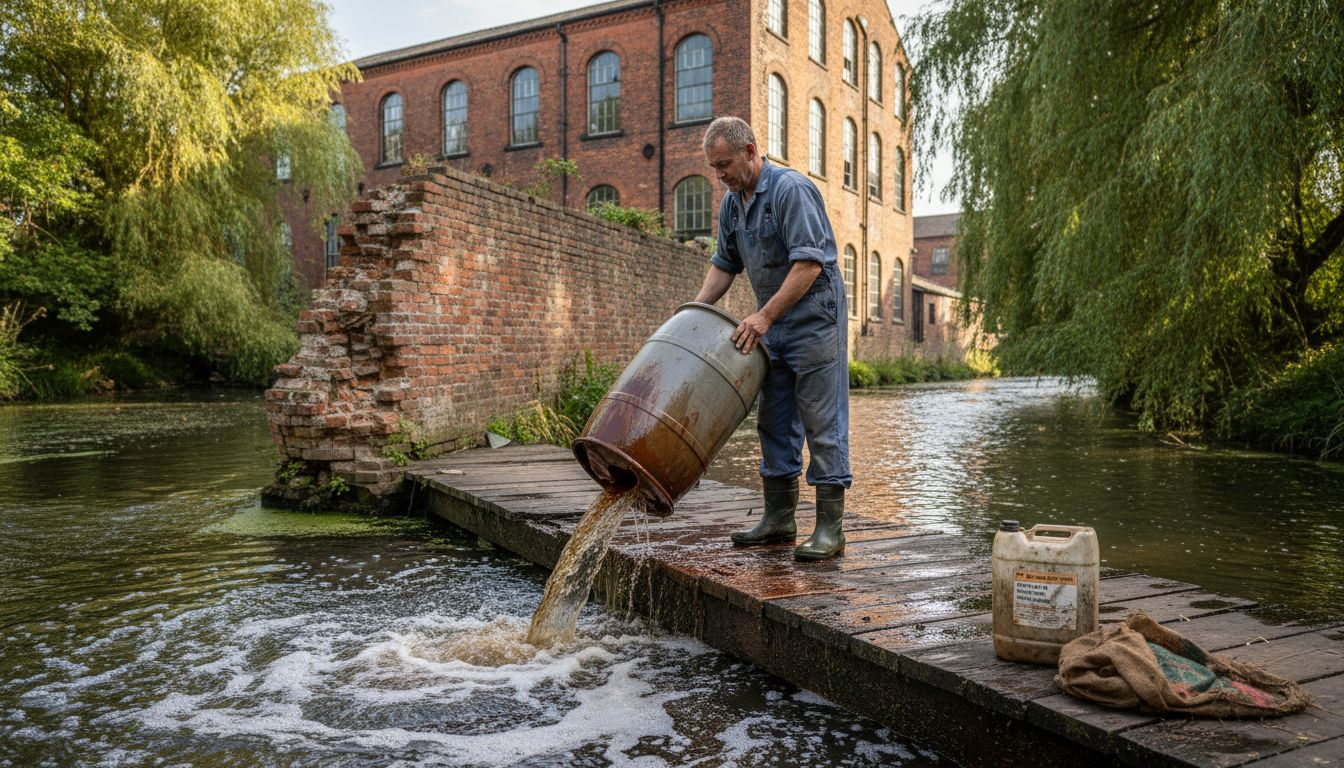
Chemical pollution from textile production represents one of the most severe impacts. Textile dyeing accounts for 20% of global industrial wastewater whilst releasing 1.2 million tons of hazardous chemicals annually into waterways. These chemicals include heavy metals, formaldehyde, and toxic dyes that poison aquatic ecosystems, kill marine life, and contaminate drinking water supplies. Manufacturing facilities frequently discharge untreated wastewater directly into rivers, devastating downstream communities and wildlife. The ecological impact of fast fashion extends to entire river systems rendered lifeless by industrial pollution.
Microplastic pollution creates another insidious threat. The fashion industry produces 10% of global microplastic pollution, primarily from synthetic fibres shedding tiny particles during washing. Each laundry cycle releases hundreds of thousands of microplastic fibres into wastewater systems. These particles pass through treatment facilities, entering oceans where they accumulate in marine food chains. Fish, seabirds, and marine mammals ingest microplastics, causing physical harm and introducing toxins that biomagnify through ecosystems.
Landfill waste represents the final pollution pathway. 85% of textiles end up in landfills annually, taking up to 200 years to decompose. As materials break down, they release methane and other greenhouse gases, contributing to climate change whilst leaching chemicals into soil and groundwater. The sheer volume overwhelms waste management infrastructure, creating toxic sites that contaminate surrounding environments for generations.
Biodiversity loss accelerates as pollution disrupts ecosystem functions. Contaminated waterways lose species diversity, whilst soil pollution reduces agricultural productivity. The cumulative effect weakens ecosystem resilience, making natural systems more vulnerable to climate change and other stressors. You’re witnessing a cascading crisis where pollution from fast consumerism fundamentally alters the natural world’s capacity to support life.
Common misconceptions about fast consumerism’s environmental costs
Several persistent myths prevent consumers from recognising and addressing fast consumerism’s true environmental burden. Challenging these misconceptions helps you make informed decisions and avoid greenwashing that obscures genuine sustainability issues.
- Myth: Cheap fast fashion products mean low environmental impact
Many assume low prices reflect minimal resource use and environmental costs. Reality tells a different story. Fast fashion’s business model incentivises rapid production and disposal cycles that prioritise quantity over quality, driven by social media trends and profit motives. Artificially low prices externalise environmental and social costs onto workers, communities, and ecosystems. You’re not seeing the true price when purchasing cheap items; you’re shifting costs to polluted rivers, exploited workers, and future generations facing climate impacts. The hidden cost of convenience reveals how bargain prices mask substantial environmental damage.
- Myth: Individual consumers have limited influence on environmental outcomes
Some believe personal shopping choices barely register against massive industrial systems. This misconception ignores how collective consumer behaviour shapes market demand and corporate practices. Consumer willingness to choose sustainable products influences company strategies, though price sensitivity and convenience preferences create complex purchasing patterns. When enough consumers demand sustainable options, companies respond by reformulating supply chains and product offerings. Your choices join millions of others, creating market signals that drive meaningful change.
- Myth: Sustainable alternatives are always unaffordable and inconvenient
Whilst some sustainable products carry premium prices, increasing market competition has improved accessibility and affordability across the UK. Durability often makes sustainable products more cost-effective over time, reducing replacement frequency. Many practical options exist that balance environmental benefits with reasonable costs. Charity shops, repair services, clothing swaps, and mindful purchasing strategies offer sustainable alternatives without financial strain.
Pro Tip: Start with small, manageable changes rather than attempting complete lifestyle transformation overnight. Choose one product category to focus on, research sustainable alternatives, and gradually expand your approach as you discover what works for your budget and lifestyle.
Comparing fast consumerism and sustainable alternatives: a framework
Understanding concrete differences between fast consumerism and sustainable consumption empowers you to make informed choices backed by data rather than marketing claims. This comparison reveals where sustainable alternatives offer measurable environmental advantages and what trade-offs you might encounter.
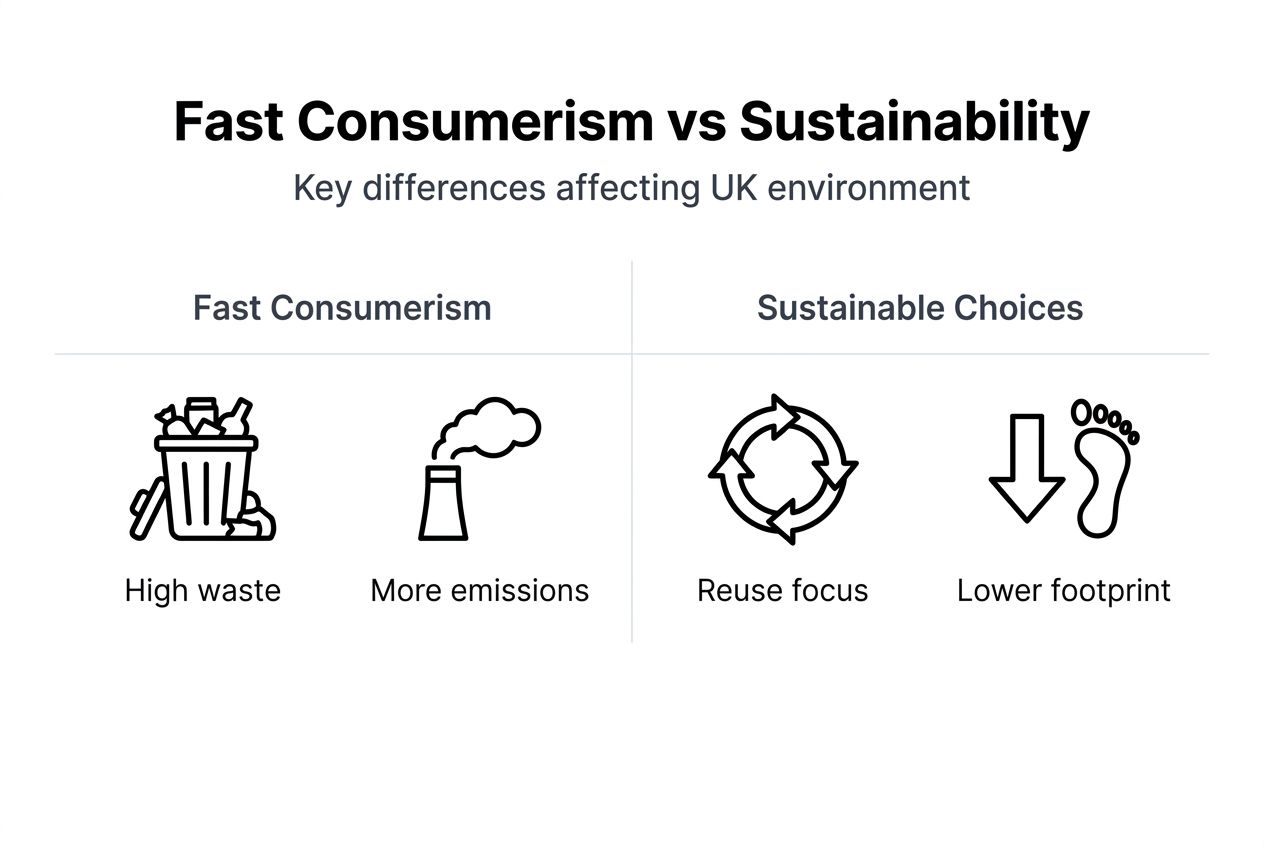
| Impact Category | Fast Consumerism | Sustainable Alternatives |
|---|---|---|
| Carbon Emissions | High emissions from frequent production cycles and global shipping networks | Significantly lower emissions; doubling product lifespan reduces emissions by 44% |
| Water Use | Intensive water consumption in textile production and manufacturing processes | Reduced water use through eco-friendly materials, recycled content, and efficient production |
| Waste Generation | 85% of textiles discarded annually end up in landfills with centuries-long decomposition | Minimal waste through durability, repairability, and circular economy principles |
| Chemical Pollution | 1.2 million tons of hazardous chemicals released annually from textile dyeing | Natural dyes, organic materials, and cleaner production methods dramatically reduce toxicity |
| Social Impact | Exploitative labour conditions and inadequate worker protections in supply chains | Fair wages, safe working conditions, and transparent supply chains |
| Economic Cost | Low upfront price but frequent replacement creates higher lifetime costs | Higher initial investment offset by durability, reduced replacement frequency, and lower environmental costs |
Sustainable alternatives demonstrate clear environmental advantages across multiple metrics. Carbon emissions drop substantially when you extend product lifespans through quality purchases and proper maintenance. Water conservation becomes significant when choosing organic cotton, recycled materials, or innovative fibres requiring minimal irrigation. Waste reduction proves most dramatic, as durable products designed for repair avoid the landfill trajectory plaguing fast fashion items.
Social and ethical dimensions reveal stark contrasts between production models. Fast consumerism frequently relies on exploitative labour practices in countries with weak worker protections, paying poverty wages whilst imposing dangerous working conditions. Sustainable brands increasingly prioritise supply chain transparency, fair wages, and safe facilities, ensuring your purchases support dignified working conditions rather than exploitation.
Economic trade-offs require honest assessment. Sustainable products often cost more initially, reflecting true production costs rather than externalised environmental damage. However, durability extends product lifespans significantly, reducing replacement frequency and lowering lifetime costs. A quality jacket worn for ten years costs less per wear than cheap alternatives replaced annually. You’re making an investment that pays environmental and financial dividends over time.
Practical steps for UK consumers to shop sustainably and reduce impact
Transforming awareness into action requires concrete strategies you can implement immediately. These practical steps reduce your environmental footprint whilst maintaining a fulfilling lifestyle aligned with your values and budget.
Extending product lifespans represents the single most effective strategy for reducing consumption impacts. Care for clothing properly through appropriate washing temperatures, air drying, and prompt repairs. Learn basic mending skills or support local repair businesses for more complex fixes. Consider each purchase’s longevity potential, choosing quality items designed for durability over trendy pieces with limited wear potential. UK consumers discard 7kg of clothing waste annually, highlighting how extending lifespans could dramatically reduce waste.
Choosing sustainable brands requires research but yields significant environmental benefits. Look for companies using organic materials, recycled content, or innovative sustainable fibres. Verify certifications like GOTS for organic textiles, Fair Trade for ethical production, or B Corp status indicating comprehensive sustainability commitments. Explore eco-friendly home products that reduce environmental impacts across multiple product categories. Prioritise transparency, favouring brands openly sharing supply chain information over those making vague green claims.
Waste reduction strategies extend beyond product selection to encompass entire consumption patterns. Adopt zero waste lifestyle principles by refusing unnecessary purchases, reducing overall consumption, reusing items creatively, and recycling properly. Plan purchases carefully to avoid impulse buying driven by marketing manipulation or social media trends. Create a waiting period before non-essential purchases, allowing time to assess genuine need versus fleeting desire.
Sustainable shopping strategies include:
- Buying secondhand through charity shops, vintage stores, or online platforms
- Participating in clothing swaps with friends or community groups
- Renting special occasion items rather than purchasing rarely worn pieces
- Supporting local businesses and makers with transparent production practices
- Maintaining a capsule wardrobe focused on versatile, quality pieces
Pro Tip: Keep a wishlist for non-essential items and revisit it monthly. You’ll often find initial desire fades, preventing unnecessary purchases whilst ensuring items you do buy reflect genuine needs and preferences rather than momentary impulses.
Systemic changes and policy directions to curb fast consumerism’s harm
Whilst individual actions matter greatly, systemic changes prove essential for addressing fast consumerism’s environmental crisis at scale. Government policies, industry accountability measures, and broader cultural shifts create frameworks enabling sustainable consumption patterns across society.
Government regulations increasingly target greenwashing and improve waste management infrastructure. UK policies now require companies to substantiate environmental claims with verifiable data, reducing misleading green marketing. Extended producer responsibility schemes make manufacturers accountable for product end-of-life disposal, incentivising durable, recyclable designs. Waste management improvements include better textile recycling facilities and programmes diverting materials from landfills toward reuse and recycling streams.
Industry accountability initiatives push companies toward genuine sustainability rather than superficial gestures. Supply chain transparency requirements force brands to disclose manufacturing locations, working conditions, and environmental practices. Some retailers now publish environmental impact data, enabling consumers to compare brands meaningfully. Circular economy business models gain traction, with companies offering repair services, take-back programmes, and products designed for disassembly and material recovery.
Consumer education plays a crucial role in shifting demand patterns. As more people understand how consumerism influences desire, they resist manipulative marketing and make deliberate purchasing choices. Educational campaigns highlighting fast consumerism’s environmental costs empower consumers to question throwaway culture and embrace sustainable alternatives. However, consumer willingness to choose sustainable products doesn’t always translate into action due to price sensitivity and convenience preferences, demonstrating the complexity of behaviour change.
Systemic change requires:
- Stronger regulations penalising environmental damage and greenwashing
- Industry standards mandating supply chain transparency and ethical production
- Investment in recycling infrastructure and circular economy systems
- Educational programmes building widespread environmental literacy
- Cultural shift away from status consumption toward mindful purchasing
The most effective approach combines consumer action with systemic reform. Your purchasing decisions create market signals whilst supporting policy changes that make sustainable options more accessible and affordable. Fast fashion’s business model incentivises rapid disposal cycles, but collective consumer pressure and regulatory reform can fundamentally reshape industry practices toward genuine sustainability.
Summary: balancing convenience with environmental responsibility
Fast consumerism presents profound environmental challenges that demand urgent attention and action. You’ve seen how this ‘fast everything’ culture depletes resources, pollutes ecosystems through chemical discharge and microplastics, generates massive waste, and accelerates climate change. The scale of impact extends from local waterways contaminated by textile dyeing to global carbon emissions threatening planetary stability.
Your informed choices create meaningful change when multiplied across millions of consumers. Small actions like extending product lifespans, choosing sustainable brands, and reducing unnecessary purchases collectively shift market demand toward environmental responsibility. These personal steps work best alongside systemic reforms that make sustainable options more accessible whilst holding industries accountable for environmental damage.
Balancing convenience with sustainability doesn’t require perfection or complete lifestyle transformation. Focus on gradual improvements that align with your values, budget, and circumstances. Research sustainable alternatives in product categories you purchase frequently. Support policy changes that strengthen environmental regulations and improve waste management. Share knowledge with friends and family, expanding collective awareness and action.
Practical integration strategies:
- Start with one product category and gradually expand sustainable choices
- Prioritise quality over quantity in purchasing decisions
- Learn basic repair skills to extend product lifespans
- Support brands demonstrating genuine environmental commitment through transparent practices
- Engage with women’s clothing style guide resources that emphasise timeless, versatile pieces over fast fashion trends
The environmental crisis demands both individual responsibility and systemic transformation. You have power as a consumer to drive change through purchasing decisions whilst advocating for policies that address fast consumerism’s structural causes. Every mindful choice contributes to building a more sustainable economy that respects planetary boundaries and protects ecosystems for future generations.
Discover sustainable products that support the environment
You’ve explored fast consumerism’s environmental impacts and learned practical strategies for reducing your footprint. Now take the next step by discovering sustainable products that align with your values. STOMART offers eco-conscious UK consumers a curated selection spanning home goods, fashion, beauty, and lifestyle categories with environmental responsibility in mind.
Explore products designed for durability, made from sustainable materials, or supporting circular economy principles. Compare options, read detailed descriptions, and make informed choices that reduce your environmental impact without sacrificing quality or convenience. Whether you’re seeking eco-friendly home essentials, sustainable fashion pieces, or zero-waste alternatives, you’ll find options that help translate environmental awareness into practical action. Visit the online store today and start building a more sustainable lifestyle through thoughtful purchasing decisions.
Frequently asked questions
What are the main environmental harms caused by fast consumerism?
Fast consumerism depletes water and energy resources whilst producing significant carbon emissions from constant manufacturing cycles. It generates toxic chemical pollution through industrial processes like textile dyeing, releases microplastics into oceans, and creates vast waste with 85% of textiles ending in landfills. These impacts harm biodiversity, contaminate ecosystems, and accelerate climate change through resource extraction and pollution.
How can UK consumers make more sustainable shopping choices?
Extend product lifespans through proper care, repair, and mindful purchasing of quality items designed for durability. Choose brands prioritising eco-friendly materials, ethical production, and supply chain transparency. Reduce waste by planning purchases carefully, avoiding impulse buying, shopping secondhand, and exploring zero waste lifestyle tips that minimise consumption impacts.
What systemic changes are being made to reduce fast consumerism’s impact?
Government policies increasingly improve waste management infrastructure and verify green claims to prevent greenwashing. Industry moves toward greater supply chain transparency, extended producer responsibility, and circular economy models emphasising repair and recycling. Consumer education programmes build environmental literacy whilst understanding how consumerism influences desire helps people resist manipulative marketing.
Are sustainable products always more expensive and inconvenient?
Sustainable products increasingly offer competitive pricing as market competition grows across the UK. Whilst some items carry higher upfront costs, durability often makes them more economical over time through reduced replacement frequency. Many practical options exist that balance affordability, convenience, and environmental benefits, including secondhand shopping, repair services, and accessible sustainable brands.
How does extending product lifespan reduce environmental impact?
Doubling clothing lifespan reduces greenhouse gas emissions by 44% by avoiding repeated manufacturing, transport, and disposal cycles. Extended use decreases demand for new production, conserving water, energy, and raw materials whilst reducing waste sent to landfills. This simple strategy represents one of the most effective individual actions for lowering consumption’s environmental footprint.