

How weather impacts mood, conflict, and decisions
on Apr 07, 2026TL;DR:
- Weather significantly influences mood, behavior, and societal conflict across populations.
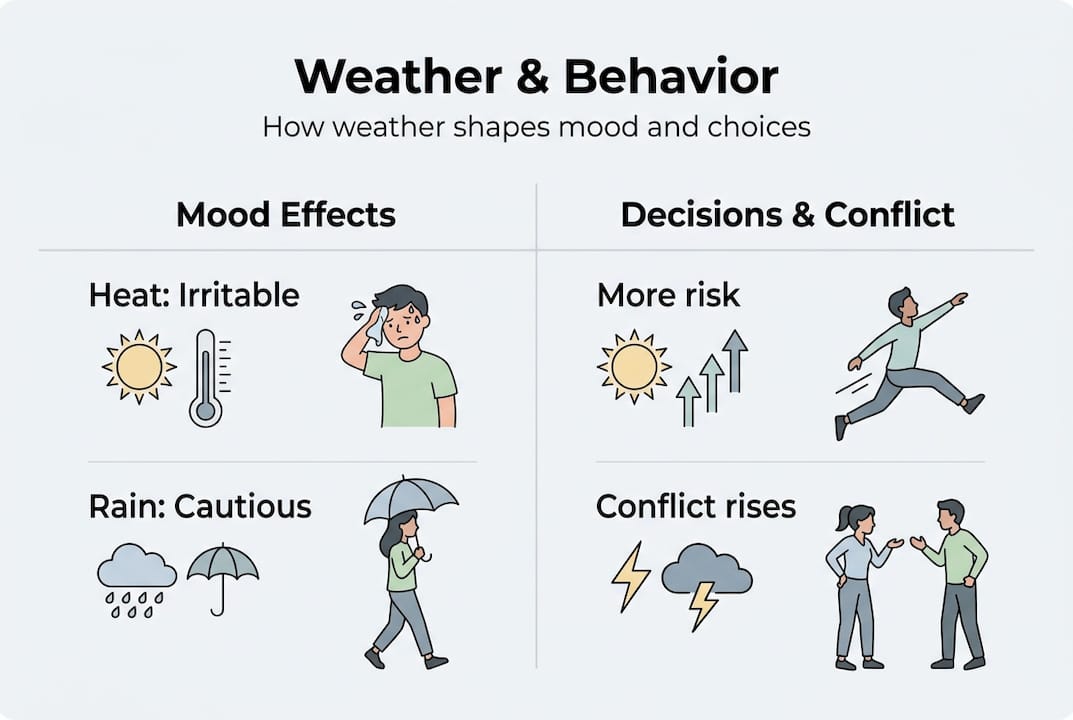
- Extreme heat raises aggression and negative emotions, especially in vulnerable groups.
- Seasonal and environmental factors affect decision-making, stress levels, and social interactions.
Weather is not just background noise. A 25% rise in negative sentiment linked to extreme heat in lower-income countries suggests our emotional lives are more tethered to the thermometer than most of us care to admit. From the irritability that creeps in during a heatwave to the cautious, stay-indoors mentality of a grey November afternoon, atmospheric conditions shape how we feel, how we treat others, and the choices we make. This article unpacks the evidence, explores the surprising scale of these effects, and offers a clearer picture of how weather quietly steers human behaviour every single day.
Key Takeaways
| Point | Details |
|---|---|
| Heat drives negative mood | Just a small rise in temperature can dramatically worsen mood and increase irritability for many people. |
| Weather influences risk | Sunny days promote optimism and risk-taking while rainy weather encourages caution and restraint. |
| Conflicts rise after extreme weather | Floods and high temperatures are directly linked to more aggression and even local armed conflict. |
| Effects depend on context | Personal habits, regional climate, and social adaptation all shape how strongly weather impacts emotions and choices. |
The science behind weather and mood
The relationship between weather and human emotion is not new territory, but the scale of modern evidence is striking. For years, researchers relied on small surveys and self-reported mood diaries. Today, large-scale digital data paints a far more convincing picture. Analysing millions of internet searches, scientists have found that depression, anxiety, and loneliness search rates rise sharply with every 1°C increase in temperature. That is not a small signal buried in statistical noise. It is a consistent, population-wide pattern.
The biological mechanisms are well understood. Serotonin, the neurotransmitter closely tied to feelings of wellbeing, is produced at higher rates during exposure to natural light. When daylight hours shrink in winter, serotonin production drops and melatonin, the hormone that promotes sleep and low energy, rises. This shift disrupts circadian rhythms, the internal clocks that regulate sleep, appetite, and mood. The result is the familiar sluggishness and low motivation many people experience during darker months.
Heat works differently. Rather than suppressing serotonin, excessive warmth triggers physiological stress responses. The body diverts energy to cooling itself, leaving less cognitive and emotional resource available for calm, rational processing. This is why contrasting studies have emerged over decades, with older research sometimes finding weak or mixed effects. Those studies often used small samples or failed to account for regional adaptation. Modern data, drawn from billions of digital interactions, supports strong and consistent weather effects.
Vulnerable populations feel these effects most acutely. Elderly individuals, those with pre-existing mental health conditions, and people in lower-income brackets show amplified mood responses to temperature shifts. Interestingly, this mirrors findings about stress and home productivity, where environmental stressors compound one another in ways that are easy to underestimate.
Key mood-weather links at a glance:
- Rising temperatures correlate with higher rates of anxiety and loneliness searches
- Winter light reduction lowers serotonin and raises melatonin
- Extreme heat disrupts circadian rhythms and cognitive processing
- Vulnerable groups experience stronger emotional responses to weather shifts
- Digital search behaviour now provides real-time population-level mood data
| Weather condition | Primary biological effect | Mood outcome |
|---|---|---|
| High heat (above 30°C) | Physiological stress, cortisol rise | Irritability, anxiety |
| Low winter light | Reduced serotonin, raised melatonin | Low mood, fatigue |
| Mild, sunny conditions | Serotonin boost, stable rhythms | Improved wellbeing |
| Overcast, cold | Reduced outdoor activity | Social withdrawal |
Pro Tip: If you notice your focus or mood dipping during grey stretches, consider supplementing natural light exposure with a daylight lamp. Even short bursts of bright light in the morning can help stabilise your circadian rhythm and lift your baseline mood.
How weather shapes conflict, aggression, and group behaviour
Individual mood shifts are one thing. What happens when those shifts scale up across communities is far more consequential. The heat-aggression hypothesis, one of the most studied ideas in environmental psychology, proposes that high temperatures create physiological arousal that the brain misreads as anger or threat. The result is a lower threshold for hostile behaviour.
Recent historical analysis of the Taiping Rebellion in China found that floods significantly increase local armed conflicts far more than droughts do. This is a counterintuitive finding. Droughts are often seen as the more destabilising force, yet floods, with their sudden displacement, resource destruction, and community trauma, appear to tip communities into direct violence more reliably. The effect is highly localised, strongest within 10 kilometres of the impacted area.
Contemporary crime data supports the same pattern. Research from South Africa demonstrates that air temperature and precipitation dramatically increase violent crime rates. Hotter, wetter conditions create a volatile combination of physiological stress and disrupted daily routines. Meanwhile, Chinese crime data reveals that extreme heat increases crime following a nonlinear pattern, meaning the relationship is not a straight line. Once temperatures cross certain thresholds, crime rates climb sharply and disproportionately.
This matters for how we understand the impact of weather on retail and public spaces too. Businesses and urban planners who dismiss weather as irrelevant to customer behaviour or community safety are missing a significant variable. Effective strategies for customer satisfaction increasingly account for environmental context, including seasonal mood shifts and weather-driven footfall changes.
How weather escalates conflict: a comparison
| Weather event | Conflict type | Scale of effect |
|---|---|---|
| Floods | Direct local violence | High, within 10km |
| Droughts | Indirect, resource tension | Moderate, dispersed |
| Sustained heat | Aggression, violent crime | High, nonlinear above threshold |
| Mild conditions | Reduced hostility | Lower conflict rates |
The escalation sequence in heat-driven aggression:
- Core body temperature rises above comfortable range
- Physiological arousal increases, mimicking the stress response
- The brain interprets this arousal as social threat or frustration
- Impulse control weakens as cognitive resources are diverted to cooling
- Minor provocations trigger disproportionate reactions
- At population scale, this aggregates into measurable crime and conflict spikes
“The relationship between heat and human hostility is not metaphorical. It is physiological, measurable, and consistent across cultures and centuries.”
Weather’s influence on everyday decisions and risk-taking
Beyond mood and conflict, weather quietly reshapes the quality of our everyday judgements. Cognitive performance is not immune to atmospheric conditions. Temperatures above 85°F impair decision-making and reduce focus, a finding with real implications for workplaces, financial markets, and anywhere that careful thinking matters.

Sunny days carry their own bias. Sunny weather increases optimism and risk-taking, while rainy weather nudges people towards caution and reduced spending. This is not simply about feeling cheerful. Optimism changes the mental models we use to evaluate risk. On a bright day, losses feel less likely, gains feel more certain, and we are more willing to commit to uncertain outcomes. Investors, gamblers, and even job applicants have been shown to behave more boldly on sunny days.
Rainy conditions reverse this. Caution rises, spending drops, and people are more likely to delay decisions or avoid commitments. Retailers and marketers have long suspected this intuitively, but the behavioural science now confirms it. Understanding emotional buying and decisions means accounting for the sky outside as much as the sale inside.
Individual differences do moderate these effects. People who are highly aware of their own emotional states, a trait psychologists call high emotional intelligence, tend to show smaller weather-driven decision shifts. Regular outdoor exposure and physical activity also buffer the cognitive impacts of heat. And of course, weather-driven style choices reflect this same adaptive instinct: we adjust our external presentation to match both the conditions and our internal state.
Practical ways weather shifts your decision-making:
- Hot days reduce patience and increase impulsive choices
- Sunny conditions inflate confidence and willingness to take financial risks
- Rainy days encourage conservative, risk-averse behaviour
- Overcast weather is associated with more analytical, detail-focused thinking
- Extreme conditions of any kind narrow attention and reduce creative problem-solving
Pro Tip: Before making a significant financial or personal decision on a sweltering day, pause and ask whether you would feel the same way in cooler, calmer conditions. This simple check can counteract heat-driven impulsivity.
Seasonal variation and individual differences
Not everyone responds to weather in the same way, and not every place experiences the same effects. This is where the science becomes genuinely nuanced. Research on temperature in cold seasons shows that in cooler climates, higher ambient temperatures during winter months actually lower stress and boost life satisfaction. Warmth, in that context, is a relief rather than a stressor. The same temperature that triggers irritability in a tropical city might feel like a gift in Edinburgh in February.
Vulnerable populations consistently show amplified responses. Elderly individuals face greater physiological stress from heat. People in low-income communities, with less access to air conditioning, green space, or flexible working arrangements, absorb more of the emotional burden of weather extremes. Children and those with pre-existing anxiety disorders are also disproportionately affected.
Urban environments intensify these effects through the heat island effect, where dense building materials absorb and radiate heat, pushing city temperatures several degrees above surrounding rural areas. Rural populations, by contrast, often have more access to shade, natural water, and outdoor space, which buffers emotional responses to temperature shifts.
Adaptation plays a fascinating role. Populations that regularly experience extreme weather develop behavioural and physiological coping strategies over time. This blunts, but does not eliminate, the mood and decision effects. Seasonal patterns in aggression, depression, and risk-taking remain visible even in well-adapted populations, particularly during the transition periods between seasons.
Who feels weather effects most strongly:
- Elderly individuals with reduced thermoregulation capacity
- Low-income populations with limited environmental control
- Urban residents in high-density heat islands
- People with pre-existing anxiety, depression, or mood disorders
- Those in regions experiencing rapid or unusual seasonal shifts
Exploring a seasonal style roadmap is one practical way to stay ahead of these shifts, aligning your wardrobe and daily habits with the emotional rhythms of the year.
Why understanding weather’s impact on mood and behaviour really matters
The prevailing assumption is that weather is trivial background context, something we mention in small talk precisely because it seems inconsequential. The data says otherwise. Population-scale effects on mood, conflict, and decision-making mean that weather is a genuine variable in public health, economic planning, and social policy.
Ignoring this leads to real errors. Misreading a spike in aggression or a dip in consumer confidence as purely economic or political, when it is partly atmospheric, produces flawed analysis and poor responses. Recognising hormones and human behaviour as environmentally sensitive is not a soft or speculative claim. It is a practical insight with hard applications.
As climate change accelerates, these insights become urgent. More frequent heatwaves, unpredictable seasonal shifts, and extreme precipitation events will amplify the psychological and social effects we have documented here. The individuals and institutions that understand this will be better positioned to adapt, support vulnerable people, and make clearer decisions when conditions are working against them.
Explore more and take action
Understanding how weather shapes your mood, choices, and environment is only the first step. At STOMART, we believe that living well means staying attuned to the conditions around you, whether that is choosing the right outfit for a changeable British day or creating a home environment that supports your wellbeing through every season. Browse our weather-based fashion guides for practical, style-conscious advice that works with the forecast rather than against it. From comfort-focused home goods to seasonal fashion picks, STOMART brings together everything you need to adapt and thrive, whatever the weather brings.

Frequently asked questions
How does heat specifically affect human emotions and behaviour?
Heat increases irritability, anxiety, and impulsive actions, particularly above 30°C, with extreme heat linked to a 25% rise in negative sentiment in lower-income countries.
Does rainy weather really make people more cautious?
Yes. Rainy weather increases caution and reduces risk-taking and spending, as the brain shifts into a more conservative, analytical mode under grey skies.
Are the effects of weather on conflict as strong as on mood?
Weather has powerful localised effects on conflict during extremes, with floods increasing conflict likelihood significantly within 10 kilometres of impacted areas.
Do all people react the same way to weather changes?
No. Reactions vary by age, location, season, and personal adaptation, with stronger effects in vulnerable groups such as the elderly and those in low-income communities.
Recommended
- How cities shape your personality and emotional health - STOMART.CO.UK
- How to Dress for the Weather With Style - STOMART.CO.UK
- How modern architecture improves mood, memory and connection - STOMART.CO.UK
- What Your Sleep Setup Says About Your Mental Health - STOMART.CO.UK
- Why Naming Your Feelings Helps — The Caia Journal