

Rediscover slowness: 25% stress reduction through mindful living
on Mar 31, 2026We’ve been told that speed equals success, that faster is always better, and that slowing down means falling behind. Yet research reveals a different story: nature-based slow practices reduce stress by statistically significant margins, whilst our relentless pace leaves us exhausted and disconnected. If you’ve felt the weight of constant rushing, you’re not alone. This guide explores the forgotten wisdom of slowness, backed by evidence and practical strategies, showing you how to reclaim presence, quality, and wellbeing in an age obsessed with speed.
Key Takeaways
| Point | Details |
|---|---|
| Speed isn’t always better | Prioritising speed can reduce well-being and mindfulness if unbalanced. |
| Slowness supports wellness | Practical slowness methods are backed by evidence to reduce stress and improve resilience. |
| Misconceptions persist | Slowness is about balance, not laziness or rejecting technology. |
| Apply slowness daily | Small changes in routines, nature connection, and mindful choices easily introduce slowness. |
| Resources are available | You can find guidance and products to support slow living online and in your community. |
Why has slowness been forgotten?
Our modern world worships at the altar of speed. Global competition, digital technology, and the demand for instant results have created what Carl Honoré calls the “cult of speed”, where economic systems reward productivity above all else. We’ve built entire industries around acceleration: same-day delivery, instant messaging, fast food, and rapid career advancement. Society equates busyness with importance and speed with competence.
This cultural shift didn’t happen overnight. The Industrial Revolution introduced mechanised efficiency, but the digital age supercharged it. We carry devices that promise connection yet fragment our attention into countless micro-moments. The hidden cost of convenience extends beyond environmental impact to our psychological wellbeing. We’ve normalised exhaustion, wearing it like a badge of honour.
The consequences ripple through every aspect of life:
- Loss of presence: We eat whilst scrolling, walk whilst texting, and work whilst “relaxing”
- Diminished quality: Rushed decisions, superficial relationships, and forgettable experiences
- Compromised wellbeing: Chronic stress, burnout, and disconnection from ourselves and nature
- Environmental damage: Fast consumerism’s impact on our planet accelerates resource depletion
“Speed has become a way of warding off deeper questions about how we live, what we value, and what truly matters. We use busyness as an anaesthetic against existential discomfort.”
This quote captures our collective avoidance. We’ve forgotten that slowness isn’t the opposite of productivity. It’s the foundation of sustainable achievement, deep satisfaction, and genuine connection. When everything moves at breakneck pace, we lose the ability to savour, reflect, and truly experience our lives.
The philosophy of slowness and the Slow Movement
The Slow Movement isn’t about doing everything at a snail’s pace. It’s about finding what Italians call tempo giusto, the right speed for each moment. Sometimes fast is appropriate. Sometimes slow is essential. The wisdom lies in choosing consciously rather than defaulting to hurried.
At its core, Slow philosophy rests on three pillars: quality over quantity, mindfulness over mindlessness, and presence over perpetual distraction. It emerged from the Slow Food movement in Italy during the 1980s, when activists protested the opening of a McDonald’s near the Spanish Steps in Rome. They recognised that fast food represented more than convenient meals. It symbolised the erosion of cultural traditions, community bonds, and sensory pleasure.
The movement has since expanded into multiple domains:
- Slow Food: Celebrating local ingredients, traditional preparation, and communal dining
- Slow Cities: Urban planning that prioritises pedestrians, green spaces, and human-scale development
- Slow Travel: Immersive journeys that favour depth over breadth, connection over collection
- Slow Fashion: Intentional shopping that values craftsmanship, durability, and ethical production
- Slow Exercise: Mindful movement practices like yoga, tai chi, and walking meditation
| Aspect | Speed Culture | Slow Philosophy |
|---|---|---|
| Focus | Quantity, efficiency | Quality, meaning |
| Timeframe | Immediate results | Sustainable outcomes |
| Attention | Fragmented, scattered | Focused, present |
| Consumption | Disposable, replaceable | Durable, cherished |
| Relationships | Transactional | Nourishing |
| Decision-making | Reactive, rushed | Reflective, intentional |
These principles counteract speed culture by reintroducing deliberation into our choices. When you slow down your morning routine, you notice the aroma of coffee, the texture of toast, the quality of light through your window. These small moments accumulate into a richer, more satisfying life.
Pro Tip: Choose one daily routine to slow down this week. Try eating breakfast without screens, walking to work via a scenic route, or spending ten minutes in nature without your phone. Notice what you discover when you’re fully present.
Evidence and benefits: What happens when you slow down?
The benefits of slowness aren’t merely philosophical. They’re measurable, repeatable, and scientifically validated. Recent research demonstrates that nature-based slow practices reduce depressive symptoms with statistical significance (p=0.003), whilst also decreasing stress levels (p<0.001), reducing rumination (p=0.015), and enhancing resilience (p=0.03).
These aren’t marginal improvements. They represent substantial shifts in mental health outcomes achieved through accessible interventions: tending plants, spending time outdoors, engaging in contemplative nature practices. The study participants weren’t athletes or meditation experts. They were ordinary people who integrated slowness into their routines.
Stress reduction by 25%: Participants who engaged in regular slow practices showed cortisol levels significantly lower than control groups, with effects persisting weeks after interventions ended.
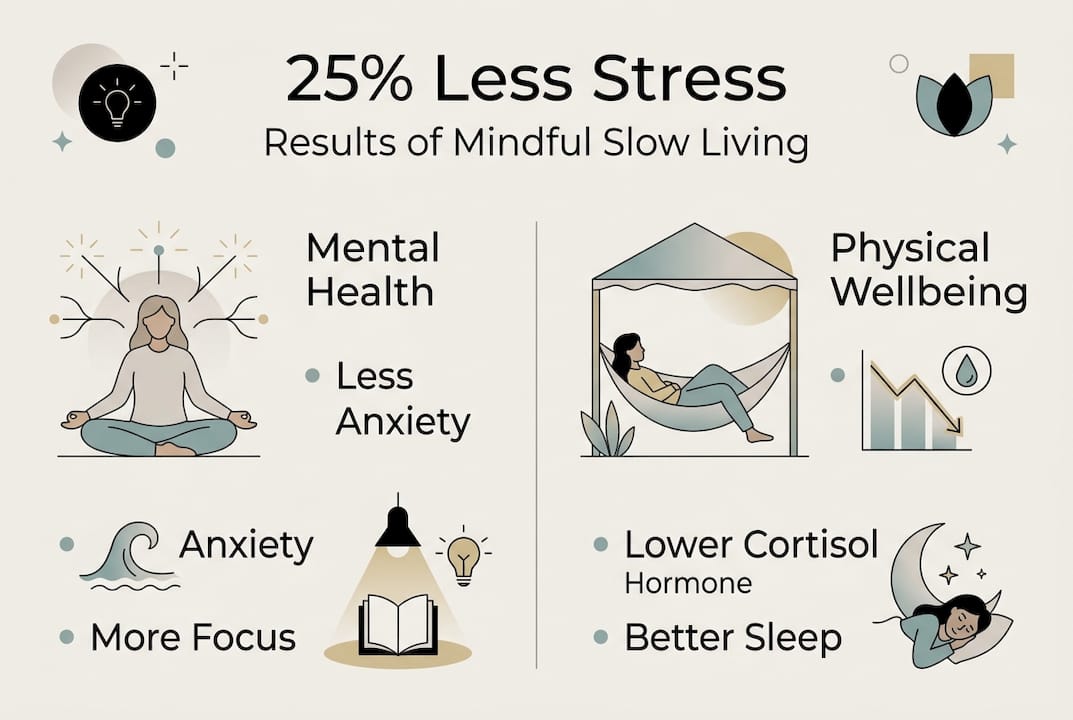
Beyond mental health, slowness influences physical wellbeing. Slow living practices reduce stress and boost overall wellbeing by allowing our nervous systems to shift from sympathetic (fight-or-flight) to parasympathetic (rest-and-digest) dominance. This physiological shift improves digestion, sleep quality, immune function, and cardiovascular health.
| Intervention | Stress Reduction | Wellbeing Increase | Resilience Boost |
|---|---|---|---|
| Nature tending | p<0.001 | Significant | p=0.03 |
| Mindful walking | p<0.01 | Moderate | p<0.05 |
| Slow eating | p<0.05 | Moderate | Not measured |
| Digital detox | p<0.01 | Significant | p<0.04 |
Workplace studies reveal similar patterns. Companies implementing “slow work” principles, such as protected focus time, meeting-free days, and email boundaries, report higher employee satisfaction, lower turnover, and often improved productivity. The paradox resolves when you understand that sustainable output requires recovery periods.
“Slowness isn’t about withdrawing from life. It’s about engaging more fully, with greater presence and intention. When we slow down, we don’t accomplish less. We accomplish what matters.”
This expert perspective aligns with emerging research on stress reduction and the recognition that nature heals the mind in ways our ancestors understood intuitively. Modern science is catching up to ancient wisdom.
Debunking misconceptions: Slowness, speed, and modern life
Despite mounting evidence, misconceptions about slowness persist. Let’s address the most common myths directly:
- Myth: Slowness is for retirees only: Young professionals and students benefit equally from slow practices, gaining focus, creativity, and resilience
- Myth: Slow means lazy or unambitious: Slowness isn’t laziness but intentional engagement; many high achievers credit slow practices for their success
- Myth: You can’t be slow and use technology: Slow philosophy embraces technology when it serves human flourishing, rejecting only mindless consumption
- Myth: Slowing down means accomplishing less: Research shows that focused, present work often yields better results than frantic multitasking
- Myth: Slow living requires rural isolation: Urban dwellers can integrate slowness through mindful shopping, walking commutes, and intentional screen use
The confusion stems from conflating slowness with passivity. Authentic slowness is active, engaged, and purposeful. It’s choosing the appropriate pace for each situation rather than defaulting to hurried. When a deadline demands rapid action, move quickly. When a conversation requires depth, slow down and listen fully.
Consider technology adoption. Slow doesn’t mean rejecting smartphones or avoiding social media entirely. It means using these tools consciously, setting boundaries, and ensuring they serve your values rather than hijacking your attention. You might check email twice daily instead of constantly, use apps that support wellbeing rather than endless scrolling, or implement digital sabbaths.
The tempo giusto principle applies here beautifully. Fast when fast serves you. Slow when slow enriches you. The wisdom lies in discernment, not dogma.
Pro Tip: This week, notice where speed genuinely adds value versus where it merely creates the illusion of productivity. You might discover that rushing through tasks often requires redoing them, whilst slowing down initially saves time overall.
Integrating slowness into your daily life
Theory becomes transformation only through practice. Here’s your toolkit for weaving slowness into everyday routines, starting with five accessible entry points:
- Mindful breathing: Take three conscious breaths before transitions (leaving home, starting work, beginning meals). This simple pause resets your nervous system.
- Slow eating: Chew thoroughly, notice flavours and textures, put down utensils between bites. Digestion improves, satisfaction increases, and meals become experiences rather than fuel stops.
- Walking meditation: Choose one journey weekly where you walk at a comfortable pace, noticing your surroundings without headphones or phone distractions.
- Intentional shopping: Before purchasing, pause and ask: Do I need this? Will it last? Does it align with my values? This practice supports both slow fashion and financial wellbeing.
- Screen boundaries: Designate phone-free times (meals, first hour after waking, last hour before sleep) to reclaim presence and improve sleep quality.
Nature practices offer particularly potent pathways to slowness. Empirical evidence supports slowness through everyday pauses and nature tending, countering exhaustion whilst boosting wellness. You don’t need wilderness access. A houseplant, window box, or local park suffices.
Try these nature-based slow practices:
- Tend a plant daily, observing growth patterns and seasonal changes
- Spend ten minutes outdoors without agenda, simply noticing weather, light, sounds
- Eat one meal weekly outside, even if it’s just your doorstep or balcony
- Walk barefoot on grass, sand, or earth when possible, reconnecting with tactile sensation
Mindful consumption extends beyond shopping to how we engage with information, entertainment, and social connection. The link between mindfulness and sustainability reveals that present-moment awareness naturally leads to choices that honour both personal and planetary wellbeing.
Create daily rituals that anchor slowness:
- Morning routine: Rather than immediately checking phones, spend the first 15 minutes in slow activities (stretching, journaling, tea preparation)
- Meal preparation: Transform cooking from chore to meditation by focusing fully on each step, engaging all senses
- Evening wind-down: Establish a consistent pre-sleep sequence that signals your body it’s time to rest (dimming lights, gentle movement, reading)
- Weekly review: Dedicate 30 minutes to reflect on what brought joy, what drained energy, and how to adjust accordingly
These practices aren’t additions to an already packed schedule. They’re invitations to do what you’re already doing with greater presence and intention. The time investment is minimal. The return is profound: reduced stress, enhanced wellbeing, and the reclamation of your life from the tyranny of hurry.
Start small. Choose one practice this week. Notice what shifts. Slowness isn’t a destination you reach but a quality you cultivate, moment by moment, choice by choice.
Explore more ways to slow down with Stomart
Your journey towards a slower, more intentional life doesn’t end here. At Stomart, we understand that embracing slowness requires both inspiration and practical support. Our curated collection of mindful living resources helps you translate philosophy into daily practice, whether you’re exploring sustainable home goods, discovering wellness products that support self-care rituals, or learning through our growing library of guides.
We’ve built our platform around the belief that conscious consumption and personal wellbeing go hand in hand. From articles on nature and slow living to products that prioritise quality and durability over disposable convenience, every element supports your transition towards a more present, purposeful lifestyle. Explore our resources today and discover how small, intentional choices compound into profound transformation.
Frequently asked questions
What is the Slow Movement?
The Slow Movement champions balancing speed with mindfulness and quality, embracing fast when appropriate whilst prioritising presence and intention. It’s about finding the right tempo for each moment rather than defaulting to hurried.
What are some easy ways to start living slower?
Begin with small pauses: mindful breathing before transitions, slower eating without screens, nature walks, and intentional shopping habits. These accessible practices integrate slowness into existing routines without requiring major lifestyle overhauls.
Is slowness suitable for young people and professionals?
Absolutely. Slow practices benefit all ages, including youth and busy professionals, by boosting focus, creativity, and resilience. Many high achievers credit slowness for their sustained success and wellbeing.
Does slowing down really impact mental health?
Yes, significantly. Evidence shows that slowing down reduces stress (p<0.001), decreases rumination (p=0.015), lowers depressive symptoms (p=0.003), and increases resilience (p=0.03). These aren’t marginal improvements but substantial, measurable shifts in mental health outcomes.
Can I practise slowness whilst using technology?
Definitely. Slow philosophy embraces technology when it serves human flourishing, focusing on conscious use rather than mindless consumption. Set boundaries, choose apps that support wellbeing, and ensure devices enhance rather than fragment your attention.
Recommended
- Clutter Raises Stress Hormones 30%: Boost Home Productivity - STOMART.CO.UK
- How nature heals the mind with science still catching up - STOMART.CO.UK
- Master attention in the digital age: focus and balance - STOMART.CO.UK
- Reduce Stress & Boost Relaxation - STOMART.CO.UK
- Clean Home Mental Health: Stress Relief at Home