

What rivers teach about resistance, flow and purpose
on Mar 24, 2026Rivers are far more than simple channels of moving water. They embody profound lessons about navigating resistance, sustaining momentum, and pursuing meaningful direction. For those seeking inspiration from nature and personal growth, rivers offer a masterclass in adaptive resilience and purposeful living. By observing how water shapes landscapes and overcomes obstacles, we uncover insights directly applicable to mindfulness, philosophy, and environmental consciousness. This exploration reveals how natural phenomena mirror our own journeys through life’s challenges and opportunities.
Key Takeaways
| Point | Details |
|---|---|
| Resistance as catalyst | Obstacles prompt rivers to carve new channels, illustrating how resistance can drive transformation rather than halt progress. |
| Adaptive navigation | Rivers split, meander, and erode around barriers showing that flexible strategies turn impediments into opportunity. |
| Flow sustains vitality | Continuous movement supports ecological diversity and keeps systems clear, while stagnation leads to decay. |
| Presence enables flow | Mindfulness of the current moment enhances responsiveness and helps adapt to unfolding conditions. |
Understanding resistance: how rivers shape their paths
When water encounters a boulder, it doesn’t stop. Instead, it finds alternative routes, carving new channels and reshaping the landscape over time. This fundamental behaviour illustrates a powerful truth about resistance: it’s not an endpoint but a catalyst for transformation. How water shapes the land demonstrates this dynamic interaction between force and form.
Rivers face countless obstacles throughout their courses. Rocky outcrops, fallen trees, sediment deposits, and terrain variations all present challenges to forward movement. Rather than viewing these impediments as failures, rivers respond with remarkable flexibility. They split into tributaries, meander around barriers, or gradually erode resistant materials through persistent contact. This adaptive behaviour reveals that resistance itself becomes a creative force.
The erosive power of water transforms solid rock into smooth pebbles and intricate canyon systems. What appears as obstruction initially becomes the very thing that defines the river’s character and beauty. Similarly, personal resistance often marks points of potential growth rather than permanent blockages. When we encounter difficulties in our own paths, the river teaches us to seek alternative approaches rather than abandoning our direction entirely.
This principle extends beyond physical navigation. Emotional resistance, creative blocks, and interpersonal conflicts all mirror the river’s experience with obstacles. By incorporating natural elements into our living spaces, we create daily reminders of this adaptive wisdom.
Pro Tip: When facing resistance in life, ask yourself not “How do I eliminate this obstacle?” but rather “What new path might this resistance reveal?” This reframing transforms frustration into curiosity and opens unexpected possibilities.
The river’s relationship with resistance also demonstrates patience. Massive geological formations didn’t yield to water in days or weeks but through millennia of persistent contact. This temporal perspective reminds us that meaningful transformation often requires sustained effort rather than immediate breakthroughs. Small, consistent actions compound over time to create dramatic results.
The principle of flow: embracing movement in life and nature
Flow represents the river’s essential characteristic: continuous, purposeful movement. This principle extends beyond mere motion to encompass adaptability, responsiveness, and dynamic equilibrium. The science of river flow reveals how maintaining momentum sustains ecological vitality and prevents stagnation.

Stagnant water breeds decay, whilst flowing water supports diverse life forms and maintains clarity. This biological reality offers a profound metaphor for human experience. When we cease moving forward, whether physically, intellectually, or emotionally, we risk deterioration. Flow requires releasing attachment to fixed positions and embracing change as a natural state.
Mindfulness practices emphasise presence in the current moment, which paradoxically enables flow. By fully experiencing where we are now, we become more responsive to emerging conditions and opportunities. The river doesn’t anticipate tomorrow’s course but navigates today’s terrain with complete attention. This presence allows immediate adaptation without the paralysis of overthinking.
Cultivating flow in daily life involves several practical steps:
- Release rigid expectations about how situations should unfold, allowing reality to guide your responses.
- Maintain consistent forward momentum through small, regular actions rather than sporadic bursts of effort.
- Develop sensitivity to feedback from your environment, adjusting course when current approaches prove ineffective.
- Practise acceptance of circumstances beyond your control whilst actively engaging with what you can influence.
- Build recovery periods into your rhythm, recognising that flow includes both movement and rest.
The relationship between eco-friendly upgrades and natural flow principles demonstrates how our built environments can either support or hinder our connection to these rhythms. Spaces designed with natural materials and organic forms facilitate the psychological experience of flow.
As environmental philosopher David Abram observes:
“The river’s flow teaches us that vitality emerges not from static perfection but from dynamic engagement with an ever-changing world.”
This wisdom challenges cultural narratives that equate success with achieving permanent stability. Instead, the river suggests that true mastery lies in skilful navigation of constant change. By embracing flow rather than resisting it, we align ourselves with nature’s fundamental patterns and access greater ease in our endeavours.
Purpose and direction: lessons rivers offer on meaningful progression
Every river flows towards something. Whether joining a larger watercourse, feeding a lake, or reaching the ocean, this directional purpose shapes the river’s entire journey. Ecological role of rivers illustrates how this purposeful progression supports countless species and maintains landscape health.
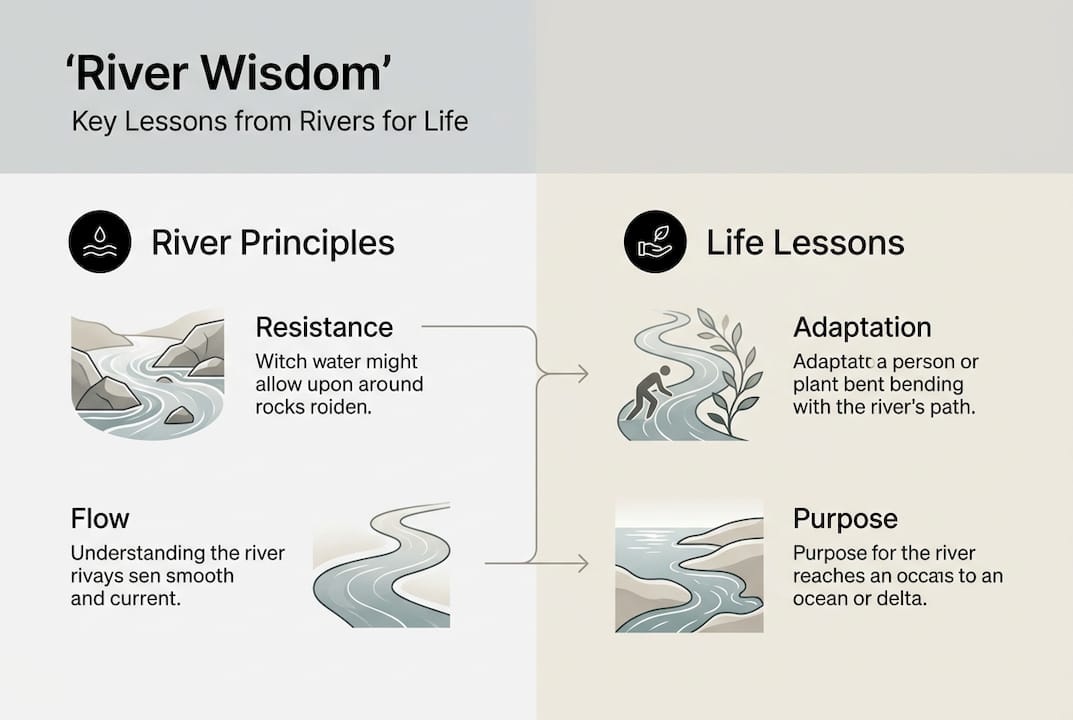
The river’s destination isn’t arbitrary but determined by gravitational forces and topographical features. Similarly, authentic human purpose often emerges from the intersection of internal inclinations and external realities. Forcing a direction that conflicts with fundamental conditions creates unnecessary struggle, whilst aligning with natural tendencies enables efficient progress.
This doesn’t imply passive acceptance of any path. Rivers actively shape their courses through erosion and deposition, demonstrating that purpose involves both following and creating. The key lies in distinguishing between productive effort that works with available energy and futile resistance that exhausts resources without meaningful results.
| River behaviour | Human growth stage | Key characteristic |
|---|---|---|
| Source spring | Initial inspiration | Clarity of origin |
| Mountain stream | Early development | High energy, rapid change |
| Mature river | Sustained progress | Steady, powerful flow |
| Delta formation | Culmination | Broad impact, multiple channels |
| Ocean meeting | Integration | Merging with larger whole |
This progression reveals that purpose evolves through distinct phases, each with appropriate characteristics. Expecting mature river qualities during the mountain stream phase creates frustration, whilst clinging to youthful energy in later stages prevents necessary deepening.
The river also demonstrates how purpose serves something beyond itself. Whilst flowing towards the sea, it simultaneously nourishes ecosystems, shapes landscapes, and enables countless life processes. This dual nature of purpose—pursuing a personal direction whilst contributing to larger systems—offers guidance for meaningful living.
Pro Tip: Regularly assess whether your current efforts align with your natural inclinations and environmental realities. Like a river finding its course, periodically check if you’re working with or against fundamental forces in your life. Adjustment isn’t failure but intelligent navigation.
Connecting your living environment with these principles through modern décor styles that incorporate natural motifs reinforces purposeful direction in daily experience. Visual reminders of natural patterns support psychological alignment with these principles.
Applying river wisdom: practical steps to harness resistance, flow, and purpose
Transforming conceptual understanding into lived experience requires deliberate practice. The following approaches translate river wisdom into actionable strategies for personal growth and mindfulness development. Nature and mindfulness benefits confirms that nature-inspired reflection significantly enhances psychological well-being.
Begin by developing observational skills through direct engagement with rivers or flowing water. Even urban fountains or rainfall offer opportunities to witness flow principles in action. Notice how water responds to obstacles, maintains momentum, and follows gravitational pull without resistance. These observations become templates for personal behaviour patterns.
Mindfulness practices inspired by river behaviour include:
- Meditation on continuous movement: focus on breath as a flowing process rather than discrete inhalations and exhalations.
- Resistance mapping: identify current obstacles in your life and explore multiple potential responses rather than fixating on one solution.
- Flow state cultivation: engage activities that balance challenge and skill, creating conditions for effortless concentration.
- Purpose clarification: examine whether your goals align with your natural strengths and environmental opportunities.
Daily habits that embody river principles:
- Morning intention setting that acknowledges both direction and flexibility, establishing purpose without rigidity.
- Regular progress reviews that celebrate adaptation rather than only measuring distance towards fixed goals.
- Obstacle reframing exercises that transform perceived barriers into information about alternative paths.
- Evening reflection on flow experiences, noting when you felt most aligned with natural momentum.
- Weekly nature connection through walks near water sources or mindful observation of weather patterns.
Integrating natural elements into your personal environment serves as constant reinforcement of these principles. Water features, river stone collections, or nature photography create visual anchors for river wisdom. Consider upgrading living spaces to include these elements as functional reminders rather than mere decoration.
The practice of journaling about personal flow experiences deepens understanding over time. Record moments when you successfully navigated resistance, maintained momentum despite challenges, or felt aligned with meaningful purpose. These documented experiences become reference points during difficult periods, reminding you of your capacity for adaptive resilience.
Physical movement practices that embody flow principles include tai chi, yoga, or simply walking with attention to natural rhythm. These activities train the body to experience flow states, making the concept tangible rather than abstract. The physical memory of flowing movement transfers to mental and emotional domains.
Explore nature-inspired products and ideas at STOMART
Bringing river wisdom into your daily environment strengthens your connection to these timeless principles. STOMART offers a curated selection of nature-inspired home products that transform abstract concepts into tangible reminders. From water features to organic materials, these items support mindful living and environmental consciousness.
Explore our guides on natural elements incorporation for practical strategies to create spaces that reflect flow, adaptability, and purpose. Our range of eco-friendly home products aligns with sustainable values whilst enhancing your connection to natural rhythms. Each carefully selected item serves as a functional tool for deepening your practice of river-inspired wisdom.
Frequently asked questions
What are the main lessons rivers teach about life?
Rivers demonstrate three fundamental principles: resistance catalyses creative adaptation, continuous flow maintains vitality, and purposeful direction emerges from aligning with natural forces. These lessons translate directly to personal development, showing how obstacles become opportunities, momentum prevents stagnation, and meaningful goals arise from authentic alignment. By observing river behaviour, we learn that flexibility combined with persistent direction creates sustainable progress.
How can I apply the concept of flow from rivers to my daily routine?
Start by releasing rigid expectations about how tasks should unfold, allowing yourself to adapt as circumstances change. Maintain consistent forward momentum through small, regular actions rather than waiting for perfect conditions. Practise full presence in current activities instead of mentally jumping ahead to future concerns. Notice when you feel most naturally engaged and structure more time around those flow-inducing activities.
Why is resistance important according to river behaviour?
Resistance forces rivers to develop creative solutions, carving new channels and reshaping landscapes in ways that wouldn’t occur without obstacles. This process builds the river’s character and creates ecological diversity. Similarly, personal resistance often marks growth opportunities rather than dead ends. Obstacles provide information about alternative approaches and develop our capacity for adaptive problem-solving.
What does the river’s purpose teach us about finding meaning?
Rivers show that authentic purpose emerges from the intersection of internal nature and external conditions, not from arbitrary choice alone. Their destination is determined by gravitational forces and landscape features, suggesting we should align goals with our natural inclinations and environmental realities. Purpose also serves something beyond itself, as rivers nourish ecosystems whilst flowing towards the sea, teaching us that meaningful direction benefits both ourselves and larger systems.
How do rivers demonstrate the balance between persistence and adaptation?
Rivers maintain unwavering direction towards lower elevation whilst constantly adjusting their immediate path around obstacles. This combination of steadfast purpose and tactical flexibility offers a model for human endeavour. They never abandon their fundamental direction but readily modify their route when necessary. This balance prevents both rigid inflexibility and aimless wandering, showing how to pursue goals with intelligent responsiveness.