

Why comfort can become a trap: unlocking growth beyond ease
on Mar 19, 2026You crave comfort, yet prolonged comfort reduces neuroplasticity and stifles the very growth that leads to lasting satisfaction. This paradox sits at the heart of personal development: the safe, familiar routines that feel protective often become invisible barriers to learning, creativity, and fulfilment. Understanding why your brain instinctively seeks ease and how that preference can limit your potential is the first step toward breaking free. This article explores the neuroscience behind comfort seeking, reveals how staying too comfortable damages performance and satisfaction, and provides practical strategies to embrace healthy discomfort without overwhelming yourself.
Key takeaways
| Point | Details |
|---|---|
| Evolutionary wiring | The brain’s preference for familiarity stems from survival mechanisms that equate comfort with safety and uncertainty with threat. |
| Performance plateau | Remaining in the comfort zone leads to low arousal, reducing motivation, creativity, and the neural plasticity needed for learning. |
| Optimal challenge | Moderate discomfort aligns with flow states and peak performance, whereas excessive comfort causes boredom and regret. |
| Balanced approach | Gradual exposure to novelty and manageable challenges rewires fear responses and promotes sustainable growth. |
| Long term regret | Research shows people regret missed opportunities from inaction far more than mistakes from trying something new. |
How the brain creates the comfort trap
The brain’s preference for comfort stems from evolutionary survival mechanisms where familiarity signals safety and uncertainty triggers fear. Your amygdala, a small almond shaped structure deep in the brain, acts as an alarm system that scans for potential threats. When you encounter unfamiliar situations or novel experiences, the amygdala fires warning signals, releasing stress hormones that create feelings of anxiety and discomfort. This response made perfect sense for our ancestors, who faced genuine physical dangers in unpredictable environments. Staying within known territories and routines reduced the risk of predation, starvation, or injury.
Today, that same wiring persists even though most modern challenges pose no physical threat. Your brain still interprets uncertainty as danger, rewarding you with dopamine and a sense of calm when you stick to familiar patterns. Over time, this creates a feedback loop: comfort feels good, so you seek more of it, which makes any deviation feel increasingly threatening. The longer you remain in your comfort zone, the more sensitive your amygdala becomes to change, heightening anxiety about even minor disruptions. This avoidance spiral explains why people often feel paralysed when contemplating career shifts, new hobbies, or lifestyle changes, even when they intellectually recognise the need for growth.
“The comfort trap is not about laziness; it’s about a brain wired to prioritise short term safety over long term flourishing.”
Breaking this cycle requires understanding that your discomfort response is not a reliable indicator of actual danger. When you choose new styles or explore fresh collections, you’re practising the same mental flexibility needed for broader personal growth. Recognising the brain’s survival wiring as outdated in many contexts empowers you to reinterpret discomfort as a signal for potential learning rather than a red flag to retreat.
Why comfort limits growth and performance
According to the Yerkes Dodson Law, performance peaks at moderate arousal, while too little leads to boredom and too much to anxiety. This inverted U shaped relationship reveals why comfort zones become performance traps. When arousal is too low, your brain enters a state of disengagement. Tasks feel monotonous, attention wanders, and motivation plummets. You might find yourself scrolling mindlessly through social media or procrastinating on meaningful projects because nothing feels urgent or stimulating. This low arousal state not only reduces productivity but also diminishes the quality of your work and the satisfaction you derive from it.
Staying comfortable also weakens your brain’s capacity for adaptation. Prolonged comfort reduces neuroplasticity, the process by which your brain forms new neural connections in response to learning and experience. When you repeat the same routines day after day, existing neural pathways become more efficient, but your brain stops building new ones. This is why skills you don’t practise fade, why learning new information becomes harder with age if you avoid challenge, and why creative thinking stagnates without exposure to novelty. Neuroscience research confirms that novelty and moderate discomfort are essential triggers for neuroplasticity, promoting the growth of new synapses and strengthening cognitive flexibility.
Consider how this plays out across different life domains:
- Career stagnation occurs when you avoid stretch assignments or new responsibilities, limiting skill development and advancement opportunities.
- Relationship monotony sets in when couples stop trying new activities together, reducing emotional connection and satisfaction.
- Physical decline accelerates when you stick to the same exercise routine, as your body adapts and stops improving.
- Creative blocks emerge when you consume the same media and ideas repeatedly, starving your imagination of fresh inputs.
| Arousal level | Performance | Learning | Emotional state | | — | — | — | | Too low (comfort zone) | Poor, disengaged | Minimal, stagnant | Bored, unfulfilled | | Moderate (growth zone) | Peak, focused | High, adaptive | Energised, satisfied | | Too high (panic zone) | Impaired, scattered | Blocked, overwhelmed | Anxious, stressed |
Pro Tip: Schedule one small challenge each week, such as learning a new recipe, taking a different route to work, or striking up a conversation with a stranger. These micro novelties keep your brain adaptable without triggering overwhelming anxiety, gradually expanding your comfort zone through repeated, manageable exposure.
The good news is that you can reverse this decline. By intentionally introducing variety and challenge into your routines, you signal your brain to remain plastic and responsive. Exploring new arrivals and fresh product categories might seem trivial, but these small acts of novelty mirror the cognitive flexibility required for larger life changes. Even browsing a diverse digital ecosystem engages your brain’s pattern recognition systems in new ways, reinforcing the neural pathways that support adaptability and creative problem solving.
Balancing comfort and challenge for healthy growth
While comfort limits growth, excessive challenge without adequate support stifles creativity and wellbeing. The key lies in finding the sweet spot where you feel stretched but not broken. Moderate discomfort aligns with flow states and higher life satisfaction, those moments when you’re fully absorbed in an activity that challenges your skills just enough to keep you engaged without overwhelming you. Psychologist Mihaly Csikszentmihalyi’s research on flow reveals that people report their highest levels of happiness and fulfilment during these moderately challenging experiences, not during passive relaxation.

This balance matters because pushing too hard creates chronic stress, which impairs cognitive function, damages physical health, and reduces motivation over time. Your brain needs a foundation of safety and predictability to take risks. When you feel psychologically secure, supported by relationships and routines that provide stability, you’re far more willing to venture into uncertain territory. This explains why effective growth strategies emphasise gradual progression rather than dramatic leaps. Small, incremental challenges allow you to build confidence and competence while maintaining the sense of control necessary for sustained effort.
Nostalgia boosts growth motivation, whereas idealising past comfort hinders progress. Reflecting on times when you successfully navigated change can inspire you to take new risks, reminding you of your resilience and adaptability. However, there’s a crucial distinction between constructive nostalgia and declinism, the tendency to romanticise the past as superior to the present. Declinism breeds resistance to change, convincing you that your best days are behind you and that any deviation from familiar patterns represents loss rather than opportunity. Constructive nostalgia, by contrast, acknowledges past achievements while recognising that growth requires moving forward, not backward.
| State | Characteristics | Outcomes | Psychological impact |
|---|---|---|---|
| Comfort zone | Low challenge, high familiarity | Stagnation, boredom, regret | Short term ease, long term dissatisfaction |
| Growth zone | Moderate challenge, adequate support | Learning, flow, satisfaction | Energised, confident, fulfilled |
| Panic zone | Excessive challenge, inadequate support | Overwhelm, avoidance, burnout | Anxious, defeated, withdrawn |
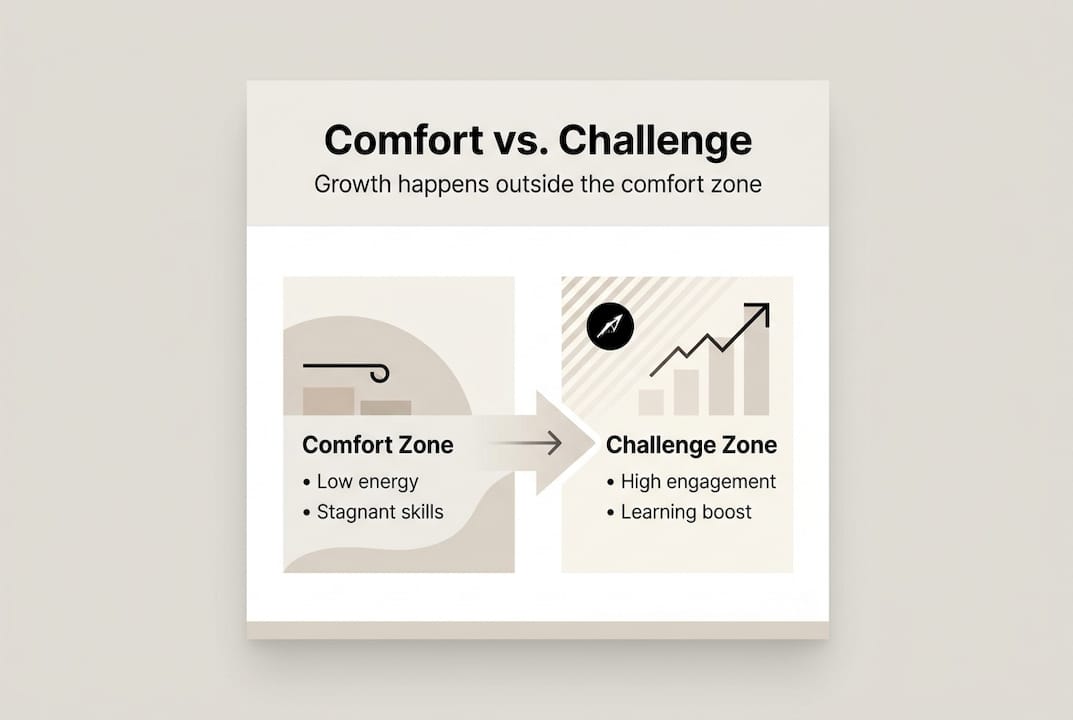
Achieving balance requires self awareness and experimentation. Pay attention to how different levels of challenge affect your mood, energy, and performance. Some people thrive on high intensity environments, while others need gentler nudges. The goal is not to eliminate comfort entirely but to prevent it from becoming a prison. You need rest, recovery, and familiar routines to recharge, but you also need novelty, challenge, and growth to feel alive.
Pro Tip: Use nostalgia constructively by journaling about past moments when you stepped outside your comfort zone and succeeded. Reflect on the skills you used, the support you received, and the satisfaction you felt. This practice builds a mental library of evidence that you can handle discomfort, making future challenges feel less daunting.
When you compare retail strategies or evaluate design choices, you’re engaging in the same comparative thinking that helps you assess your own life patterns. Recognising what works, what doesn’t, and why empowers you to make intentional choices about where to seek comfort and where to embrace challenge.
Overcoming the comfort trap: practical strategies
Recognising that you’re stuck in a comfort trap is the first step toward change. Common signs include chronic boredom despite having free time, feeling envious of others’ achievements without taking action yourself, and experiencing vague dissatisfaction with life even when nothing is objectively wrong. These symptoms indicate that your brain has adapted to low arousal and needs re-engagement through novelty and challenge. Empirical data shows people regret inactions more than actions in the long term, a finding that should motivate you to prioritise growth over safety when the stakes are manageable.
Implement a stepwise approach to expand your comfort zone without triggering overwhelming anxiety:
- Identify one area of your life where you feel stuck or unfulfilled, whether it’s your career, relationships, health, or creative pursuits.
- Set a small, specific challenge related to that area, such as attending one networking event, trying one new fitness class, or spending 30 minutes daily on a creative project.
- Schedule the challenge at a time when you have adequate energy and support, avoiding periods of high stress or fatigue.
- Reflect on the experience afterwards, noting what you learned, how you felt, and what you might do differently next time.
- Gradually increase the difficulty or frequency of challenges as your confidence and competence grow, always maintaining a balance between stretch and support.
This gradual exposure method works because it allows your amygdala to recalibrate its threat assessment. Each time you face a challenge and survive, your brain updates its models, recognising that discomfort does not equal danger. Over time, activities that once felt terrifying become merely uncomfortable, then manageable, and eventually routine. This is how comfort zones expand: not through sudden dramatic changes, but through consistent, incremental exposure to novelty.
Maintaining a support system is crucial during this process. Share your goals with trusted friends or family members who can encourage you, hold you accountable, and provide perspective when you feel discouraged. Social support buffers the stress response, making challenges feel less threatening and failures less catastrophic. You’re far more likely to persist through discomfort when you know someone believes in you and will be there regardless of the outcome.
Common signs you’re trapped in comfort and effective mindset shifts:
- Procrastinating on meaningful goals while staying busy with trivial tasks; shift to prioritising one growth oriented activity daily.
- Feeling jealous of others’ success without taking action; shift to viewing their achievements as proof that change is possible.
- Avoiding new experiences due to fear of embarrassment or failure; shift to reframing mistakes as valuable learning data.
- Rationalising inaction with excuses about timing, resources, or readiness; shift to starting with whatever you have right now.
- Experiencing physical restlessness or emotional flatness despite stability; shift to recognising these as signals your brain needs stimulation.
Pro Tip: Track your regrets and learning moments in a simple journal or note app. At the end of each week, write down one thing you wish you’d tried and one thing you learned from stepping outside your comfort zone. This practice builds awareness of the cost of comfort and the benefits of growth, gradually shifting your default response from avoidance to curiosity.
Maximising your collections or exploring home decor options might seem unrelated to personal growth, but these activities train the same skills: evaluating options, making decisions, and embracing change. Each time you refresh your environment or try a new style, you’re practising the cognitive flexibility and risk tolerance required for larger life transitions.
Unlock growth with Stomart
Breaking free from comfort traps requires more than insight; it demands action and inspiration. Stomart offers a curated platform where you can explore new collections, refresh your style, and discover products that symbolise personal growth and positive change. Whether you’re revamping your home decor, updating your wardrobe, or seeking wellness products that support your development goals, Stomart provides the variety and novelty your brain craves to stay adaptable and engaged.
Our blog features expert advice on embracing change, from choosing the perfect clothing store to understanding broader lifestyle trends that encourage growth. By regularly engaging with fresh ideas and new products, you’re practising the same openness and curiosity that fuel personal development in all areas of life.
Benefits of exploring Stomart:
- Access to diverse product categories that encourage experimentation and novelty.
- Curated collections designed to inspire lifestyle upgrades and positive change.
- Expert blog content that bridges consumer choices with personal growth insights.
- Convenient platform for breaking routine and discovering unexpected solutions.
Why is comfort sometimes harmful to personal growth?
Why does the brain prefer comfort over challenge?
Your brain evolved to prioritise survival, which meant avoiding uncertainty and seeking familiar, safe environments. The amygdala triggers fear responses to novelty, while dopamine rewards comfort seeking behaviour. This wiring served our ancestors well but now limits growth because modern challenges rarely pose physical threats, yet your brain treats them as dangerous.
How does staying comfortable affect learning and performance?
Prolonged comfort reduces neuroplasticity, weakening your brain’s ability to form new connections and adapt to change. Low arousal states caused by excessive comfort lead to boredom, disengagement, and poor performance. Without regular exposure to novelty and moderate challenge, skills atrophy and creativity stagnates.
What is the optimal level of discomfort for growth?
Moderate discomfort that stretches your abilities without overwhelming you creates flow states and peak performance. This sweet spot, described by the Yerkes Dodson Law, occurs when challenges slightly exceed your current skill level, requiring focus and effort but remaining achievable with persistence and support.
Can nostalgia help or hinder personal development?
Constructive nostalgia that recalls past successes and resilience boosts motivation to take new risks. However, idealising past comfort and viewing the present as inferior, known as declinism, creates resistance to change and hinders progress. Use nostalgia to remind yourself of your adaptability, not to avoid moving forward.
What are practical ways to overcome comfort traps?
Start with small, manageable challenges in one life area, then gradually increase difficulty as confidence grows. Maintain a support system to buffer stress, track regrets to motivate action, and reframe discomfort as learning rather than danger. Consistent, incremental exposure to novelty rewires your brain’s threat assessment over time.
Why do people regret inaction more than mistakes?
Research shows that long term regret stems primarily from missed opportunities and paths not taken rather than from actions that failed. Staying comfortable feels safe in the moment but creates lasting dissatisfaction, whereas taking risks, even when they lead to mistakes, provides learning and growth that ultimately feels more fulfilling.