

Are we advancing or just accelerating? The truth
on Apr 05, 2026TL;DR:
- Progress involves meaningful societal improvements, unlike mere acceleration of change.
- Human development has made significant gains such as reduced poverty and increased life expectancy.
- Unchecked technological acceleration can worsen inequality, harm the environment, and weaken social cohesion.
We live in an era of breathtaking technological speed. New tools, platforms, and breakthroughs arrive faster than most of us can process them. Yet despite this relentless momentum, many thoughtful people feel something is missing: a sense that genuine improvement in human life is not keeping pace with the sheer velocity of change. This tension sits at the heart of one of the most important philosophical debates of our time. Are we truly advancing as a society, or are we simply moving faster? The answer matters enormously, not just for policymakers and philosophers, but for every individual trying to make sense of the world they inhabit.
Key Takeaways
| Point | Details |
|---|---|
| Advancement versus speed | Real progress is not just faster change but meaningful improvement that benefits society as a whole. |
| Society sees gains | Global data indicates rising wellbeing, lower poverty, and longer life expectancy reveal true progress. |
| Acceleration carries risks | Unchecked rapid change can outpace ethics and institutions, potentially causing harm. |
| Balanced approach needed | A sustainable future depends on mixing technological innovation with thoughtful governance and shared values. |
What does progress really mean?
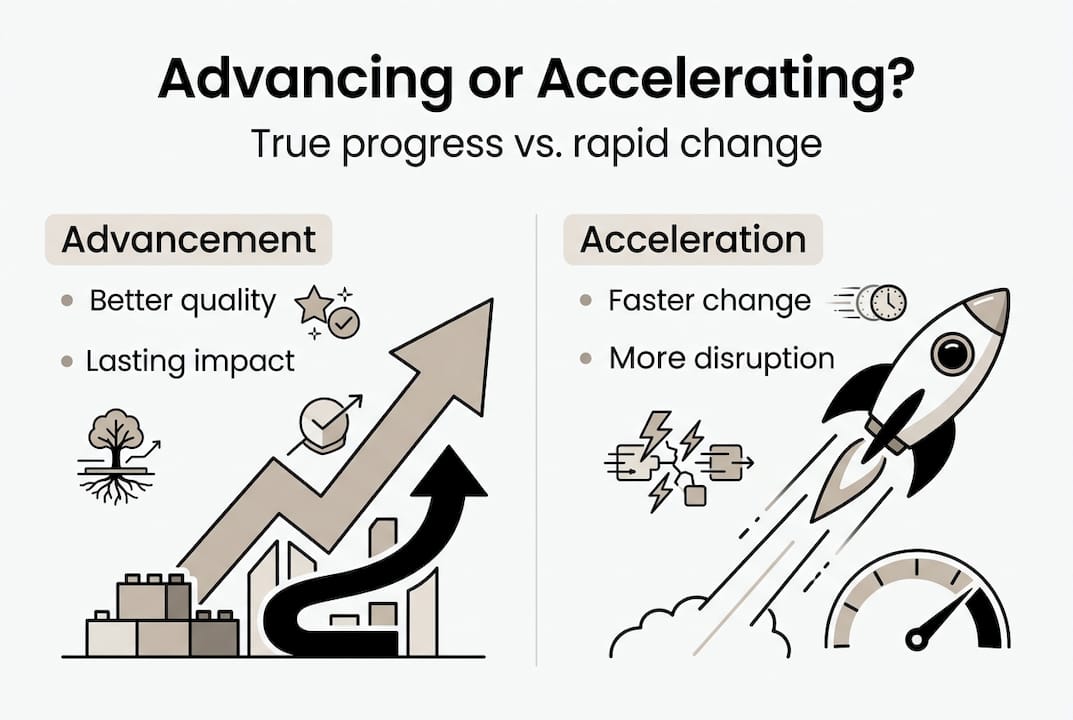
With our central question set, we must clarify the fundamental concepts at stake. Progress and acceleration are often used interchangeably, but they describe very different things. Acceleration is a measure of speed: how quickly change is happening. Progress is a measure of direction: whether that change is actually making things better. You can accelerate in the wrong direction. You can move faster and faster toward a cliff edge. Speed, on its own, tells you nothing about whether you are heading somewhere worthwhile.
True advancement requires distinguishing speed from meaningful societal improvement. This is not a trivial philosophical point. It has real consequences for how governments invest public money, how businesses prioritise innovation, and how individuals choose to spend their attention and energy.
Philosophically, progress implies a value judgement. It asks: better by what standard? Better for whom? A factory that doubles its output through automation may represent acceleration for shareholders, but if it displaces workers without support, it is harder to call genuine progress. Technological change in retail offers a vivid illustration: faster delivery and wider product choice are genuine improvements for consumers, but only if the supply chains behind them are fair and sustainable.
| Dimension | Acceleration | Advancement |
|---|---|---|
| Focus | Speed of change | Quality of change |
| Measure | Output, growth rate | Wellbeing, equity, meaning |
| Risk | Outpacing adaptation | Slower but more durable |
| Example | AI adoption rate | Reduction in global poverty |
Some common misconceptions about technological progress are worth naming directly:
- More technology always means better outcomes
- Faster adoption signals societal readiness
- Economic growth is a reliable proxy for human flourishing
- Innovation is inherently neutral or positive
- Disruption is the same as improvement
Pro Tip: When you encounter a new technology or trend, ask yourself two questions before embracing it. First, what problem does this actually solve? Second, who benefits and who bears the cost? If you cannot answer both clearly, you may be witnessing acceleration rather than AI and innovation that genuinely serves people.
Evidence of advancement: Societal progress in data
Having defined meaningful progress, we can now examine where the evidence points in society at large. The picture is more encouraging than many assume. Across a range of key indicators, humanity has made measurable, substantial gains over recent decades.

Global median thriving sits at 33%, representing a meaningful rise in people rating their lives positively. Extreme poverty has fallen dramatically. Life expectancy has climbed in nearly every region. Literacy rates are at historic highs. These are not trivial statistics: they represent billions of lives genuinely improved.
33% of people globally now rate their lives as thriving — a figure that, while still leaving much room for improvement, marks a significant upward shift from previous decades.
Areas showing the clearest evidence of genuine progress include:
- Reduction in extreme poverty (from over 36% in 1990 to under 9% today)
- Rising global life expectancy, now averaging over 73 years
- Improved access to education and literacy across developing nations
- Declining rates of violent crime in many regions
- Broader access to healthcare and clean water
| Indicator | 1990 | 2026 (approx.) |
|---|---|---|
| Extreme poverty rate | ~36% | ~9% |
| Global life expectancy | ~65 years | ~73 years |
| Adult literacy rate | ~76% | ~87% |
| Human Development Index (avg.) | 0.60 | 0.74 |
| Median thriving (Gallup) | N/A | 33% |
These human development gains do not happen by accident. They reflect sustained investment in institutions, healthcare, education, and governance. In daily life, this progress shows up in ways we often take for granted: safer food, cleaner water, access to medicines that did not exist a generation ago. Retail’s role in societal improvement is part of this picture too, as wider access to affordable goods has contributed to rising living standards globally. Even shifts in consumer wellbeing reflect broader patterns of rising aspiration and improved quality of life.
The limits and risks of acceleration
While these data points reveal progress, not all changes qualify as true advancement, especially when acceleration carries its own hazards. The same technologies driving extraordinary gains can, when left unchecked, generate serious harm.
Critics argue that progress becomes illusory when technology outpaces social development. This is sometimes called the Promethean gap: the space between what we can do and what we are wise enough to do responsibly. It is a gap that widens with every new capability we deploy before fully understanding its consequences.
Major areas where unchecked acceleration can cause harm:
- Inequality: Automation and AI concentrate wealth among those who own the technology, widening gaps between rich and poor.
- Environmental degradation: Faster production cycles increase resource consumption and waste, often faster than ecosystems can recover.
- Institutional lag: Governments and legal systems struggle to regulate technologies that evolve faster than legislation can be written.
- Social fragmentation: Algorithmic platforms accelerate the spread of misinformation and erode shared civic reality.
- Loss of expertise: Over-reliance on AI tools risks what some researchers call ‘brain rot’, a gradual erosion of deep human skill and critical thinking.
“The Promethean gap describes the dangerous distance between our technological power and our moral wisdom to wield it. Closing this gap is the defining challenge of the 21st century.” — Promethean gap researchers
Edge risks of AI include undermining the very human innovation it claims to accelerate. When people stop practising skills because a machine can do them faster, we may be trading long-term capability for short-term convenience. Integrating tech with ethics is not a luxury for businesses; it is a strategic necessity. And ethical oversight in retail demonstrates that responsible innovation is both possible and commercially viable.
Pro Tip: Before celebrating a new technology in your personal or professional life, pause to ask: is this making me more capable and thoughtful, or simply faster? The distinction is crucial.
Debates, philosophies, and the search for a balanced future
Given these perils, it is crucial to assess the philosophies driving our attitudes toward progress and speed. The intellectual landscape is rich, and understanding the major camps helps you form your own grounded view.
Optimists affirm Enlightenment-driven material and moral progress, pointing to the data on poverty, health, and literacy as proof that reason and science are working. Accelerationists, by contrast, seek to push technological change even faster, believing that utopia lies just beyond the next breakthrough, if only we stop hesitating.
“We are, by any objective measure, living in the greatest era of human prosperity, health, and freedom in history. The data are unambiguous.” — The Free Press, summarising the optimist case
The major philosophical camps and their core focus:
- Optimists (Pinker et al.): Science, reason, and institutions drive measurable moral and material improvement
- Accelerationists (e/acc movement): Unrestrained technological growth will solve all problems; accelerationist views hold that slowing down is the real risk
- Sceptics: Question whether metrics capture genuine wellbeing; warn of hidden costs and marginalised voices
- Balanced pragmatists: Embrace innovation while insisting on ethical frameworks, democratic oversight, and equity
The balanced pragmatist position is arguably the most intellectually honest. It neither dismisses the extraordinary gains of the last century nor ignores the genuine risks of unchecked speed. It asks: what kind of future are we actually building, and for whom? Ethical alternatives in retail reflect this pragmatist spirit: choosing innovation that serves people rather than simply chasing the fastest or cheapest option.
Reflect for a moment: what counts as genuine progress in your own life? Is it having more options, or better ones? Moving faster, or moving with greater intention?
Why disentangling true progress from acceleration matters more than ever
Here is a perspective you will not often hear in mainstream debates about technology and society. The confusion between speed and advancement is not accidental. It is psychologically convenient. Acceleration feels like progress. Notifications, updates, new features, record-breaking metrics: all of it creates a sensation of forward movement that is deeply satisfying, even when the underlying direction is unclear or actively harmful.
This is costly at every level. In public policy, it leads to investment in shiny technologies before the social infrastructure to support them exists. In business, it produces products that disrupt without genuinely improving. In daily life, it fills our hours with activity that leaves us feeling oddly empty.
Meaning versus speed in retail captures this tension beautifully: the most successful retailers are not simply the fastest, but those who understand what their customers actually need and deliver it with genuine care. The same principle applies to civilisation. Genuine progress requires continual reflection on values, not just faster execution. Before embracing any new innovation, ask: does this serve human flourishing, or merely human appetite for novelty?
Continue exploring progress and innovation with Stomart
To deepen your understanding and see practical applications, explore more with Stomart. At Stomart, we believe that thoughtful engagement with innovation is not just a philosophical exercise; it shapes the products we offer, the content we create, and the conversations we invite. Our blog covers the real-world intersection of technology, retail, and human wellbeing, from digital retail transformation to the ethics of consumer choice. Whether you are thinking about the future of shopping, the meaning of progress, or simply looking for products that reflect your values, Stomart is a space where curiosity and commerce meet with genuine purpose.
Frequently asked questions
What is the difference between progress and acceleration?
Progress means meaningful improvement in society, while acceleration is simply the increasing speed of change, which may not always lead anywhere worthwhile. You can accelerate rapidly in the wrong direction.
Has global wellbeing actually improved in recent years?
Yes, metrics show rising thriving, falling poverty, and higher life expectancy globally over recent decades, though significant inequalities remain.
What are the risks of focusing only on technological acceleration?
Prioritising speed can widen inequality, strain social institutions, and erode the deep human skills and ethical judgement that genuine progress depends upon.
Can accelerating AI solve societal problems?
AI can contribute meaningfully, but ethics and human judgement must keep pace with the technology, or we risk solving the wrong problems at great cost.