

New Arrivals Significance: Driving Retail Success
on Jan 30, 2026
Finding the perfect piece to refresh your wardrobe or beauty routine often comes down to discovering the right new arrivals at just the right moment. In online retail, new arrivals are more than a passing trend. They spark curiosity, create excitement, and shape what is considered stylish worldwide. From seeking the latest designer drop to tracking the freshest skincare launches, this guide explains why new products matter, how they influence buying behaviour, and what makes them a must-watch for style-savvy shoppers aiming to stay inspired each season.
Key Takeaways
| Point | Details |
|---|---|
| Strategic Importance of New Arrivals | New arrivals should not be viewed solely as product updates but as essential tools for customer engagement and sales enhancement. |
| Category-Specific Strategies | Retailers must tailor new arrival strategies to align with consumer expectations unique to each market segment. |
| Impact of Technology on Shopping Behaviour | The integration of advanced technologies, such as AI and mobile platforms, significantly influences modern consumer purchasing decisions. |
| Avoiding Launch Mistakes | Thorough preparation, including market research and timing, is crucial for the successful introduction of new products. |
Defining New Arrivals in E-Commerce
In the dynamic world of online retail, new arrivals represent more than just recently added products - they are strategic catalysts for customer engagement and sales growth. E-commerce transformations have elevated the concept of new product introductions beyond simple inventory updates, making them crucial components of digital merchandising strategies.
The strategic significance of new arrivals encompasses multiple dimensions for online retailers:
- Creating immediate customer excitement
- Signalling continuous product innovation
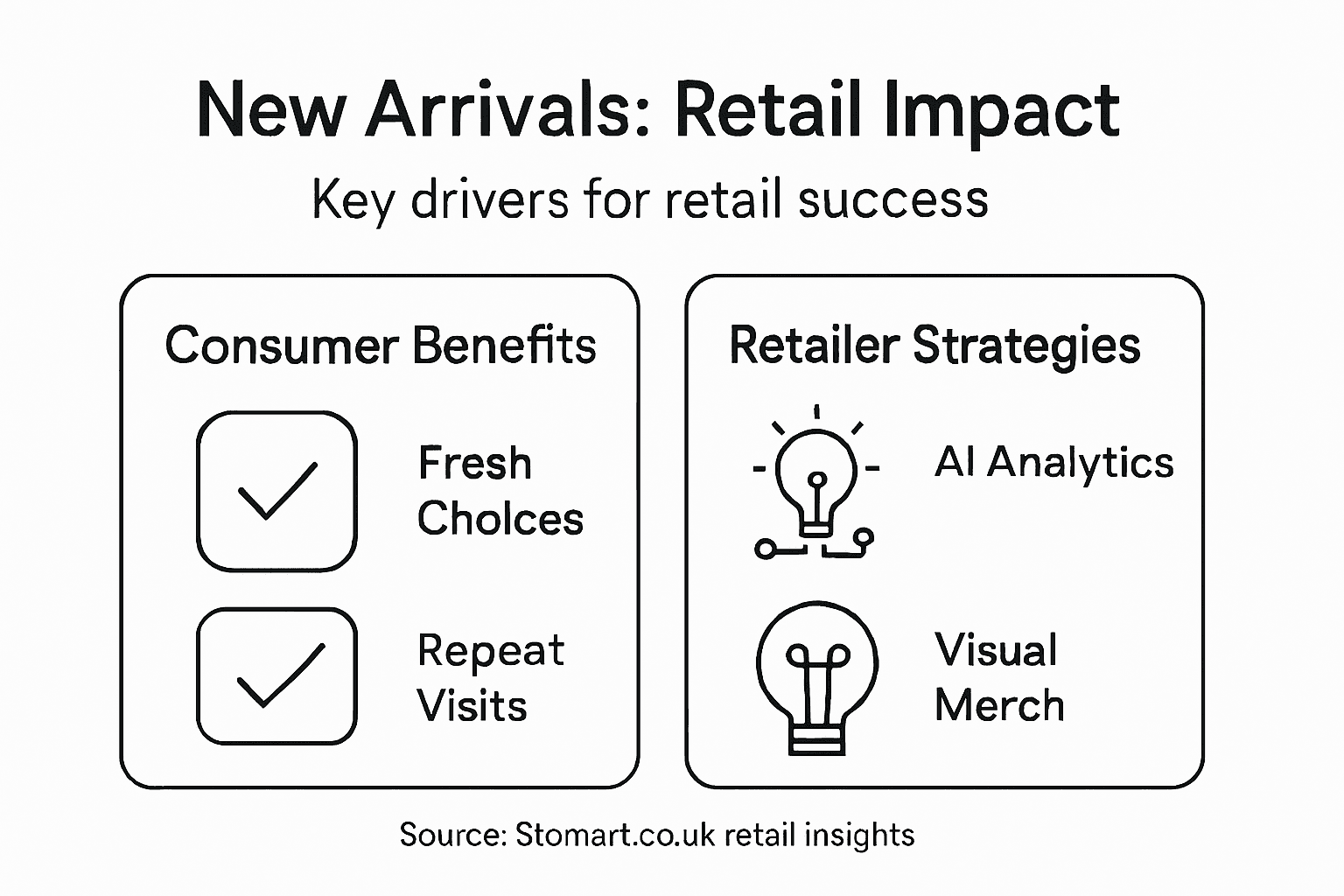
- Driving repeat website visits
- Encouraging spontaneous purchasing behaviour
- Providing fresh content for marketing campaigns
According to European E-commerce research, new arrivals function as critical stimuli in consumer demand management. They represent more than transactional opportunities; they are dynamic interfaces between retailer offerings and customer expectations, continuously reshaping online shopping experiences.

Understanding new arrivals requires recognising their multifaceted role in digital retail ecosystems. These product introductions are not merely inventory updates, but strategic communication tools that signal a brand’s responsiveness, creativity, and commitment to meeting evolving consumer preferences.
Pro tip: Track your new arrivals’ performance metrics closely to understand customer engagement patterns and refine future product introduction strategies.
Variations Across Retail Categories
Retail categories demonstrate remarkably diverse responses to new product arrivals, with strategies and consumer behaviours varying significantly across different market segments. Consumer shopping patterns reveal nuanced differences in how new inventory impacts purchasing decisions and customer engagement.
The impact of new arrivals varies dramatically across retail categories:
- Luxury Retail: Highly sensitive to seasonal trends and economic conditions
- Discount Retailers: Consistent consumer interest in frequent product drops
- Fashion: Rapid turnover and continuous style refreshment
- Electronics: Technical innovation drives new arrival significance
- Home Goods: More measured approach with strategic product introductions
Each retail category approaches new arrivals with unique strategic considerations. Luxury brands often curate limited collections that create exclusivity, while discount retailers focus on creating constant excitement through frequent, affordable product introductions. Fashion retailers particularly leverage new arrivals as critical marketing tools, using them to maintain customer interest and reflect rapidly changing style trends.
New product introductions are not uniform across retail segments - they are precision instruments tailored to specific market dynamics and consumer expectations.
Understanding these category-specific nuances is crucial for retailers seeking to optimise their product introduction strategies. The approach must be carefully calibrated to match the specific consumer psychology and purchasing behaviours inherent in each retail category.
The table below highlights the different strategic focuses for new arrivals across key retail categories:
| Retail Category | Strategic Focus | Consumer Expectation |
|---|---|---|
| Luxury | Exclusivity, curated launches | Limited availability, prestige |
| Discount | Frequency, affordability | Constant novelty, low price |
| Fashion | Trend relevance, fast cycles | Latest styles, rapid updates |
| Electronics | Innovation leadership | Cutting-edge features, trust |
| Home Goods | Selective refresh, stability | Quality additions, reliability |
Pro tip: Develop category-specific new arrival strategies that align with your target market’s unique consumption patterns and expectations.
Impact on Consumer Behaviour and Shopping Trends
Consumer behaviour in modern retail environments is undergoing profound transformations, driven by technological advancements and shifting economic landscapes. Consumer behaviour patterns reveal a complex interplay between technological integration, economic uncertainty, and purchasing decisions.
Key characteristics of contemporary shopping trends include:
- Increased demand for personalised shopping experiences
- Growing preference for omni-channel retail interactions
- Rising importance of mobile and social platform purchases
- Enhanced focus on value-driven consumption
- Greater emphasis on immediate gratification
The emergence of hybrid digital-physical commerce has fundamentally restructured how consumers interact with new product launches. Shoppers now seamlessly navigate between online and offline channels, expecting frictionless experiences that provide instant information, comparative pricing, and personalised recommendations.
Modern consumers demand retail experiences that are simultaneously convenient, personalised, and technologically sophisticated.
Advanced technologies like artificial intelligence and social commerce are reshaping consumer engagement with new arrivals. E-commerce growth trends demonstrate that mobile platforms and recommendation algorithms significantly influence purchasing decisions, creating more dynamic and responsive shopping environments.
Below is a summary of how advanced technology is currently influencing consumer behaviour in retail:
| Technology Driver | Impact on Consumer Behaviour | Retailer Benefit |
|---|---|---|
| AI Recommendations | More personalised product suggestions | Higher conversion rates |
| Mobile Platforms | Increased on-the-go shopping | Greater reach and sales |
| Social Commerce | Seamless buying within social apps | Boosted impulse purchases |
| Omni-channel Systems | Unified shopping experiences | Improved customer loyalty |
Pro tip: Continuously adapt your new arrival strategies to align with evolving consumer technology preferences and expectations.
Strategies to Increase Product Visibility
Enhancing product visibility requires a sophisticated, multi-dimensional approach that leverages advanced technological tools and strategic marketing techniques. AI-driven product visibility tools have transformed how retailers understand and improve their product presentation and discoverability.
Key strategies for maximising product visibility include:
- Implementing advanced predictive analytics
- Personalising customer segmentation approaches
- Optimising cross-channel product placement
- Utilising dynamic pricing mechanisms
- Developing targeted promotional campaigns
- Integrating digital and physical retail experiences
The contemporary retail landscape demands a nuanced approach to product visibility. Intelligent data integration enables retailers to create more responsive and adaptive marketing strategies that align closely with consumer preferences and emerging market trends.
Effective product visibility is not about overwhelming consumers with information, but about presenting the right products to the right audience at the right moment.
Product data optimization strategies have become crucial in connecting digital discovery with actual purchasing decisions. Retailers must continuously audit and refine their product information to match evolving consumer search behaviours and expectations.
Pro tip: Regularly conduct comprehensive product data audits and leverage AI-powered insights to dynamically adjust your visibility strategies.
Mistakes to Avoid When Launching New Arrivals
Launching new product arrivals requires meticulous strategic planning and comprehensive market understanding. Critical product launch mistakes can dramatically undermine even the most promising retail initiatives, making strategic preparation essential for success.
Common mistakes retailers frequently encounter include:
- Insufficient market research
- Neglecting competitive landscape analysis
- Poor brand positioning
- Misaligned marketing and distribution channels
- Inadequate timing of product introduction
- Overlooking customer segment preferences
- Failing to establish clear value proposition
The preparation phase represents a critical juncture in new arrival success. Retailers must develop comprehensive strategies that integrate market insights, competitive intelligence, and targeted consumer understanding to mitigate potential launch failures.
Successful product launches are not about perfect execution, but about strategic adaptability and precise market positioning.
Understanding the intricate relationships between branding, distribution, and market timing allows retailers to create more resilient and responsive launch strategies. Comprehensive preparation involves not just product development, but holistic ecosystem alignment that considers consumer expectations, market dynamics, and competitive landscapes.
Pro tip: Conduct rigorous pre-launch market simulations and gather multidimensional feedback to identify potential launch vulnerabilities before public introduction.
Unlock the Potential of New Arrivals to Drive Your Retail Success
Understanding the true value of new arrivals is essential for any retailer aiming to capture customer excitement and boost sales. This article highlights how strategic product introductions can transform shopper behaviour and strengthen your brand’s market position. If you want to avoid common pitfalls like poor timing or misaligned marketing, it is crucial to embrace data-driven approaches that personalise and maximise product visibility.
At Stomart.co.uk, we cater to your need for fresh and exciting products across a wide range of categories including home goods and fashion accessories. Our platform makes discovering new arrivals simple and engaging, enhancing your shopping experience with curated selections and timely promotions. Don’t miss the chance to explore the latest additions that match your style and preferences.
Elevate your shopping today and experience how well-planned new arrivals can inspire and satisfy your consumer desires. Visit Stomart.co.uk now and be among the first to access exclusive, quality products that keep you ahead in the retail wave.
Frequently Asked Questions
What are new arrivals in e-commerce?
New arrivals in e-commerce refer to recently added products that are integral to retailer strategies, aimed at increasing customer engagement and driving sales growth.
How do new arrivals impact consumer behaviour?
New arrivals create excitement among customers, signalling brand innovation and prompting repeat visits, which can lead to spontaneous purchases.
What strategies can enhance the visibility of new products?
Strategies include using predictive analytics, personalising customer segmentation, optimising cross-channel placements, and leveraging digital marketing campaigns.
What common mistakes should retailers avoid when launching new products?
Retailers should avoid insufficient market research, neglecting competitive analysis, poor brand positioning, and misaligned marketing strategies to ensure successful product launches.