

Lessons from trees: Building stronger communities
on Mar 27, 2026Beneath every forest floor lies a secret that overturns everything we thought we knew about competition and survival. Trees, it turns out, are not the solitary rivals battling for sunlight that we once imagined. They share food, send warnings, and support their weakest neighbours through an underground network so sophisticated it mirrors the very systems we build in our own communities. This article explores what forest science reveals about cooperation, resilience, and the practical lessons we can carry into our homes, workplaces, and neighbourhoods.
Key Takeaways
| Point | Details |
|---|---|
| Forests thrive through cooperation | Mycorrhizal networks allow trees to share resources and signals, giving forests resilience. |
| Elders play essential roles | Mother trees guide, nourish, and protect young and stressed members of the community. |
| Diversity boosts survival | Forests with varied tree types recover better and store more carbon, showing the value of diversity. |
| Balance competition and cooperation | Research shows that both collaboration and competition exist, offering nuanced lessons for human societies. |
| Human communities can learn | Building resilient networks, valuing diversity, and supporting vulnerable members strengthens society. |
The hidden networks beneath our feet
The soil beneath a mature forest is anything but inert. It pulses with activity, threaded through with fungal filaments that connect tree roots across vast distances. These are mycorrhizal networks, a term for the symbiotic relationship between fungi and plant roots where both parties exchange what the other needs. Trees form mycorrhizal networks enabling the exchange of carbon, water, nitrogen, and chemical warning signals between individuals that may be metres apart.
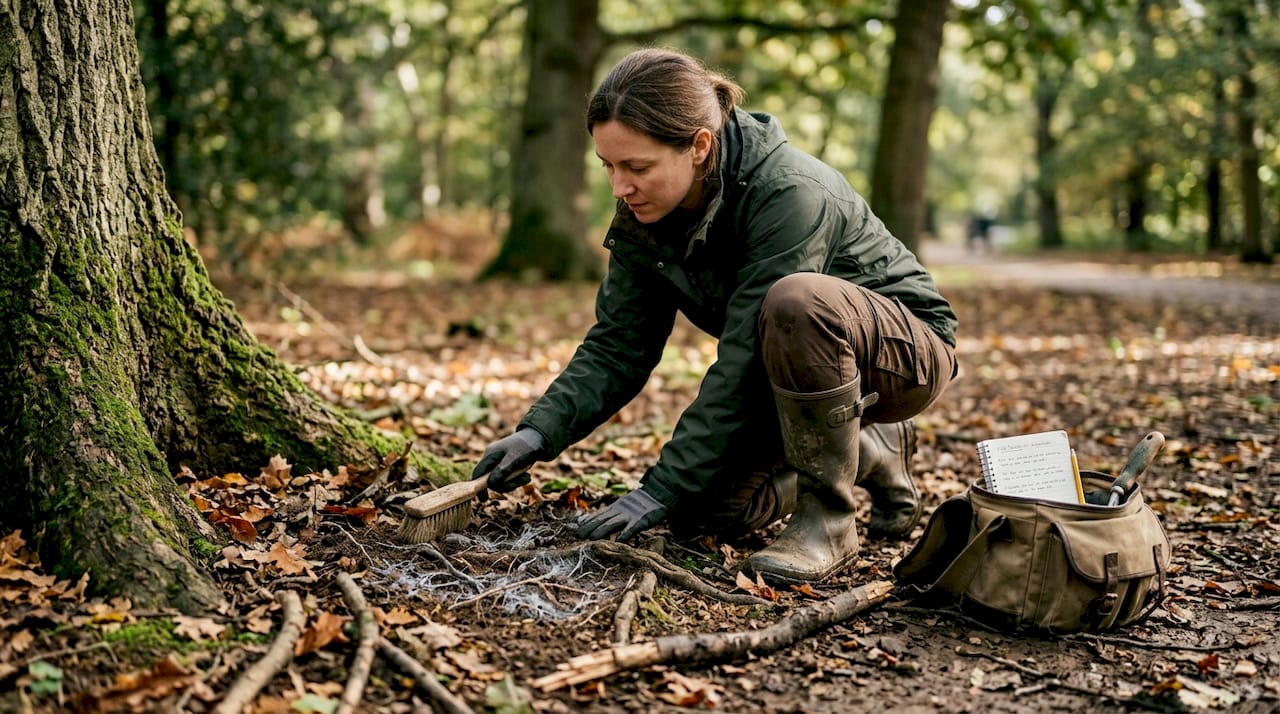
The scale of these connections is staggering. Suzanne Simard’s landmark 1997 research found that up to 80% of trees in a given forest may be joined through these overlapping fungal webs. This is not a fringe finding. Current forest research continues to map the complexity of these systems, revealing that a single tree can be connected to dozens of others simultaneously.
What travels through these networks is remarkable:
- Carbon from photosynthesis, transferred from resource-rich trees to shaded seedlings
- Water, redistributed during drought from deeper-rooted individuals
- Phosphorus and nitrogen, shared between species with different soil access
- Chemical warning signals, alerting neighbours to insect attack or disease
- Electrical pulses, potentially carrying rapid distress information
| Resource transferred | Direction of flow | Benefit to recipient |
|---|---|---|
| Carbon | Surplus to deficit trees | Supports growth and survival |
| Water | Deep roots to shallow | Drought resilience |
| Nitrogen | Fungi to tree roots | Boosts leaf production |
| Warning signals | Stressed to unstressed | Triggers defensive chemistry |
Understanding forest interdependence reframes how we think about ecosystems entirely. Survival is not purely a solo endeavour.
Pro Tip: When thinking about networks, picture the internet of the forest. Constant exchanges serve group resilience far more than individual dominance ever could. The same principle applies to any community you are part of.
Mother trees: The elders and their vital role
Not all trees are equal within these networks. The largest, oldest, most deeply connected individuals act as hubs, and researchers have given them a name that resonates far beyond biology: mother trees. These elders are not simply passive conduits. Mother trees preferentially support kin and stressed neighbours, directing more resources towards seedlings that share their genetics or towards those struggling under difficult conditions.
Simard’s decades of research on resource transfer revealed something even more striking. When a mother tree is dying, it does not simply fade. It releases a pulse of carbon and defensive signals into the network, a kind of inheritance passed to the next generation. This death legacy can measurably improve the survival odds of surrounding trees.
The Simard mother tree research has become one of the most cited examples of apparent altruism in the plant kingdom, though as we will explore shortly, the interpretation remains contested.
Here is what the mother tree concept teaches us about community leadership:
- Recognise your elders. Those with the deepest roots in a community hold connections and knowledge that newer members simply cannot replicate.
- Invest in mentorship. Resources and wisdom flow most effectively when experienced individuals actively support those who are struggling.
- Plan for succession. The most resilient communities prepare for transitions, ensuring that knowledge and relationships outlast any single individual.
- Protect hubs. Removing a mother tree from a forest can collapse the network around it. The same is true of key connectors in human organisations.
The parallels with digital ecosystem parallels in modern organisations are striking. Every network, whether biological or digital, depends on its most connected nodes.
Pro Tip: In any group you belong to, identify its mother trees. These are the people with deep trust, wide connections, and quiet expertise. Nurture them, learn from them, and make sure their knowledge does not leave when they do.
How trees communicate: The forest warning system
If elders support the network, how do all members coordinate responses to danger? The answer lies in a communication system that is both ancient and surprisingly rapid. When a tree is attacked by insects or infected by disease, it releases volatile organic compounds (VOCs) into the air. VOCs are airborne chemical molecules that carry coded information about the nature of the threat.
Neighbouring trees detect these compounds and respond by boosting their own chemical defences, producing tannins and other compounds that make their leaves less palatable to the same insects. The response is not random. Trees appear to distinguish between different types of threat and adjust their chemistry accordingly.
Key features of the forest warning system:
- Airborne VOC signals travel within minutes of an attack beginning
- Root-based chemical signals move through soil and fungal networks
- Electrical impulses through mycorrhizal threads may carry rapid distress information
- Species-specific responses mean trees can tailor their defence to the specific threat detected
Statistic: Some chemical warning signals spread across a forest stand within minutes, allowing coordinated defensive responses before an insect population can establish itself fully.
The forest protection parallels for human communities are clear. Transparent, rapid communication about shared threats strengthens collective defence. Communities that share information openly recover faster from disruption than those where knowledge is hoarded or delayed. The lessons from tree signals point consistently towards openness as a survival strategy.
Cooperation versus competition: What the evidence really shows
At this point, it is tempting to conclude that forests are harmonious places of pure cooperation. The science, however, demands more nuance. A growing number of researchers caution against what they call the romanticisation of forest networks.
“The evidence for common mycorrhizal networks is real, but the leap to ‘trees are altruistic’ is a significant one. Competition and cooperation coexist in forests, just as they do in every complex system.” — Forest ecologist, summarising the current scientific debate
The debate over tree cooperation versus self-interest is genuine and ongoing. Critics point out that what looks like resource sharing may simply be fungi acting in their own interest, using trees as vehicles. Others note that overinterpretation and citation bias have crept into the popular science narrative around forest networks.
| Observation | Cooperative interpretation | Competitive interpretation |
|---|---|---|
| Carbon transfer to seedlings | Parent trees nurturing offspring | Fungi redistributing resources for their own benefit |
| Warning signals between trees | Altruistic defence sharing | Accidental chemical leakage with incidental benefit |
| Resource flow to stressed trees | Community support | Passive diffusion along concentration gradients |
| Death legacy of mother trees | Intentional inheritance | Uncontrolled release as cells break down |
This tension is not a reason to dismiss the science. It is a reason to engage with it honestly. Eco-friendly community ideas rooted in ecological thinking are most durable when they are grounded in what the evidence actually supports, rather than what we wish it showed. The honest lesson from forests is that cooperation and competition are not opposites. They are partners in producing resilience.
Thriving through diversity: Lessons for resilience and sustainability
Whatever the precise mechanisms, one finding from forest ecology is robust and well-replicated: diversity makes forests stronger. Mixed forests, those containing multiple species of varying ages and sizes, recover faster from storms, droughts, fires, and pest outbreaks than monocultures, which are forests planted with a single species.
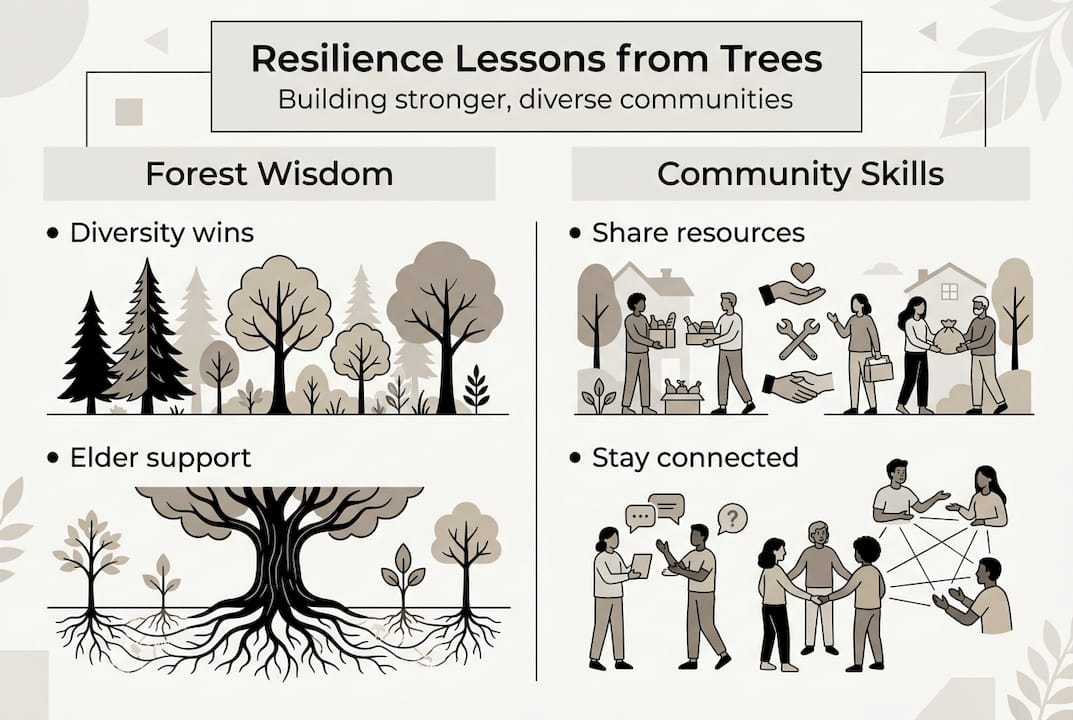
The carbon storage figures are particularly striking. Old-growth forests store vastly more carbon than new plantations, with some estimates suggesting old-growth can hold over 600% the carbon of a same-area plantation. This is not simply a matter of age. It reflects the complexity of relationships, the layered canopy, the diversity of species, and the depth of the mycorrhizal network.
| Indicator | Old-growth forest | Monoculture plantation |
|---|---|---|
| Carbon storage | Very high | Low to moderate |
| Recovery from disturbance | Fast, multi-pathway | Slow, single-pathway |
| Species diversity | High | Very low |
| Network complexity | Extensive | Minimal |
| Resistance to pests | High | Low |
What does this mean for us? The resilience lessons from forests translate directly into community and organisational life. Here are four actions worth taking:
- Support diversity in your community, team, or household. Different perspectives and skills create redundancy, which is the ability to absorb shocks without collapsing.
- Invest in relationships before you need them. Networks built under stress are weaker than those built during stability.
- Champion elders and experience. Long-term knowledge is a form of stored carbon. It takes time to accumulate and is easily lost.
- Foster knowledge sharing. Information that stays with one person is a single point of failure. Distributed knowledge is resilient knowledge.
Building eco-resilient home habits is one practical way to bring these principles into daily life, starting with the choices you make about the products you buy and the values you support.
Taking inspiration: From forests to our daily choices
Forests have spent millions of years refining the art of cooperative survival, and the principles they embody are available to all of us. Just as trees prosper through connection and mutual support, our communities and daily choices can reflect the same wisdom. At Stomart, we believe that living well and living sustainably are not competing goals. Our range of eco-friendly home goods, organic products, and garden essentials is curated with exactly this philosophy in mind. Whether you are looking to reduce your environmental footprint, support regenerative practices, or simply make more considered choices, Stomart offers the tools to help you act on nature’s most enduring lessons. Your support for resilient, connected living starts with everyday decisions.
Frequently asked questions
How do trees actually support one another underground?
Trees use mycorrhizal networks through which they exchange nutrients, water, and warning signals, often benefiting both related and unrelated neighbours. These fungal threads act as living conduits between root systems across the forest floor.
Is tree communication similar to how humans communicate?
Tree signals are chemical and electrical rather than conscious, making them more automatic than human language, but they achieve remarkably coordinated group responses to threats. The outcome, shared awareness and collective defence, mirrors what good human communication achieves.
Why is forest diversity important?
Diverse forests recover more quickly from disturbances and store significantly more carbon than single-species plantations, making diversity a practical survival strategy rather than simply an aesthetic preference.
Are trees really altruistic, or is this a myth?
Current science confirms that trees share resources, but the debate over genuine cooperation versus self-interested mechanisms remains active. The honest answer is that both forces are probably at work simultaneously.
Recommended
- What birds, bees, and forests reveal about interdependence - STOMART.CO.UK
- Secret Language of Plants - STOMART.CO.UK
- How environmental harm reflects our inner disconnection - STOMART.CO.UK
- What soil, seeds, and seasons teach about human growth - STOMART.CO.UK
- Plant Trees in Memory of Your Loved One – Maritime Burials at Sea