

Why modern homes feel full yet lack real meaning
on Apr 08, 2026TL;DR:
- Consumerism and social media drive impulse buying, leading to cluttered, impersonal homes.
- Items lacking personal meaning contribute to feelings of chaos and lower life satisfaction.
- Creating a meaningful home involves curating personal objects and focusing on quality over quantity.
Most of us have more stuff than ever before. Yet walk through the average British home and something feels oddly hollow, like a hotel room with good lighting but no soul. 45% of impulse buys are driven by positive emotions like happiness, meaning our homes fill up fast but not always with purpose. This article explores how consumer culture quietly empties the emotional warmth from our living spaces, and what you can do to reverse that pattern without throwing everything out and starting again.
Key Takeaways
| Point | Details |
|---|---|
| Consumerism fuels clutter | Current home trends and impulse buying fill homes with objects but rarely with meaning. |
| Meaning enhances well-being | Displaying objects with stories or personal ties strengthens emotional comfort and identity. |
| Clutter impacts mental health | Too many unused or impersonal items can lower life satisfaction and raise stress levels. |
| Mindful choices matter | Simple reflection and editing of possessions can transform a cluttered space into a soulful home. |
How consumerism and trends drive home clutter
Consumerism is not simply about buying things. It is a system designed to make you feel that what you already own is not quite enough. Social media accelerates this constantly. A new colour palette trends on a home décor account, and within weeks it appears in shops, in adverts, and in your own mental wish list. The cycle is relentless, and it is built to be.
Impulse buying and marketing trends are among the principal contributors to the accumulation of objects in modern homes. Brands do not just sell products; they sell the idea that your current home is one purchase away from being complete. The trouble is, ‘complete’ keeps moving.
The effects of impulse purchases on our homes and our wellbeing are more significant than most people realise. When you buy something on a whim, it rarely earns a permanent, considered place in your space. It lands on a shelf, gets shuffled to a drawer, and eventually becomes part of the background noise of clutter.
Here is a snapshot of how impulse buying shapes our homes:
| Behaviour | Percentage of people affected |
|---|---|
| Impulse buys driven by happiness | 45% |
| Items kept ‘just in case’ | 63% |
| Buyers who regret impulse purchases | 54% |
The most common triggers for this kind of accumulation include:
- Seasonal sales and limited-time offers that create artificial urgency
- Social media posts that frame trend-based items as essential
- Following modern styling trends without asking whether they suit your actual life
- Replacing functional items simply because something newer exists
- Buying duplicates because the original cannot be located in existing clutter
“Industry creates a sense of inadequacy through constant trends, driving more purchases and clutter.” This is not accidental. It is the engine of home décor store strategies built around aspiration rather than need.
The result is homes that look busy but feel anonymous. Objects arrive quickly, lose their novelty within weeks, and rarely earn any lasting emotional significance.
When possessions lack personal meaning
There is a difference between a home that looks styled and a home that feels lived in. Many beautifully arranged spaces today resemble showrooms: consistent, photogenic, and entirely forgettable. The reason is simple. Trend-driven, mass-produced objects are often devoid of stories, making spaces feel impersonal regardless of how carefully they are arranged.
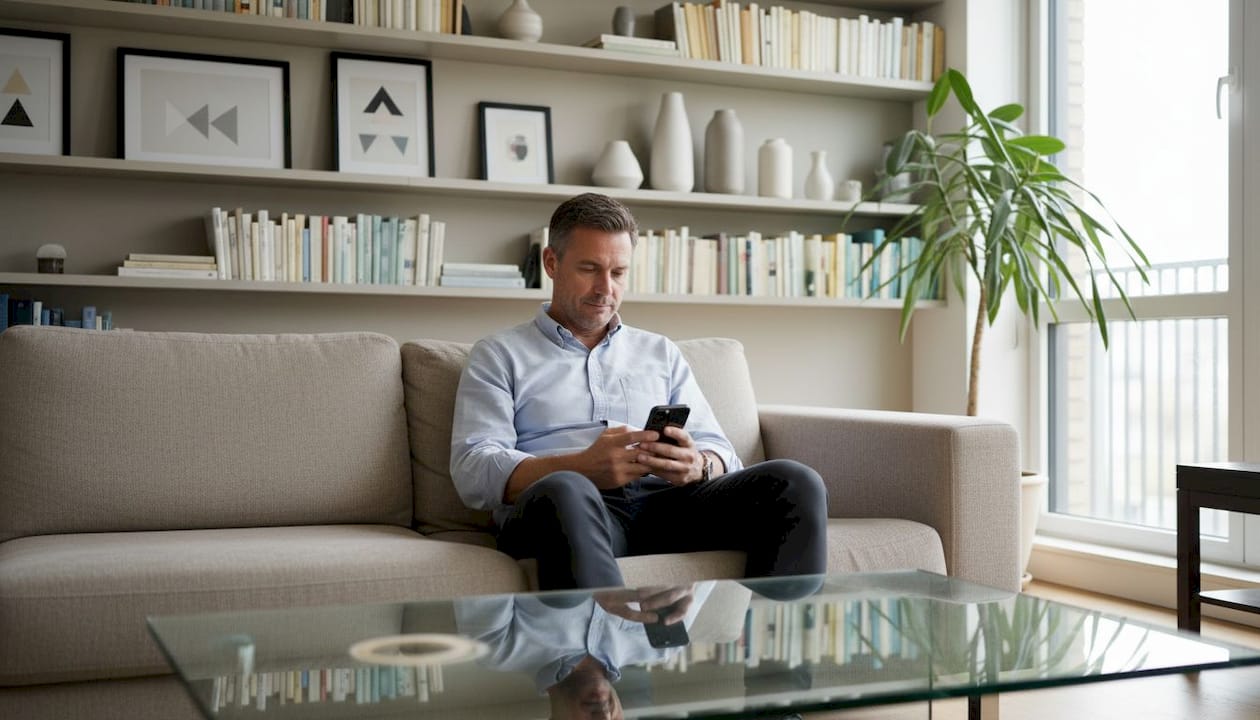
Think about the difference between a framed family photograph and a generic botanical print bought because it matched the sofa. Both hang on a wall. Only one carries weight. The photograph anchors a memory, a relationship, a moment in time. The print is simply filling space.
This is not about sentimentality for its own sake. It is about the philosophy of meaningful objects and how the things we surround ourselves with quietly shape how we feel at home. Objects with personal resonance create a sense of identity and belonging. Objects without it create visual noise.
Consider this comparison:
| Object type | Emotional impact | Longevity in the home |
|---|---|---|
| Family heirloom or gift | High, tied to memory and relationship | Often kept for life |
| Trend-based purchase | Low, novelty fades quickly | Often replaced within 1 to 2 years |
| Handmade or artisan piece | Medium to high, tied to craft and story | Kept long term |
| Mass-produced décor item | Low, interchangeable | Replaced when trends shift |
Interior designers increasingly argue that interior design trends have contributed to a homogenisation of living spaces. Homes across the country now share the same neutral tones, the same rattan accessories, the same abstract prints. When everything looks the same, nothing feels personal.
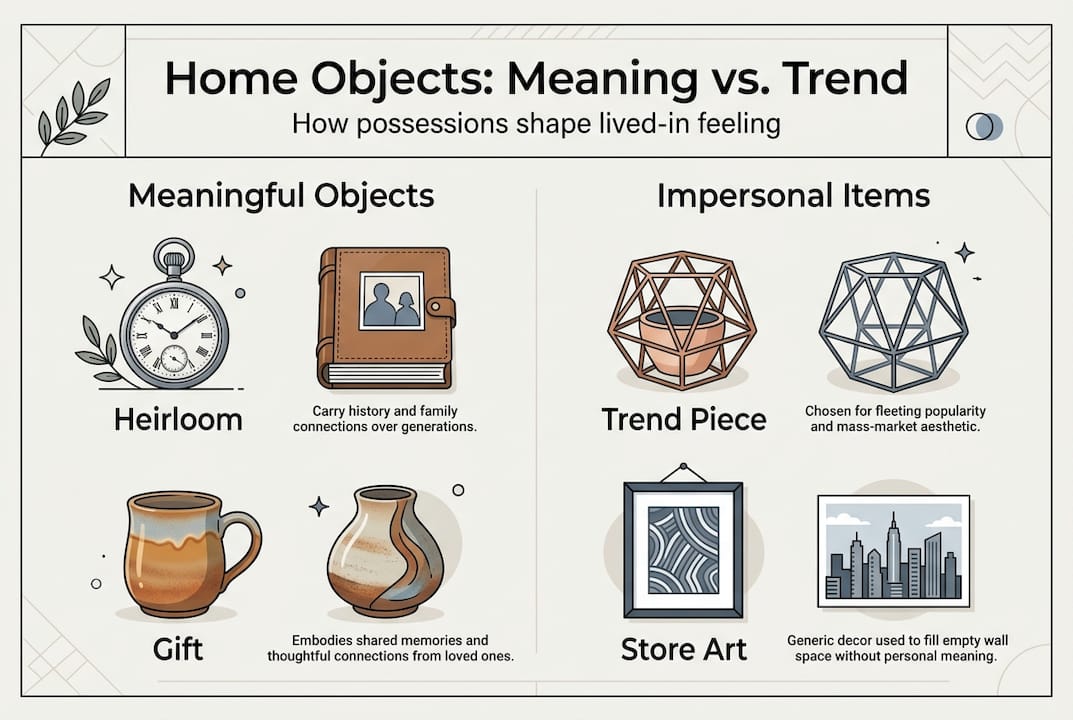
When selecting décor for meaning, the most useful question is not ‘Does this look good?’ but ‘Does this belong to my story?’
Pro Tip: Before buying any decorative item, ask yourself whether you will remember where you got it and why in five years’ time. If the answer is no, it is probably filling space rather than adding meaning.
The psychological impact of clutter and beauty
Clutter is not just an aesthetic problem. It has measurable effects on how we think and feel. Research published in the Journal of Environmental Psychology found that clutter increases negative affect and lowers life satisfaction, particularly when it undermines a person’s perception of their home’s beauty.
This matters because we spend enormous amounts of time at home. When the environment feels chaotic or impersonal, it creates a low-level mental load that is easy to overlook but hard to escape. Every object in your home is a small decision waiting to happen: where it goes, whether it stays, what to do with it. Multiply that by hundreds of items and you have what psychologists call decision fatigue.
“Clutter lowers life satisfaction especially when it undermines a person’s perception of home beauty.” The connection between visual chaos and emotional wellbeing is more direct than most people expect.
Here is how clutter quietly erodes daily happiness:
- It increases background stress by creating a constant sense of incompleteness
- It makes it harder to relax because the brain registers disorder even when you are not consciously noticing it
- It reduces your sense of control over your environment, which is closely tied to wellbeing
- It makes clutter’s effect on productivity tangible, as concentration suffers in visually busy spaces
- It fosters guilt, particularly around items you spent money on but never use
One of the more surprising findings in this space involves what researchers call ‘specialness spirals.’ Non-use increases perceived specialness over time, meaning the longer an item sits unused, the more emotionally valuable it feels, even if it has no real significance. This is why decluttering feels so difficult. Your brain has quietly convinced itself that the unopened candle or the unused vase is precious, simply because it has been there for so long.
| Clutter factor | Psychological effect |
|---|---|
| Visual disorder | Increased cortisol and stress levels |
| Unused items | Perceived specialness, harder to discard |
| Overcrowded shelves | Reduced sense of home beauty |
| Trend-based accumulation | Lower emotional connection to space |
Curating meaning: From impersonal clutter to a soulful home
The good news is that creating a more meaningful home does not require a complete overhaul. It requires a shift in how you think about what enters your space. Curating meaningful objects creates a powerful emotional anchor, and designers increasingly recommend building what they call ‘altars of sentiment’: small, intentional groupings of objects that carry genuine personal significance.
This approach draws on ideas from minimalism and luxury décor, where emptier spaces allow individual pieces to breathe and be truly seen. The Japanese concept of ‘ma’, which refers to the beauty of negative space, captures this perfectly. When everything competes for attention, nothing gets it.
Here are practical steps for increasing meaning in your home:
- Identify three to five objects you already own that carry a strong personal story and give them a prominent, intentional place
- Remove items that you cannot explain the origin of, or that you feel indifferent towards
- Before any new purchase, ask whether it will enrich your home’s story or simply add to its volume
- Explore the philosophy of everyday objects to develop a more considered relationship with your belongings
- Create one ‘meaning corner’: a shelf or surface dedicated entirely to objects with emotional significance
- Think about maximising your collections rather than expanding them endlessly
Cultural context matters here too. What counts as meaningful varies widely. For some, it is inherited objects. For others, it is pieces collected during travel, or handmade gifts. The point is not to follow a universal rule but to understand your own emotional landscape and let that guide your space. Nostalgia and décor are more deeply connected than most of us acknowledge.
Pro Tip: When you feel the urge to buy something new for your home, pause and ask, ‘Will this enrich my home’s story, or am I just filling a gap?’ That single question can save significant money and emotional energy.
A new approach to homes: Quality, not quantity
The overfilled home is a genuinely modern phenomenon. For most of human history, people owned far less and felt far more connected to what they had. There is something worth examining in that. We are not suggesting you live with bare walls and a single chair. But we do think the pressure to keep up with trends, to refresh your space every season, and to equate accumulation with comfort deserves to be questioned.
Authentic, restorative homes tend to grow slowly. They accumulate meaning the way a good friendship does: through time, shared experience, and genuine care. The philosophy of everyday objects reminds us that the most powerful interiors are not the most decorated ones. They are the ones that feel unmistakably like the person who lives there.
Resisting trend pressure is not about being contrarian. It is about recognising that your home is not a catalogue page. It is a lived space, and it deserves objects chosen with the same care you would give to a long-term relationship. When you stop buying for the moment and start choosing for the life you are actually living, something shifts. The space feels quieter, warmer, and genuinely yours.
Find meaningful home inspiration
If this has prompted you to think differently about your space, you are not alone. At Stomart, we believe that thoughtful shopping and genuine home inspiration go hand in hand. Our blog and product ranges are designed to help you make considered choices rather than reactive ones. Whether you are looking for home décor guidance or simply want to explore what a more intentional home might look like, we have resources to support that journey. Shopping with purpose feels different. It feels better. And it tends to result in a home that actually reflects who you are.
Frequently asked questions
How can I tell if an object is truly meaningful or just trendy?
A meaningful object usually carries a personal story or emotional resonance that you can articulate clearly. Experts recommend prioritising objects tied to memory over trend-driven purchases that lose their appeal quickly.
Does clutter really affect my mental health?
Yes. Research shows that clutter can increase stress and lower life satisfaction, particularly when it reduces your sense of your home’s beauty. The impact on mental wellbeing is measurable and well-documented.
What steps can I take to make my home more meaningful?
Start by displaying objects with genuine personal significance and question any impulse purchase before it enters your home. Displaying sentimental items and reducing trend-driven acquisitions are the most effective starting points.
Why do I keep items I never use?
Psychological ‘specialness spirals’ cause unused items to feel increasingly valuable simply because they have been in your possession for a long time. Non-use increases perceived value, making these items feel harder to part with than they should be.