

Why material wealth leaves many feeling empty: causes & fixes
on Mar 28, 2026Despite living in an era of unprecedented comfort, millions of people report feeling hollow, restless, and unfulfilled. Supermarkets overflow, wardrobes burst, and smartphones connect us to the entire world in seconds. Yet people feel less fulfilled even as affluence rises. This guide unpacks the surprising psychology behind that contradiction, drawing on the latest research to explain why ‘more’ so rarely delivers lasting happiness, and what genuinely does.
Key Takeaways
| Point | Details |
|---|---|
| Material gains don’t last | People quickly adapt to new comforts, making it harder for material improvements to produce lasting happiness. |
| Social comparison drives emptiness | Measuring yourself against others fuels ongoing dissatisfaction, even as abundance rises. |
| Meaning and connection matter most | Building relationships and finding purpose have greater impact on emotional well-being than acquiring more possessions. |
| Stress can rise with wealth | Above a certain income, stress often increases—highlighting a limit to the happiness money can buy. |
| Practical change is possible | Shifting focus from possessions to purpose and connections is a proven way to reduce emptiness. |
Understanding the paradox: Why having more doesn’t mean feeling fulfilled
To understand why emptiness persists, we need to unpack the psychological forces at play. The first force is hedonic adaptation, sometimes called the hedonic treadmill. It describes how quickly we return to a baseline level of happiness after any positive change. Buy a new car, feel a rush of pleasure, then within weeks it becomes ordinary. Increased wealth doesn’t boost sustained happiness for precisely this reason.
The second force is the Easterlin Paradox. Economist Richard Easterlin observed that while richer individuals within a country tend to be happier than poorer ones, national income rises don’t make nations happier over the long term. The table below illustrates this clearly.
| Country | GDP per capita rise (1990–2020) | Average happiness score change |
|---|---|---|
| United States | +85% | +0.1 (negligible) |
| Japan | +40% | Flat |
| United Kingdom | +60% | +0.2 (negligible) |
| South Korea | +300% | +0.3 (marginal) |
“In high-income countries, happiness scores have remained essentially flat for decades, even as material living standards have soared.” — Easterlin Paradox revisited
The third force is status games. We don’t measure our wellbeing in absolute terms. We measure it against our neighbours, colleagues, and the curated lives we scroll past on social media. Understanding why enough feels impossible starts here: the goalposts move every time someone around us gets ahead. This is also why desire remains unfulfilled even after we achieve what we once thought we wanted.
The science of ‘never enough’: Hedonic adaptation and social comparison
By looking closely at these invisible forces, we see why ‘more’ so rarely delivers what it promises. Hedonic adaptation doesn’t just affect big purchases. It shapes how we feel about promotions, relationships, and even our health. The excitement fades. The new becomes normal. Then we reach for the next thing.
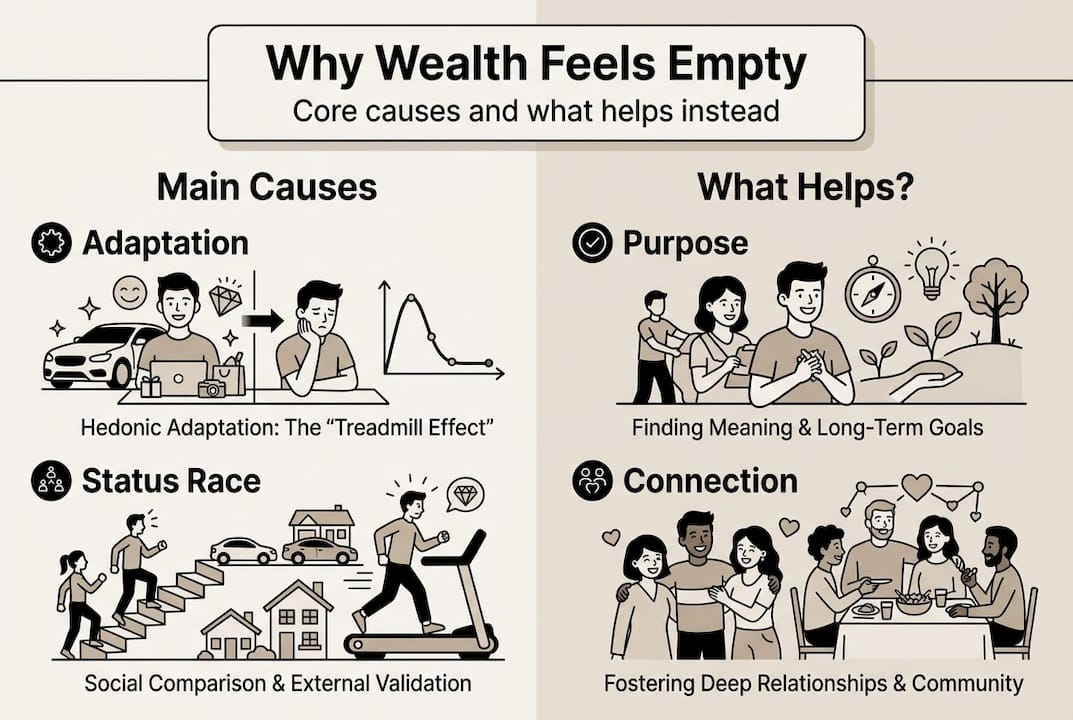
Social comparison turns material gains into zero-sum games. When your colleague gets a pay rise, your own salary suddenly feels smaller, even though nothing about your life has changed. This is the engine behind so much modern dissatisfaction.
Here is how social comparison typically plays out in everyday life:
- Status signalling: Buying visible goods to communicate success to others
- Envy spirals: Feeling inadequate when peers appear to outpace you
- Keeping up appearances: Spending beyond your means to maintain a social image
- Comparison fatigue: Exhaustion from constantly measuring yourself against others
Status competition explains why economic growth in wealthy nations fails to boost collective happiness. The gains are real, but so is the pressure to keep climbing. Understanding emotional buying and satisfaction can help you spot when you are shopping to soothe comparison anxiety rather than genuine need.
The environmental toll of this cycle is also worth noting. Fast consumerism in the UK is partly driven by the same restless striving that leaves people feeling empty. And understanding why enough feels impossible is the first step to breaking the cycle.
Pro Tip: Write down three personal values that have nothing to do with money or status. Use these as a filter before any significant purchase or life decision. Over time, this simple habit redirects your attention from external measures to internal ones.
More income, more stress: When does prosperity stop helping?
But does accumulating more always lead to better emotional lives, or are there hidden costs? The evidence is nuanced. Higher income links to greater life satisfaction but also to more daily stress above roughly £50,000 per year. In other words, the emotional picture gets more complicated, not simpler, as earnings rise.
A contrasting view suggests that income always correlates with life satisfaction, but that emotional wellbeing, meaning day-to-day feelings of joy and calm, plateaus well before life satisfaction does. You can feel your life is going well and still feel stressed, anxious, or hollow.
| Income band | Life satisfaction trend | Daily stress trend |
|---|---|---|
| Under £25,000 | Low | High |
| £25,000–£50,000 | Rising | Moderate |
| £50,000–£100,000 | High | Also rising |
| Over £100,000 | Very high | Elevated |
Here are the typical emotional stages people move through as income rises:
- Initial euphoria: The relief and excitement of financial security
- Adaptation plateau: New income becomes the new normal; excitement fades
- Comparison pressure: Awareness of those earning more creates fresh dissatisfaction
- Stress accumulation: Greater responsibility, longer hours, and higher stakes erode wellbeing
- Meaning gap: Material comfort is secured, but purpose and connection feel absent
This pattern is most visible in affluent societies. In lower and middle-income countries, rising income still delivers meaningful improvements in daily life. The paradox is a problem of abundance, not scarcity. Recognising why enough feels impossible and understanding how desire remains unfulfilled even at high income levels can help you make more intentional choices.
What really fills the void: Meaning, relationships, and purpose
If wealth alone can’t fill the void, what does science say about achieving genuine fulfilment? The answer is consistent across decades of research. Three factors stand out:
- Meaningful relationships: Close, reciprocal bonds with family, friends, and community are the single strongest predictor of long-term happiness
- Sense of purpose: Feeling that your actions contribute to something larger than yourself, whether through work, creativity, or service
- Value-driven choices: Making decisions that align with your core beliefs rather than external expectations
Experiential and relational spending predicts satisfaction far better than buying objects. A weekend away with people you love, a course that stretches your thinking, or volunteering in your community all deliver more lasting joy than a new gadget. The memory compounds. The gadget depreciates.

For young professionals battling burnout, therapy for meaning-making offers a practical pathway off the achievement treadmill. It is not about abandoning ambition. It is about redirecting it towards what actually matters to you. Exploring personal meaning in choices and being more intentional about spending on experiences are small but powerful shifts.
Pro Tip: Audit your last ten purchases. How many were objects, and how many were experiences or investments in relationships? The ratio often reveals where your values and your spending are out of alignment.
When emptiness runs deeper: Trauma, connection, and the inner life
Sometimes feelings of emptiness point to deeper emotional roots, well beyond affluence or social status. Psychologists distinguish between the ordinary restlessness of hedonic adaptation and a more profound, clinical form of emptiness.
“Emptiness can manifest as psychic deadness, a state of inner numbness and disconnection rooted in early trauma or defensive emotional repression, characterised by a profound lack of vitality.” — Frontiers in Psychiatry (2025)
This deeper form of emptiness is not solved by a holiday or a promotion. Its signs include:
- Persistent numbness or emotional flatness, even during objectively good moments
- Chronic boredom that no activity seems to relieve
- Difficulty forming or maintaining close connections
- A sense of going through the motions without genuine engagement
- Feeling like an observer of your own life rather than a participant
Childhood emotional experiences shape our capacity for connection and vitality in adulthood. When early relationships were inconsistent or painful, the inner life can shut down as a form of protection. Rebuilding that vitality often requires more than self-help. It requires supportive relationships, professional guidance, and the courage to look inward. The achievement treadmill and emotions are deeply intertwined, and addressing one without the other rarely brings lasting relief.
Minding your inner life as carefully as you mind your career or finances is not indulgent. It is essential.
Finding balance beyond ‘more’: Your next steps
With new understanding in hand, it is time to move from theory to supportive resources designed for real life. The research is clear: reflection, meaning, and connection outperform accumulation every time. That does not mean rejecting comfort or pleasure. It means choosing them with intention rather than compulsion.
At Stomart, we believe that shopping can be a mindful, values-led act rather than a reflexive response to emptiness. Whether you are exploring wellness products, investing in your home environment, or simply looking for something that genuinely serves your life, the goal is always the same: more of what matters, less of what doesn’t. Explore our resources on rethinking desire and consumption to start making choices that align with who you actually are, not who the algorithm thinks you should be.

Frequently asked questions
Does higher income always cause more happiness?
Higher income links to both satisfaction and stress. Life satisfaction generally rises with income, but emotional wellbeing tends to plateau, and daily stress can increase significantly at higher earnings.
What is hedonic adaptation and how does it affect happiness?
Hedonic adaptation means we quickly adjust to positive events, requiring ever-greater stimulation for the same pleasure. Material improvements therefore rarely produce lasting happiness.
How can I feel less empty despite having enough materially?
Experiential and relational spending is consistently more satisfying than buying objects. Focus on meaningful relationships, purpose, and values rather than acquisitions.
Is emotional emptiness always linked to trauma?
Not always, but deep and persistent emptiness can signal unresolved emotional wounds. Emptiness as psychic deadness is linked to early trauma and a lack of meaningful connection.
Does everyone experience the Easterlin Paradox?
The paradox mainly affects high-income countries. In poorer nations, happiness still rises with economic growth. The Easterlin Paradox mostly applies to affluent societies where basic needs are already met.