

Gratitude and sustainable living: the surprising link
on Apr 03, 2026TL;DR:
- Cultivating gratitude shifts focus from scarcity to abundance, reducing overconsumption and waste.
- Gratitude paired with self-transcendence values significantly enhances eco-friendly behaviors.
- Daily gratitude practices foster mindful living, strengthening personal well-being and sustainable habits.
Most people assume sustainability demands big sacrifices: switching to solar panels, overhauling your diet, or waiting for governments to act. Yet a growing body of research suggests something far simpler and more personal sits at the heart of lasting environmental change. Feeling genuinely grateful, for what you already own, for the food on your table, for the natural world around you, quietly reshapes the choices you make every day. This guide explores how cultivating gratitude reduces overconsumption, cuts waste, and builds a more mindful way of living, without requiring you to turn your life upside down.
Key Takeaways
| Point | Details |
|---|---|
| Gratitude reduces materialism | Feeling grateful lessens the urge to buy more and helps you appreciate what you already have. |
| Boosts sustainable actions | Gratitude reliably increases your willingness and motivation for eco-friendly behaviours. |
| Drives less waste | Practising gratitude motivates you to reduce, reuse, and repurpose, especially in food and daily habits. |
| Practical habits amplify impact | Simple gratitude rituals, like journaling and mindful pauses, create a daily pathway to more sustainable living. |
How gratitude transforms our relationship with consumption
Consumerism runs on dissatisfaction. The moment you acquire something new, the novelty fades and the cycle begins again. This is not a character flaw; it is a well-documented psychological loop tied to how consumerism and desire are wired into modern life. Gratitude interrupts that loop in a surprisingly direct way.
When you pause to appreciate what you already have, your brain shifts from a scarcity mindset (“I need more”) to an abundance mindset (“I have enough”). Research confirms that gratitude reduces materialism, promoting sustainable consumption by fostering contentment with existing possessions and shifting focus from scarcity to abundance. That is not a small finding. Materialism is one of the strongest predictors of high-consumption lifestyles, and anything that reliably dents it has real environmental value.
The psychological mechanisms at work here include:
- Contentment: Grateful people report higher satisfaction with what they own, reducing impulse purchases.
- Prosocial values: Gratitude strengthens care for others and the wider world, making ethical choices feel natural rather than effortful.
- Reduced hedonic adaptation: Appreciating existing items slows the process by which new things stop feeling special, meaning you need less novelty to feel good.
- Shift from scarcity to abundance: Feeling grateful reframes your baseline, so you stop measuring your life against what you lack.
These shifts are not abstract. They show up in tangible choices: buying fewer clothes, repairing rather than replacing, and resisting the pull of emotional buying and pollution that drives so much unnecessary consumption.
“Gratitude is not just a feeling. It is a lens that changes what you see as enough.”
Pro Tip: Before any non-essential purchase, spend 60 seconds listing three things you already own that serve a similar purpose. This brief gratitude pause dramatically reduces impulse buying.
The science behind gratitude and sustainable habits
Having clarified how gratitude transforms what and why we consume, we can turn to rigorous research on how this translates into day-to-day sustainable habits.
A 2025 study published in Frontiers in Psychology found that gratitude enhances sustainable consumer behaviour, particularly when aligned with self-transcendence values, via increased self-efficacy. Self-transcendence refers to caring beyond yourself, valuing nature, community, and future generations. When gratitude is paired with these values, the effect on eco-friendly behaviour is significantly amplified.
Here is a summary of what the research reveals:
| Factor | Effect on sustainable behaviour |
|---|---|
| Gratitude alone | Moderate positive effect |
| Gratitude plus self-transcendence values | Strong positive effect |
| Admiration (for self-enhancement types) | Moderate effect via different pathway |
| Self-efficacy (belief you can act) | Key mediator for all groups |
The study also found that for people who are more self-enhancement oriented (focused on personal success and status), admiration rather than gratitude may be the more effective emotional trigger for eco buying decisions. This is a nuanced but important distinction.
Practically, the research points to three clear steps for building gratitude-driven sustainable habits:
- Identify your values. Do you care most about community, nature, or future generations? Anchoring gratitude to your specific values makes it more powerful.
- Build self-efficacy. Start with small, achievable sustainable actions. Each success reinforces your belief that your choices matter.
- Pair gratitude with intention. Gratitude without direction stays inward. Consciously linking your grateful feelings to environmental action channels them outward.
The science is clear: gratitude is not just a mood. It is a motivational engine, and understanding how it works lets you use it far more deliberately.
Gratitude and waste: motivations to reduce, reuse, and rethink
Understanding how gratitude influences what we use and buy, it is essential to explore its effects on how we handle waste, a crucial sustainability issue.
Food waste alone accounts for roughly 8 to 10 per cent of global greenhouse gas emissions. Research published in Frontiers in Psychology shows that gratitude correlates positively with motivations to avoid food waste, specifically moral and financial motives. In plain terms, grateful people feel it is wrong to waste food, and they also feel the financial sting of throwing it away more acutely.

This has real household implications. Consider two approaches:
| Approach | Mindset | Typical outcome |
|---|---|---|
| Viewing leftovers as inconvenient | Scarcity/obligation | Higher food waste |
| Viewing leftovers as a resource | Gratitude/abundance | Creative reuse, less waste |
Gratitude reframes the second approach as natural. People who practise daily appreciation are more likely to:
- Plan meals around what they already have rather than buying new ingredients.
- Compost food scraps rather than binning them, seeing organic matter as valuable.
- Gift or share surplus food with neighbours rather than discarding it.
- Attend to understanding waste and values as a reflection of what they truly care about.
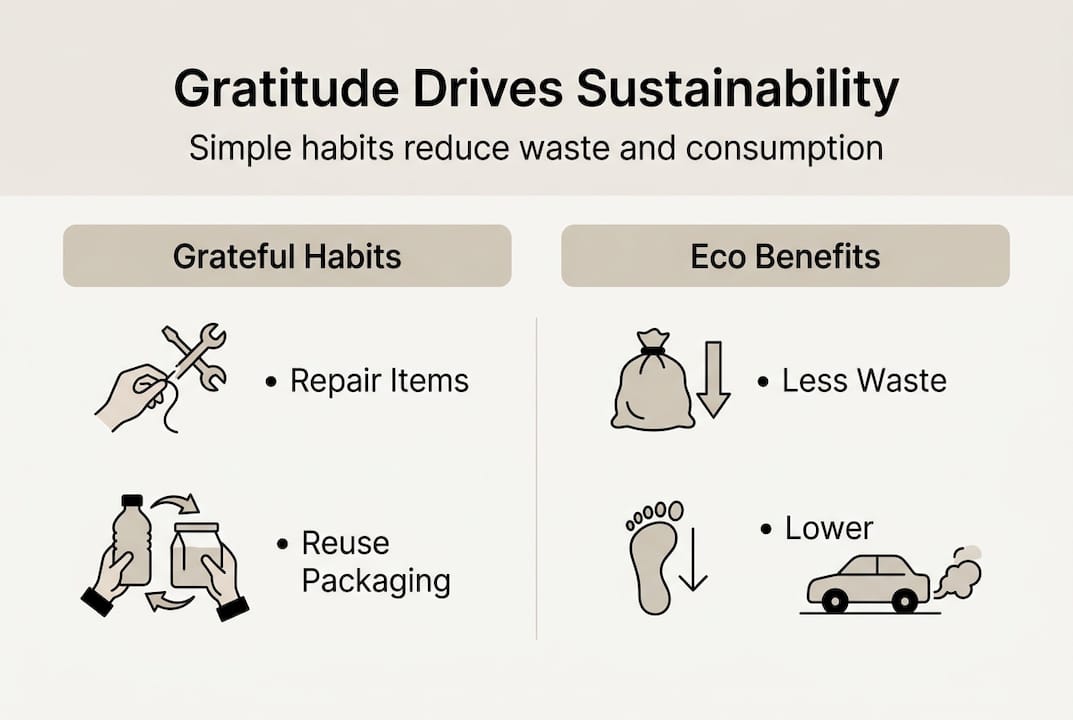
The connection extends beyond food. Grateful households tend to repair broken items, repurpose packaging, and think twice before discarding anything. This is the spirit behind a zero waste lifestyle, and gratitude is arguably its most natural foundation.
Even in social contexts, gratitude matters. Choosing digital invitations over paper for events, for example, reflects a grateful awareness of resources. Combining mindful eating habits with a grateful attitude towards food transforms mealtimes from routine to intentional, cutting waste at the source.
Daily gratitude practices for a more sustainable lifestyle
Having explored gratitude’s impact on both buying and waste, you may wonder how to weave this into daily life for lasting change.
The good news is that the most effective practices are simple and require no special equipment. Research confirms that gratitude journaling for existing items and nature reinforces sufficiency, reducing the desire for new purchases. Writing down three things you are grateful for each morning, specifically focusing on possessions and natural surroundings, is enough to begin shifting your relationship with consumption.
Here are five evidence-backed practices to try:
- Possession gratitude journal. Each evening, note one item you used and appreciated that day. Over time, this deepens your attachment to existing belongings and reduces the pull of novelty.
- Mindful appreciation walks. Spend ten minutes outdoors noticing details: birdsong, light through leaves, the texture of bark. Studies show that gratitude to nature increases pro-environmental behaviours through connectedness and anthropomorphism (treating nature as having its own worth and personality).
- Letters to nature. Write a short, informal note to a local park, river, or woodland. This practice sounds unusual but powerfully strengthens emotional bonds with the environment.
- Reuse rituals. Before discarding any item, pause and ask: “What else could this become?” This brief moment of appreciation often sparks creative reuse.
- Gratitude before purchases. Pause before buying anything non-essential and appreciate what you already own that serves a similar need. This connects naturally to choosing quality eco products over disposable alternatives.
Pro Tip: Pair your gratitude journal with a review of your eco-friendly home products once a month. Noticing what you already use mindfully reinforces the habit loop and keeps your home aligned with your values.
Anthropomorphising nature, seeing a forest as a living community rather than a backdrop, is not whimsy. It is a research-backed way to deepen your sense of nature’s interdependence and make pro-environmental choices feel personally meaningful rather than obligatory. A nature-inspired approach to life reinforces this connection in everyday decisions.
Why gratitude is the sustainability strategy nobody talks about
Every mainstream sustainability conversation gravitates towards the same topics: renewable energy, policy reform, corporate responsibility, and consumer boycotts. These matter. But they all share a common blind spot: they treat overconsumption as a logistical problem rather than a psychological one.
Gratitude addresses the root. It does not ask you to consume less by willpower alone; it changes what you want. That is a fundamentally different, and far more durable, mechanism. The eco buying guide approach acknowledges this, but gratitude goes even deeper by reshaping desire itself.
The honest barrier to gratitude as a mainstream sustainability tool is that it is not photogenic. It does not generate headlines the way a new electric vehicle or a climate summit does. It happens quietly, in journals and on morning walks, and its effects accumulate slowly. But cumulative is exactly how lasting change works. A million households consuming slightly less because they feel genuinely satisfied is more powerful than any single policy intervention.
The added reward is personal. People who practise gratitude consistently report higher wellbeing, stronger resilience, and a clearer sense of purpose. Sustainability becomes something you want to live, not a duty you endure.
Discover more mindful living with Stomart
Ready to deepen your gratitude-fuelled eco journey? At Stomart, we believe that living well and living sustainably are the same thing. Our blog and product range are built around that conviction, offering practical tools and ideas for households that want to consume more mindfully without sacrificing comfort or joy.
From guides on reducing household waste to curated eco home ideas and organic product ranges, we bring together everything you need to make your values visible in your daily life. Browse our latest articles, explore our eco-friendly collections, and join a community of people who believe that small, grateful choices add up to something genuinely significant.
Frequently asked questions
Does gratitude really make a difference in sustainable living?
Yes, studies show that gratitude reduces materialism and increases pro-environmental behaviour, making it a reliable driver of sustainability rather than just a feel-good habit.
How can I make gratitude a habit to support sustainability?
Start with a daily gratitude journal focused on possessions and nature; gratitude journaling reinforces sufficiency, reducing the desire for new purchases over time.
Is gratitude effective for people who aren’t naturally eco-conscious?
Gratitude works broadly, but it is most powerful for those with self-transcendent values; for others, effectiveness depends on personal values, and admiration-based practices can also inspire eco-behaviour.
Does feeling gratitude to nature really change behaviour?
Yes, gratitude to nature increases pro-environmental actions by building emotional connectedness with the environment, making sustainable choices feel personally meaningful.
Recommended
- What waste reveals: our values, habits, and a path to change - STOMART.CO.UK
- Zero Waste Lifestyle Daily Living - STOMART.CO.UK
- Zero Waste Lifestyle Daily Living - STOMART.CO.UK
- The problem with ‘more’: why enough feels impossible - STOMART.CO.UK
- We care about sustainability – TriEye
- Modern living architecture: Sustainable, community homes