

What waste reveals: our values, habits, and a path to change
on Mar 29, 2026We rarely pause to consider what happens after we toss something in the bin. Yet philosophers argue that throwaway culture is far from a neutral act — it is a mirror held up to our deepest values, social norms, and relationship with the planet. The way we treat our rubbish tells a story about who we are, what we prioritise, and what we believe the world owes us. This article moves from that philosophical insight through the psychology of guilt and pride, all the way to practical steps you can take today to live more consciously.
Key Takeaways
| Point | Details |
|---|---|
| Waste reflects values | Our definitions and treatment of waste reveal what we value both as individuals and as a society. |
| Cognitive dissonance drives change | Feeling guilty about waste can motivate us to align our actions with our environmental beliefs. |
| Convenience fuels throwaway culture | Short-term ease and marketing often undermine sustainable habits, building a culture of disposability. |
| Sustainable action is possible | Simple, mindful choices in how we buy, use, and dispose can reduce waste and support meaningful change. |
How we define waste and why it matters
Waste is not a fixed, objective category. What one culture discards, another treasures. What one generation considered rubbish, the next recycles into art or raw material. This is not a trivial observation. As researchers note, waste is a human construct with no natural equivalent, and its perception actively shapes societal reality and consciousness.
Philosophy has long treated waste as a lens for examining values. If something is thrown away, it has been judged worthless — but who makes that judgement, and on what basis? The answer is rarely purely rational. It is shaped by marketing, convenience, social pressure, and habit.
“Waste is not a thing in the world. It is a verdict we pass on things.” This framing reminds us that disposal is always a value judgement, not just a practical act.
The throwaway mentality accelerated sharply after the 1960s, driven by mass production and the rise of single-use packaging. Key factors that shaped this shift include:
- Planned obsolescence: Products designed to fail or feel outdated quickly
- Cheap manufacturing: Low prices made replacing easier than repairing
- Marketing culture: Novelty was sold as progress
- Urban disconnection: Distance from nature reduced awareness of waste’s consequences
Understanding emotional buying and waste is essential here, because many purchases are driven by feeling rather than need, making disposal almost inevitable from the moment of purchase.
What our waste says about us: values and social signals
Having defined waste, what does our approach to rubbish reveal about us personally and as a society? Quite a lot, it turns out.
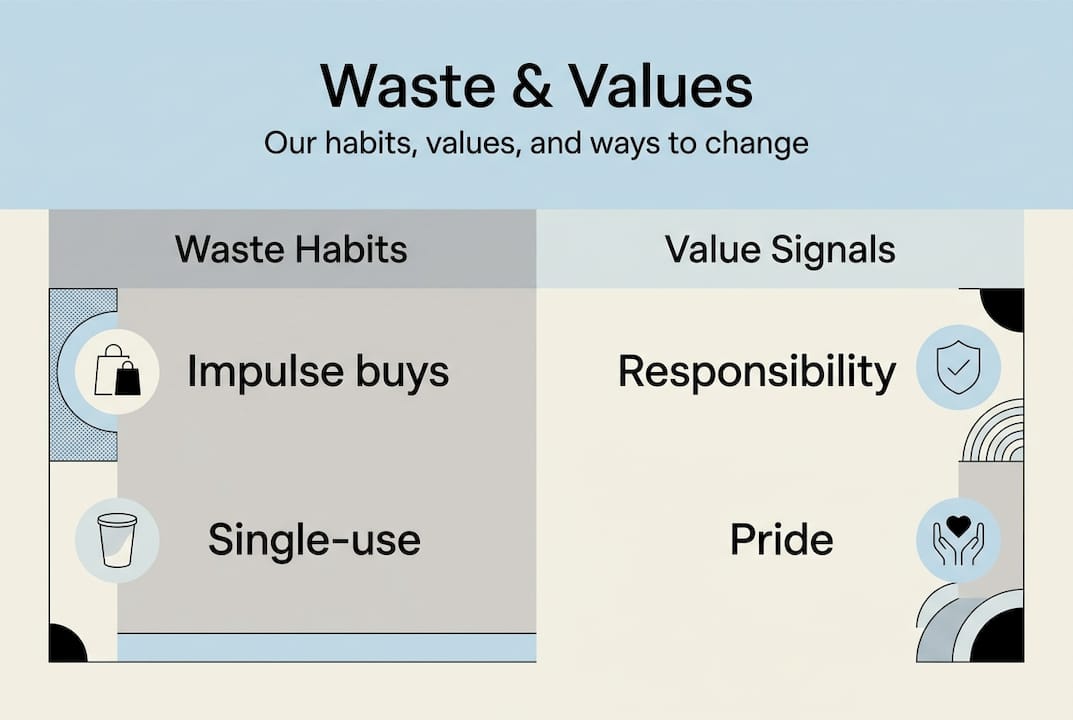
Disposal habits function as social signals. A household that carefully sorts recycling, composts food scraps, and avoids single-use plastics communicates something about its values to neighbours and visitors. Conversely, overflowing bins and discarded fast fashion signal indifference, whether intended or not.
“The gap between what we believe and what we do is where guilt lives.”
This gap has a name in psychology: cognitive dissonance. Research confirms that throwing away signals cognitive dissonance between pro-environmental values and unsustainable consumption, and this conflict reliably produces guilt. Most of us genuinely care about the environment. Yet most of us also buy things we do not need, discard them quickly, and feel vaguely uncomfortable about it.
| Behaviour | Value it signals | Emotional response |
|---|---|---|
| Careful recycling | Environmental responsibility | Pride, satisfaction |
| Buying and discarding fast fashion | Convenience over conscience | Guilt, rationalisation |
| Repairing broken items | Resourcefulness, care | Confidence, alignment |
| Ignoring waste sorting | Disengagement | Numbness or denial |
Pro Tip: Next time you throw something away, pause for three seconds and ask yourself: “Does this action match what I believe?” That brief moment of reflection is where real change begins.
Exploring consumer desire and waste reveals how our appetite for new things is often manufactured rather than genuine, making the guilt cycle almost predictable.
The philosophy and ethics of the throwaway society
To dig deeper, philosophy helps us question whether our throwaway habits are just practical or deeply irrational.
Philosophers who study consumer culture point out that disposability is not a natural human tendency. It is a constructed one. The throwaway culture critiqued in philosophy is described as irrational because it destroys value that could be preserved, and wasteful because it externalises costs onto the environment and future generations.
Three major philosophical critiques stand out:
- Anthropocentrism: The belief that nature exists purely for human use, making waste seem consequence-free
- Capitalism and disposability: Consumer culture’s disposability is driven by convenience and marketing, directly conflicting with sustainability
- The ethics of ownership: If you own something, do you have the right to destroy it? Philosophers increasingly say no, especially when disposal harms shared resources
The book On Garbage by John Scanlan explores how rubbish is not just a material problem but a philosophical one, arguing that what we discard defines civilisation as much as what we create.
| Approach | Core value | Practical example |
|---|---|---|
| Throwaway culture | Convenience, novelty | Buy, use once, discard |
| Circular economy | Resource preservation | Repair, resell, recycle |
| Right-to-repair | Ownership and responsibility | Fix your own electronics |
The impact of fast consumerism on the environment is well documented, and the cost of convenience is rarely reflected in the price tag of the products we buy and discard.

Pro Tip: Before buying anything new, ask whether a repair, a second-hand alternative, or simply going without would serve you just as well. This single habit can dramatically reduce your personal waste footprint.
How waste influences change: guilt, pride, and sustainable action
Understanding the critique is one step. What happens to us emotionally and ethically when we actually try to do better?
Guilt, as uncomfortable as it is, serves a purpose. It signals a conflict between your values and your actions. Managed well, that discomfort becomes a catalyst. Managed poorly, it leads to paralysis or denial. The key is to treat guilt as information rather than punishment.
Pride works differently. Research shows that green self-accountability boosts sustainable purchasing via anticipated pride. In other words, imagining how good you will feel after making a sustainable choice actually makes you more likely to make it. This is a powerful and underused tool.
Here is a practical sequence for turning emotional responses into lasting habits:
- Notice the feeling: Guilt or discomfort after a wasteful act is data, not a verdict on your character
- Identify the gap: What value did you compromise? Sustainability, frugality, care for others?
- Choose one small change: Not a complete lifestyle overhaul, just one adjustment
- Anticipate the pride: Visualise how you will feel after making the better choice next time
- Repeat and build: Habits form through repetition, not willpower alone
One important caveat: not all green initiatives work as intended. Studies show that recycling can induce a warm glow effect, increasing overall waste generation because disposal feels virtuous. People buy more and discard more freely when they believe recycling neutralises the harm. Awareness of this backfire effect is itself a form of protection against it.
Exploring a zero waste lifestyle and learning about upcycling and sustainable living can help you move beyond recycling as a comfort blanket and towards genuinely reducing what you consume in the first place.
Practical choices: aligning our habits with our values
Turning awareness into meaningful change is the final step towards a less wasteful, more conscious life.
The circular economy and right-to-repair movement offers a policy-level framework, but individual choices matter enormously too. Zero waste practices, upcycling, and mindful purchasing reduce both personal and societal waste in measurable ways.
Here are concrete actions you can start this week:
- Audit your bin: Spend one week noting what you throw away most. Patterns reveal habits you may not have noticed
- Buy with intention: Ask whether you need it, will use it long-term, and what happens to it at end of life
- Repair before replacing: A broken zip, a cracked screen, a worn sole — most things can be fixed for less than replacement costs
- Upcycle creatively: Old jars become storage, worn clothing becomes cleaning rags, cardboard becomes packaging for gifts
- Choose quality over quantity: One well-made item that lasts five years produces less waste than five cheap ones that each last a year
- Compost food waste: Food in landfill produces methane; composting returns nutrients to soil
Pro Tip: Set a “one in, one out” rule for your home. Every time something new comes in, something old must be repaired, donated, or responsibly disposed of. This single rule keeps consumption honest.
For deeper guidance, practical zero waste steps and eco-friendly home choices offer specific, actionable ideas tailored to everyday British households.
Take the next step towards sustainable living
If this article has shifted how you think about your rubbish, that shift is worth acting on. At STOMART, we believe that conscious consumption and sustainable living go hand in hand. Whether you are looking for eco-friendly home products, organic alternatives, or simply want to make more considered purchases, our catalogue is built with variety and value in mind. You can also discover zero waste living through our growing library of guides and articles, designed to help you move from awareness to action without feeling overwhelmed. Small, consistent choices add up. Start with one.
Frequently asked questions
Why do we feel guilty about throwing things away?
Guilt arises when our actions conflict with our values, a psychological state known as cognitive dissonance. When we care about the environment but act wastefully, that tension surfaces as discomfort or guilt.
Are all types of waste viewed the same way in different cultures?
No. Waste perception varies enormously across cultures and has changed significantly since the 1960s, shaped by economics, tradition, and environmental awareness.
Can recycling ever be bad for the environment?
Sometimes, yes. The warm glow effect in recycling can lead people to consume and discard more freely, believing that recycling cancels out the harm. Reducing consumption remains more effective than recycling alone.
What practical steps can individuals take to reduce waste and live by their values?
Zero waste practices and mindful purchasing are the most effective starting points. Focus on reducing what you buy, reusing what you have, and upcycling before discarding.
Recommended
- Harness daily habits to shape your destiny in 2026 - STOMART.CO.UK
- Hidden philosophy of everyday objects in your home - STOMART.CO.UK
- How environmental harm reflects our inner disconnection - STOMART.CO.UK
- Zero Waste Lifestyle Daily Living - STOMART.CO.UK
- 7 Essential Habit Tracking Tips for Success – Optio Station: Best Project Management App for Prioritization