

How industrialisation eroded our ecological intelligence
on Apr 11, 2026TL;DR:
- Human connection to nature has declined over 60% since 1800 due to industrialization and urbanization.
- Ecological intelligence involves understanding complex natural systems and human roles within them.
- Restoring ecological intelligence requires intentional efforts like outdoor education, green spaces, and meaningful daily habits.
Human connection to nature has declined over 60% since 1800, yet most of us barely notice the loss. We navigate cities, scroll through screens, and buy food wrapped in plastic without once considering the living systems that sustain us. This invisible erosion is not laziness or indifference. It is the predictable outcome of two centuries of industrialisation steadily replacing ecological knowledge with convenience. This article breaks down what ecological intelligence actually is, how industrialisation dismantled it generation by generation, what forces keep driving the decline today, and crucially, what realistic steps can begin to reverse it.
Key Takeaways
| Point | Details |
|---|---|
| Nature connection declined | Human societies are over 60% less connected to nature since industrialisation began. |
| Urbanisation’s role | Modern living, especially in cities, accelerates the loss of ecological intelligence. |
| Intergenerational loss | Weaker nature bonds are transmitted between generations unless active intervention occurs. |
| Hope in intervention | Green spaces, education and mindful consumer choices can begin to restore ecological intelligence. |
What is ecological intelligence and why does it matter?
Ecological intelligence is the capacity to understand nature’s complex, interconnected systems and to recognise your own role within them. It goes far beyond knowing the names of a few birds or plants. It includes reading animal behaviour to anticipate weather, understanding soil health by observing what grows, tracking seasonal cycles, and grasping how one small change in a habitat ripples outward. For most of human history, this knowledge was not a hobby. It was survival.
Think of a traditional farming community that knew exactly when to plant by watching migrating birds, or a coastal fishing village that read tidal patterns and cloud formations before setting out to sea. These were not superstitions. They were finely tuned ecological literacy systems built over generations.
Today, ecological intelligence matters for reasons beyond survival:
- Personal well-being: Research consistently links time in nature and nature awareness with lower stress, better mood, and improved cognitive function.
- Sustainable decision-making: Understanding ecological systems helps individuals and communities make choices that do not exhaust resources or damage habitats.
- Resilience: Communities with strong ecological knowledge adapt better to climate disruption, food insecurity, and environmental shocks.
- Cultural continuity: Indigenous and traditional ecological knowledge holds solutions to modern environmental crises that science is only beginning to validate.
“Biophilia, the innate human affinity for living systems, persists as a biological drive, but modern environments systematically suppress its expression.”
The biophilia hypothesis suggests we are hardwired to connect with nature. The problem is not that people have lost the instinct. The problem is that environmental disconnection has become so normalised that most people do not recognise what they are missing. When you have never experienced deep ecological awareness, you cannot mourn its absence.
How industrialisation changed the human-nature relationship
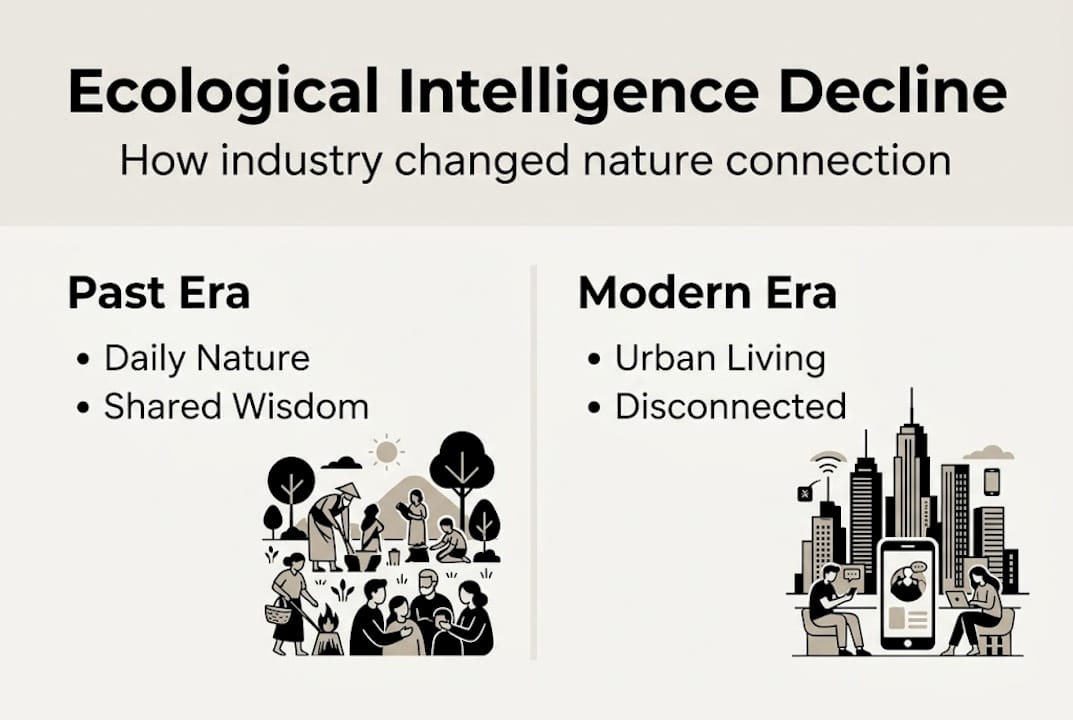
Before industrialisation, ecological intelligence was woven into the fabric of daily life. Farmers read the land. Herders followed seasonal pastures. Fishers understood currents. Even urban dwellers in pre-industrial towns kept kitchen gardens, raised animals, and tracked the seasons through food availability. Nature was not a weekend activity. It was the operating system of existence.
The industrial revolution, accelerating sharply from the mid-1800s onwards, fundamentally restructured this relationship. Factories pulled populations into cities. Artificial lighting decoupled human schedules from the sun. Mass food production removed the need to understand where food came from. Technology promised mastery over nature rather than partnership with it.
| Era | Primary nature relationship | Ecological knowledge level |
|---|---|---|
| Pre-1800 | Daily dependence | High, embedded in survival |
| 1800 to 1900 | Transitional, rural to urban | Declining in cities |
| 1900 to 2000 | Industrial and consumer society | Significantly reduced |
| 2000 to present | Digital, urban, globalised | Critically low in many populations |
The data is striking. Nature connection has declined 60% since 1800, a trajectory that maps almost precisely onto the spread of industrial urbanisation. Researchers tracking nature-related words in literature found a steady, measurable drop across the same period, a cultural signal of how thoroughly nature was being edited out of everyday thought.

Critically, urbanisation and socioeconomic development are identified as primary drivers of this decline, not simply personal preference. The more affluent and urbanised a society becomes, the weaker its average nature connectedness. You can explore long-term nature decline data to see how consistent this pattern is across cultures and continents.
For those already exploring eco-friendly living as a starting point, understanding this historical context makes the motivation far more urgent than simple trend-following. It reveals a structural problem, not a personal failing. Practical guides like those covering products for reconnecting with nature can offer accessible entry points into a much larger shift.
Why is ecological intelligence declining? Key drivers explained
The historical picture shows the slide. But what mechanisms are actively sustaining it today? Several forces work together, and understanding them is the first step to countering them.
- Intergenerational transmission: Children learn nature connection primarily from caregivers. When parents are disconnected, children inherit that disconnection as the default. Intergenerational transmission is now considered the dominant driver of declining nature connection, meaning the problem compounds with each generation.
- Extinction of experience: Each generation grows up with fewer wild spaces, fewer nature encounters, and less ecological vocabulary than the last. This means each generation inherits weaker bonds with the natural world, making restoration progressively harder without deliberate intervention.
- Urbanisation: Cities are designed for human efficiency, not ecological engagement. Concrete, artificial light, and noise replace the sensory richness of natural environments. Research on urbanisation impacts shows that urban dwellers consistently score lower on nature connectedness measures.
- Shift in values: Pre-industrial cultures typically held relational or spiritual views of nature. Industrial societies shifted towards dominionistic and utilitarian frameworks, treating nature as a resource to be managed rather than a system to be understood.
- Affluence paradox: Wealthier populations, with greater access to nature tourism and green products, often show lower ecological intelligence because comfort insulates them from genuine dependence on natural systems.
Patterns like emotional consumption and disconnection reveal how modern buying habits can actually deepen the problem rather than solve it. Genuine reconnection, as explored in resources on sustainable living practices, requires more than purchasing decisions.
Pro Tip: Start a nature journal. Spend five minutes each day noting one thing you observed outdoors, a bird, a cloud pattern, a plant pushing through pavement. This simple habit begins rebuilding the observational muscle that ecological intelligence depends on.
Can ecological intelligence be revived? Interventions and hopeful trends
The decline is real, but it is not irreversible. Across the world, researchers, educators, designers, and communities are developing approaches that genuinely move the needle.
Biophilia persists as an innate drive that modernity suppresses but does not eliminate. This is the crucial insight. The capacity for ecological intelligence has not been erased. It has been buried. The right conditions can uncover it.
Here are the interventions showing the strongest results:
- Rewilding education: Schools that incorporate regular outdoor learning, ecological literacy, and nature-based problem solving produce students with measurably stronger nature connection and environmental concern.
- Urban green spaces: Parks, urban forests, community gardens, and green corridors give city residents repeated, accessible nature contact. Design, green space policy, and intergenerational transmission are all identified as levers capable of reversing the decline.
- Citizen science: Projects that invite ordinary people to monitor local species, record seasonal events, or track water quality create structured, purposeful engagement with living systems.
- Biophilic design: Buildings and urban spaces designed with natural light, plants, water features, and natural materials actively restore the sensory connection that urban environments typically strip away. Exploring biophilic design in practice shows how architecture itself can become a tool for ecological reconnection.
- Caregiver modelling: Parents and grandparents who actively engage with nature, even in small ways, dramatically increase the likelihood that children will develop lasting nature connection.
- Mindful consumer choices: While not sufficient alone, choosing eco-friendly options builds awareness of supply chains, materials, and environmental impact, creating a bridge between daily life and ecological systems.
Pro Tip: Look for effective interventions that combine direct nature experience with social connection. Nature walks with friends or family are significantly more effective at building lasting connection than solitary exposure.
What most people miss about ecological intelligence in the modern era
Most conversations about restoring ecological intelligence stop at the surface. Buy organic. Install a bird feeder. Download a plant identification app. These are not wrong steps, but they miss the deeper point.
Real ecological intelligence is embodied knowledge. It comes from repeated, attentive engagement with living systems over time, not from a single weekend in the countryside or a carefully curated Instagram feed of nature photography. Industrialisation created what researchers describe as an environmental mismatch, a gap between the environments our minds evolved for and the environments we actually inhabit. That mismatch cannot be closed by consumption alone.
The uncomfortable truth is that digital life and industrial convenience may never fully restore the ecological aptitudes that pre-industrial living built automatically. But this is not a reason for despair. It is a reason to be strategic. Hybrid approaches, combining genuine nature immersion with mindful, intentional consumption, offer a realistic path forward. Even beginning with small steps for green homes can shift your relationship with materials, waste, and natural resources in ways that gradually build ecological awareness.
Restoring ecological intelligence is not a nostalgia trip. It is a radical act of adaptation for a world that urgently needs people who understand, and genuinely care about, living systems.
How small lifestyle changes can start your reconnection journey
For those ready to move beyond awareness into action, the good news is that meaningful change does not require moving to the countryside or overhauling your entire life. Small, consistent shifts in daily habits and home choices create real momentum. Exploring small green swaps for your home is a practical starting point that connects everyday purchasing to broader ecological values. When you are ready to go further, guidance on choosing eco products helps you cut through greenwashing and make choices that genuinely reduce your environmental footprint. At Stomart, we believe that every informed choice, however modest, contributes to a collective shift in ecological intelligence. Start where you are. Start today.
Frequently asked questions
What is ecological intelligence?
Ecological intelligence is the ability to understand nature’s complex systems and your impact within them, enabling informed, sustainable choices. It draws on the innate biophilic affinity that humans carry but modern life tends to suppress.
How did industrialisation reduce our connection to nature?
Industrialisation shifted daily life to factories and cities, reducing direct contact with nature and eroding ecological awareness across generations. Nature connection declined 60% since 1800, tracking almost precisely with industrial urbanisation.
What are signs of lost ecological intelligence?
Common signs include difficulty identifying native species, interpreting weather patterns, or knowing local seasonal cycles. These represent the deskilling and loss of ecological aptitudes that were once universal.
Can we realistically restore ecological intelligence in urban environments?
Yes. Through green urban planning, biophilic design, education, and conscious daily actions, ecological intelligence can genuinely improve even in dense cities. Interventions can restore nature connection when they combine direct experience with social and structural support.