

Shadow self philosophy: what we avoid in ourselves
on Apr 09, 2026TL;DR:
- The shadow includes repressed traits, both positive and negative, shaping our behavior unconsciously.
- Recognizing shadow manifestations like projections and emotional triggers aids personal growth.
- Integrating the shadow fosters authenticity, empathy, and wholeness through awareness and self-compassion.
Most self-improvement advice tells you to build on your strengths, sharpen your skills, and project confidence. But what if the most transformative growth happens not by polishing what you already like about yourself, but by turning towards what you instinctively avoid? Many crucial aspects of our personality are hidden from our conscious awareness, quietly shaping our choices, relationships, and emotional responses. This article explores the philosophy and psychology of the shadow self: where it comes from, how it operates, and how integrating it can lead to a richer, more honest version of who you are.
Key Takeaways
| Point | Details |
|---|---|
| Shadow self explained | Our shadow contains both repressed strengths and difficulties that shape our actions unknowingly. |
| Practical steps | Shadow work involves mindful awareness, honest journaling, and compassionate self-inquiry. |
| Benefits of integration | Embracing the shadow leads to greater authenticity, empathy, and personal growth. |
| Common pitfalls | Denial or neglect of our shadow leads to projection, inner conflict, and relationship issues. |
What is the shadow? Philosophical and psychological roots
The concept of the shadow originates with the Swiss psychiatrist Carl Jung, who described it as the unconscious storehouse of everything we have pushed out of our conscious identity. This is not simply a collection of dark impulses. The shadow contains repressed traits, both negative and positive, that we have disowned because they conflicted with how we were taught to present ourselves to the world.
From childhood, we learn which parts of ourselves are acceptable. We are praised for being kind, disciplined, or agreeable, and we quietly bury the parts that drew criticism or shame. Over time, these buried aspects form the shadow: a parallel self that operates beneath awareness, influencing behaviour without our conscious consent.
Philosophically, the shadow resonates with older ideas about concealment and truth. Shadows as pictorial and philosophical metaphors have long represented the gap between appearance and reality, much like Plato’s cave, where prisoners mistake shadows on a wall for the whole of existence. In the same way, we often mistake our curated self-image for the totality of who we are. Exploring the hidden philosophy in objects around us can sharpen this awareness of how meaning hides in plain sight.
“Until you make the unconscious conscious, it will direct your life and you will call it fate.” — Carl Jung
Key features of the shadow self:
- Contains traits repressed through social conditioning and early experience
- Operates largely outside conscious awareness
- Holds both unwanted flaws and unrecognised strengths
- Grows more influential the longer it is ignored
- Can be projected outward onto other people
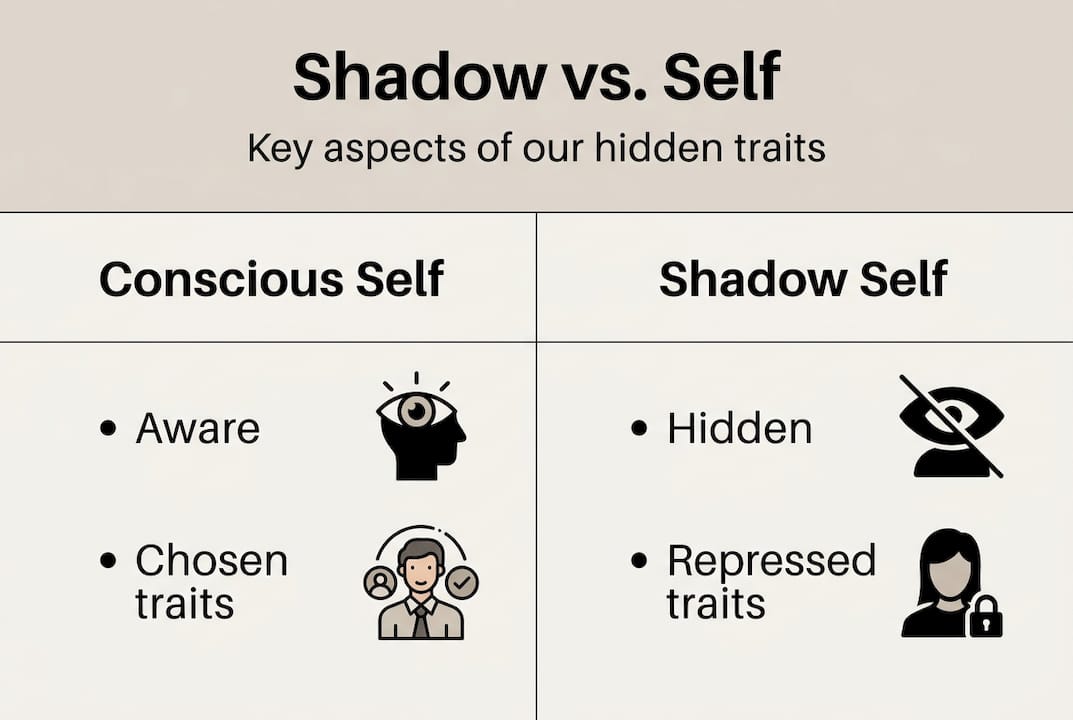
Comparison: conscious self vs. shadow self
| Aspect | Conscious self | Shadow self |
|---|---|---|
| Visibility | Fully aware | Hidden from awareness |
| Content | Accepted traits and values | Repressed traits, fears, desires |
| Influence | Deliberate choices | Automatic reactions |
| Potential | Known strengths | Untapped positive qualities |
Understanding this duality is the first step. Much like the lessons from natural growth found in seeds pushing through dark soil before reaching light, the shadow must be acknowledged before genuine development can begin.
How the shadow operates: Signs and mechanisms
Knowing the shadow exists is one thing. Recognising it in action is quite another. The shadow rarely announces itself directly. Instead, it surfaces through patterns that feel automatic, irrational, or disproportionate.

Shadow emerges through projection, emotional triggers, self-sabotage, and dreams, among other routes. Projection is perhaps the most common mechanism: when you feel an intense, almost visceral irritation towards someone else’s arrogance, laziness, or neediness, there is a strong chance that quality lives unacknowledged within you. The emotional charge is the clue.
Common ways the shadow manifests:
- Strong negative reactions to specific traits in other people
- Repeated self-sabotage just as things are going well
- Recurring dreams featuring threatening or unfamiliar figures
- Sudden emotional outbursts that feel out of proportion
- Chronic people-pleasing followed by quiet resentment
- Hypocrisy: judging others for what you secretly do yourself
The shadow also operates through what Jung called the golden shadow: the positive qualities you admire intensely in others but have not yet claimed as your own. If you feel inexplicably drawn to someone’s creativity or courage, those qualities may belong to your own unowned potential.
Left unchecked, shadow material drives relational conflict, chronic dissatisfaction, and a nagging sense of inauthenticity. Recognising comfort as a growth obstacle is part of this: we often avoid shadow work precisely because it is uncomfortable, preferring familiar patterns over honest self-examination.
Pro Tip: Keep a brief note each time you feel an unusually strong emotional reaction to someone else’s behaviour. Over a few weeks, patterns will emerge that point directly to shadow material worth exploring.
Practising mindful awareness for wellbeing can also support this process, as mindfulness builds the capacity to observe reactions without immediately acting on them. For those dealing with heightened stress during this work, practical stress management strategies can provide useful grounding techniques.
Integrating the shadow: Methods and practical tools
Integration does not mean becoming your worst impulses. It means acknowledging them, understanding their origins, and choosing how to respond rather than being driven unconsciously. Integration involves journaling, active imagination, dream analysis, and the 3-2-1 process, each offering a different entry point into unconscious material.
Step-by-step shadow integration approach:
- Notice your triggers. Begin by simply observing emotional reactions without judgement. Curiosity, not criticism, is the starting point.
- Journal your projections. Write about the qualities that irritate or fascinate you in others. Ask honestly: where might this quality live in me?
- Use active imagination. Sit quietly and mentally dialogue with a shadow figure, asking what it needs or represents. This Jungian technique externalises the inner voice.
- Analyse recurring dreams. Threatening or unfamiliar dream characters often symbolise disowned aspects of the self.
- Try the 3-2-1 process. Face the shadow figure, talk to it, and then speak as it, gradually integrating its perspective.
- Practise self-compassion throughout. Shadow material often carries shame. Treat yourself with the same kindness you would offer a close friend.
Shadow work is best done with self-compassion and, for deeper or trauma-related material, professional therapeutic support. There is no virtue in forcing yourself through painful territory without adequate support.
Shadow integration tools at a glance:
| Tool | Best for | Difficulty |
|---|---|---|
| Journaling | Daily reflection and pattern spotting | Beginner |
| Active imagination | Direct dialogue with shadow figures | Intermediate |
| Dream analysis | Accessing deeper unconscious content | Intermediate |
| 3-2-1 process | Structured integration practice | Intermediate |
| Therapy or counselling | Trauma-linked shadow material | Advanced |
Pro Tip: Pair shadow journalling with a dedicated notebook you use only for this purpose. The ritual of opening that specific journal signals to your mind that it is safe to be honest. Explore guided introspection journals as a structured starting point.
Building emotional resilience strategies alongside shadow work creates a stronger foundation, helping you process what surfaces without becoming overwhelmed.
Nuances and debates: Golden shadow, cultural differences, and critiques
The shadow concept is rich, but it is not without controversy. Understanding its limits and the debates surrounding it makes your engagement with it more nuanced and honest.
The shadow includes positive potential, risks of over-identification, and varies with cultural and philosophical context. The golden shadow is a particularly overlooked dimension: qualities like creativity, generosity, or leadership that you project onto admired figures rather than recognising in yourself. Reclaiming these is just as important as addressing darker material.
Comparison: Jungian, Freudian, and Eastern perspectives
| Perspective | View of the hidden self | Integration approach |
|---|---|---|
| Jungian | Shadow as unconscious totality, positive and negative | Active integration and dialogue |
| Freudian | Repressed drives, primarily sexual or aggressive | Psychoanalytic uncovering |
| Eastern (Buddhist) | Ego illusions and attachments | Meditation, non-attachment, awareness |
Common misunderstandings and critiques:
- Shadow work can be misused to justify harmful behaviour as “authentic expression”
- Jungian concepts lack the empirical benchmarks valued in academic psychology
- Over-focus on the individual shadow can ignore systemic or cultural forces that shape behaviour
- Cultural backgrounds significantly influence which traits become shadow material; what is repressed in one culture may be celebrated in another
The relationship between unfulfilled desire and shadow is particularly relevant here: consumer culture can amplify shadow projections by constantly presenting idealised images of what we should want or be. Similarly, environments and self-image interact in ways that can either suppress or reveal shadow material. For a broader grounding in these ideas, the psychology of the shadow offers a thorough contextual overview.
Why embracing your shadow is the missing key to wholeness
Most self-help frameworks are built on addition: add more discipline, more positivity, more productivity. What they rarely address is subtraction, specifically, the cost of leaving your shadow unexamined. In our view, this omission is where so many personal development journeys stall.
Wholeness is not achieved by becoming a better version of your curated self. It is achieved by consciously holding opposites: the generous and the selfish, the confident and the fearful, the kind and the resentful. Shadow integration fosters authenticity, empathy, and a resilient sense of self precisely because it stops the exhausting performance of being only one thing.
The hard-won lesson is this: repression does not eliminate shadow material. It amplifies it. The traits you refuse to own will surface as projection, self-sabotage, or the very hypocrisy you despise in others. Integration, by contrast, transforms that energy into creativity, compassion, and genuine self-knowledge.
Consider how philosophy in daily life often reveals itself in the most ordinary moments. Your shadow is no different. It speaks through irritation, envy, and longing. Learning to listen is not weakness. It is the most courageous form of self-awareness available to you.
Continue your self-discovery journey with Stomart
If this exploration of the shadow self has sparked curiosity, you are already doing the most important work: paying attention. At Stomart, we believe that genuine wellbeing is supported by the right environment, tools, and inspiration. Whether you are looking for wellness products to support your reflective practice, or simply want to explore more ideas about human growth lessons and personal development, our blog and product range are here to support your journey. Looking for something meaningful to share with someone on their own path? Browse our thoughtful gift ideas for inspiration that goes beyond the ordinary.
Frequently asked questions
What is the shadow self in simple terms?
The shadow self is the hidden part of your personality made up of feelings, traits, and desires you often ignore or avoid. Repressed traits and desires accumulate here throughout life, shaping behaviour without your conscious awareness.
How do you know if your shadow is affecting you?
You may notice strong emotional reactions, repeated conflicts, or find yourself criticising qualities in others that you deny in yourself. Projection and emotional triggers are the most reliable early signals that shadow material is active.
Is shadow work safe to do alone?
For most people, gentle self-reflection is safe and genuinely useful. However, professional support is advised when the material touches on significant trauma or causes persistent distress.
What is ‘golden shadow’?
The golden shadow refers to your positive potential and strengths that you admire in others but have not yet claimed as your own. Positive projections onto admired figures often point directly to these unrecognised qualities.
How can I start integrating my shadow?
Begin by noticing your emotional reactions, keeping a journal, and practising curiosity towards uncomfortable feelings. Shadow integration begins with awareness and self-reflection, making it accessible to anyone willing to look honestly inward.
Recommended
- Why we fear being alone: A deep dive into solitude - STOMART.CO.UK
- What waste reveals: our values, habits, and a path to change - STOMART.CO.UK
- Why material wealth leaves many feeling empty: causes & fixes - STOMART.CO.UK
- Hidden philosophy of everyday objects in your home - STOMART.CO.UK
- 8 Unconscious Beliefs that Hide Behind the Aggression that manifest itself as Domestic Violence - Mastering Conflict